Music has played an
important role in Jamaican society since the beginning. It was a way to bring
the community together not only as entertainment but also to express themselves
and their feelings on social issues. There are several genres of music that
have gained popularity in Jamaica throughout the decades of the past few
centuries.
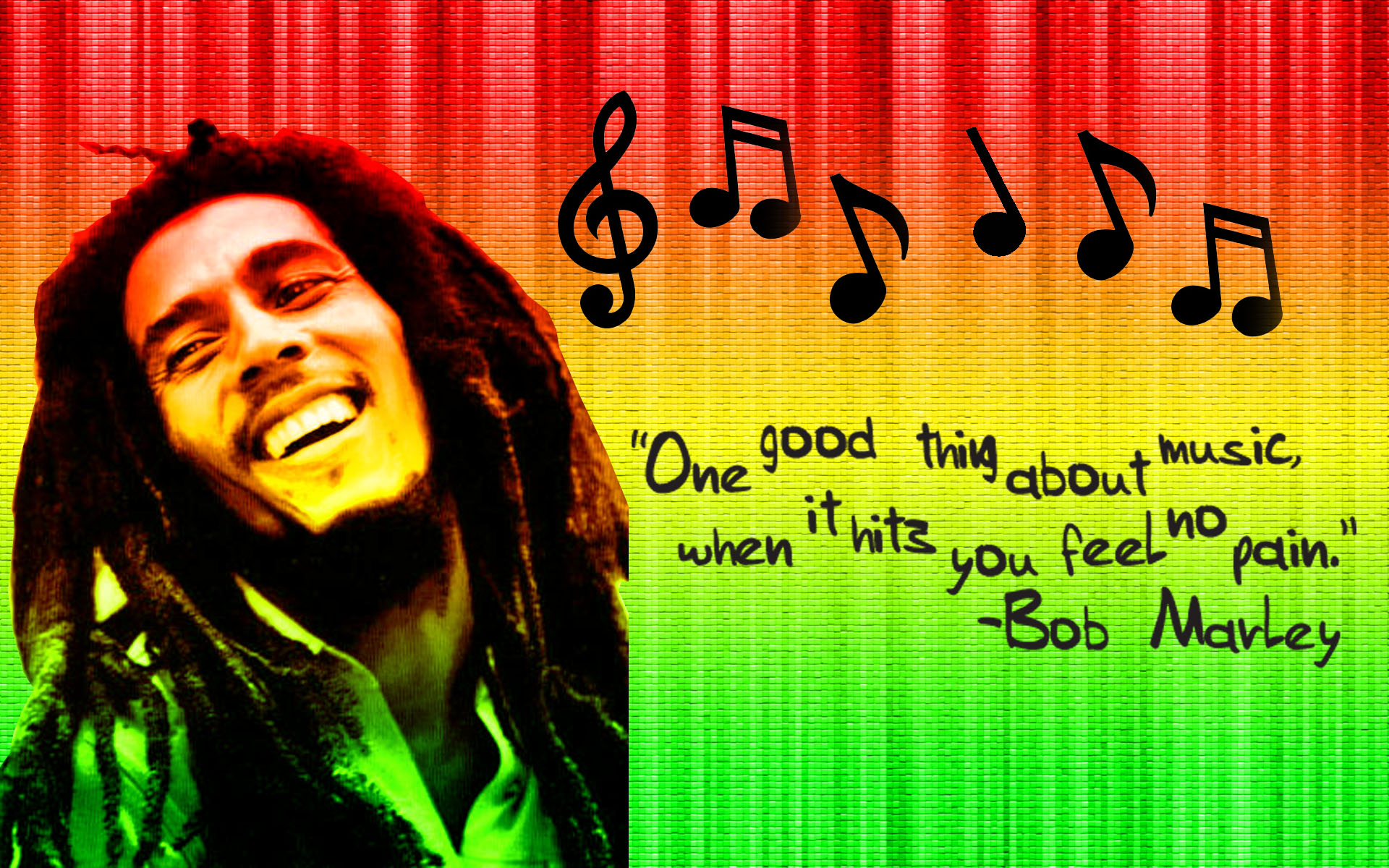 |
| Love this lyric from the song "Trenchtown Rock." Always a favorite. |
Mento music is a
style that is often mistaken for calypso music although they are two separate
genres. This style often uses an instrument called a rhumba box (it’s also
called a marímbula in other Caribbean countries). It’s basically a large mbira
(sometimes called an African thumb piano) placed on the front of a box that you
can sit on. The mbira part is in the front of the box between your legs as you’re
sitting on the top. The calypso music that mento is often confused with is
actually from Trinidad and Tobago. The lyrics often utilize humor, social
commentary, and sexual innuendos. Soca music, also stemming from Trinidadian traditions,
is also popular in Jamaica and throughout the Caribbean.
As jazz was taking
off in the early 20th century, it certainly made its way to Jamaica
as well. However, there really wasn’t much audience for jazz at that time in
Jamaica, and many musicians who wanted to pursue that musical path opted to
perform in the UK (and other areas in Europe) and the US.
Dances in Jamaica
include traditions from both Africa and Europe. And in some cases, these
traditions have been merged together. Altogether, anthropologists have identified
40 different dances in Jamaica. Jonkonnu dances are not just dances but an
entire festival/celebration associated with it as well. These jonkonnu
festivals generally incorporate mime-play and theatrical elements into it,
coupled with a variety of dances that includes acrobatic moves, moves that
mimic animals and other characters, and belly dancing. Pukkumina is another
dance that had similarities to some East Indian dances. Dancehall and ska also
have their own short-lived dances, usually limited to a popular song at the
time.
Ska, one of my
absolute favorite genres, got its start in Jamaica during the 1950s. Ska took
elements of mento and calypso and merged it with jazz and R&B. One of the
key features of ska bands are its heavy use of the horn line and its emphasis
on upbeats. One of the early ska bands was The Skatalites. There were several
waves of ska throughout the decades as musicians combined ska with other
genres. The most recent wave during the 1990s combined ska with punk rock. Ska
gave way to rocksteady and reggae. Rocksteady, made popular by musicians such
as Desmond Dekker, put an emphasis on the baseline.
Reggae is fairly
well known across the world and is especially popular throughout the Caribbean
and Africa. Bob Marley was probably one of the biggest names in reggae and
helped spread its popularity worldwide along with musicians like Peter Tosh and
Bunny Wailer. It was so popular that many musicians borrowed elements of reggae
in their music or worked with reggae musicians on certain songs. During the
1980s a style known as dancehall also came on the scene. To me dancehall and
another style called ragga are extensions of reggae. They tend to be more
upbeat tempo-wise, and their lyrics are less social/political (although there
are a few songs out there that are) and focus more on everyday life and love. Staring
in the late 1980s and 1990s, reggae and dancehall crossovers have been fairly
popular across the US, UK, and Caribbean markets. Musicians such as Buju
Banton, Capleton, Beenie Man, Shabba Ranks, Bounty Killer, Sean Paul, Shaggy,
and Sean Kingston have enjoyed much success in this category.
Now, I’ve listened
to reggae, ragga, and dancehall for many years, thanks to my husband and his
son who introduced me to these genres. And I added a lot of these artists to my
playlist. So, let’s go through some of my favorites. I mentioned Desmond Dekker
earlier as an example of early rocksteady. To me, his music has a lot of
elements of reggae and 1950s rock. Sometimes rocksteady and early ska (like The
Skatalites) share many similarities in style.
Of course, Bob
Marley is a staple. Most people know at least a few of his songs, which have
been used as anthems for promoting peace and Rastafarianism. I think even the
Jamaican Tourism Board used his music in promoting the island. Peter Tosh is in
the same genre as Bob Marley. It’s amazing how the song “Legalize It” is still
relevant today, even though that song was released in 1975.
Shabba Ranks is one
musician who I have never really listened to by himself. Everything I have
heard has always been part of a mix. It seems like he often has a lot of other
singers featured on his tracks and some of his mixes also features the iconic
orchestra hits and electric piano that were popular in the 1980s.
Beres Hammond’s
style has more of a softer, slower side of reggae. He’s another one who I have
mostly heard in reggae mixes.
Although definitely
having their own distinctive styles, I often place Beenie Man, Capleton, Buju
Banton, and Bounty Killer in the same category. In fact I have made mix CDs
with all of their music on it. I used Capleton’s “Jah Jah City” as a ringtone
for several years. To this day when I play that song, I start looking for my
phone.
And then there’s
the newer dancehall/reggae crossover artists who cater to the US/North American
crowd. Artists such as Shaggy, Sean Paul, Sean Kingston, and others have
collaborated with hip-hop, reggaeton, R&B, and pop artists.
Up next: the food
