Showing posts with label Thao Hung Thao Cheuang. Show all posts

Thursday, April 2, 2020

THAILAND: ART AND LITERATURE

Thai art can be traced back to its early days that have been discovered, from earthen pots dating to 2300 BCE to archeological findings dating to much earlier. As Buddhism became the established religion in Siam, as it was called prior to the early 20th century, Buddhist art became one of the main art forms and may have even depicted the style in which people were portrayed. Statues and sculptures in Buddha-like poses were commonly built, from small ones that can fit on a desk to the reclining Buddha at Wat Pho in Bangkok, measuring at 45m x 15m (147ft x 49ft).


Ceramics held many purposes, many of them for holding water and food preparation. However, different ethnic groups had their own styles of formation, materials they used, and ornamentation/design. And these things also changed through time, too. Many of these used a variety of red and black clays, and some may or may not have used glaze. In the early days, these ceramics were often traded with their neighbors. In more recent centuries, ceramics were painted with bright colors and gold on top of the glazed enamel.


Traditional painting in Thai art is for the most part influenced by Buddhism. It also tends to be two-dimensional. But it wasn’t all solely Buddhist-related materials: there were plenty of paintings depicting life at the time and folklore stories as well.


Thailand has some unique architecture for both common homes and for their temples (called wats). Traditional houses were built on stilts to allow for flooding during the rainy seasons and used as storage at other times. Wat architecture has changed throughout the centuries but all have an enclosing wall, which is designed to close it off from the secular world (isn’t that the point of all walls?). Regardless of its era, wats are typically highly decorated with carved designs and can be elaborately painted (often with gold).


Early literature in Thailand is almost exclusively written in Thai and mostly in the form of poetry. Although it was a highly developed artform, many works were lost when the Ayuttahaya fell in 1767. The epic poem of Thao Hung Thao Cheuang (although Laos takes claim for it) was one whose style was unique among other forms of poetry in Thai and Lao literature and would go on to influence the greater literary styles of Southeast Asia. Most prose at this point was basically just historical accounts, court records and the like.

Scene from Ramakien

During the 1400s and 1500s as Buddhism and Hinduism spread into Thailand, the Thai language borrowed influences from Indian languages such as Sanskrit and Pali. Poetic styles were also expanding to include different styles like using humor to portray different moods. Thailand did have one epic story called Ramakien, which was basically their rewritten version of the Hindu story Ramayana. (Apparently, there weren’t many plagiarism laws back then, huh.) It played a huge part in creating the dramatic arts that are known today.
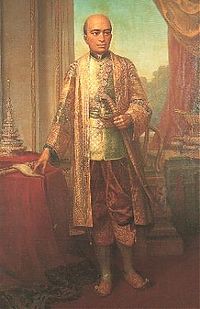
King Rama II
The Ayutthaya period saw quite a bit of expansion in poetry and several epic works came out of this period. King Rama II, who ruled after this during the early 1800s, wrote quite a bit of poetry and plays himself, so it was no surprise that he supported poets and the arts in general. He wasn’t the only king who was a writer: King Rama V and King Rama VI were also writers, both mainly in prose.
Duanwad Pimwana
During the 20th century, the literary trend started shifting into more light literature. However, longer works of a more serious nature have promoted some authors into the limelight. A few authors of note include Duanwad Pimwana (award-winning female novelist, poet, journalist), Siburapha (newspaper editor, novelist, human rights activist), Prabda Yoon (filmmaker, novelist, magazine editor, translator), Chart Korbjitti (award-winning novelist and short story writer), Khamsing Srinawk (writing as Lao Khamhom, short story writer and novelist), and Pira Sudham (novelist, short story writer, poet).

Up next: music and dance
 

Thursday, October 29, 2015

LAOS: ART AND LITERATURE


Laos is a showcase of Buddhist art and sculpture from one side to the other.  Most Buddhist art is typically made from metals like bronze, gold, and silver. Many of the larger and more elaborate Lao sculptures were looted by the Siamese over several centuries and taken to Thailand. Likewise, one of the largest gold sculptures found in Phra Bang was originally thought to have been cast in Sri Lanka even though some of the images suggest a later Khmer origin. Sculptures used a variety of other mediums as well including brick-and-mortar and wood. Most of these statues are of Buddha himself and either show him sitting in a meditative state or reclining. One of the most popular places to see great examples of these Buddhist statues (and Hindu statues as well) is Buddha Park, located in Vientiane. The park was created in 1958, and most of the statues here are created from reinforced concrete. 


In 1970, workers in a construction site unexpectedly discovered a kiln and ceramic works. They ended up finding several kilns in this area, and topographic imaging shows there may be several hundred kilns here. 


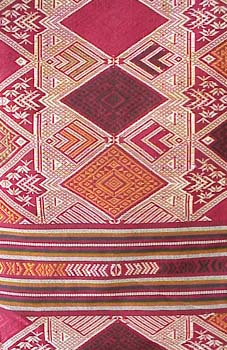
Textiles and other handicrafts are also an important part of Laotian art. Arts such as paper-making, basket-weaving, embroidery, tapestry weaving, and woodcarving have been passed down generation to generation. Dragons and other mythical animals are often common themes in their artwork. 


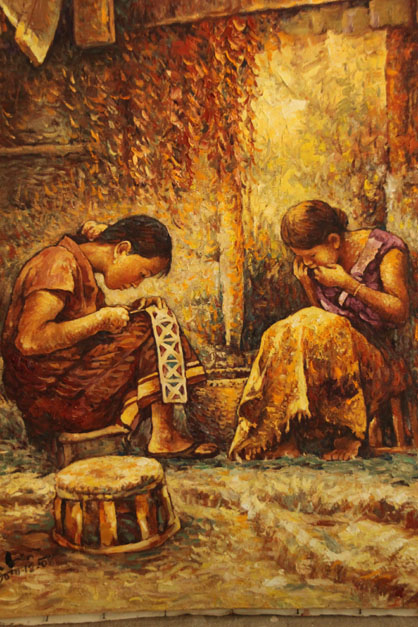
The French introduced European-style painting and sculptures as well. One of the first things they did was open up art schools around French Indochina to teach drawing, painting, metalworking, and other arts. Some artists were lucky enough to travel to France to continue their art studies. However, their society didn’t have a place specifically for this European-style art. These artists ended up painting mostly realistic paintings of their own land, people, and culture for the sake of the (mostly French) tourists. 


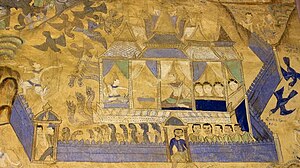
Laos has a long history of literature and storytelling. Many of the early stories were epic tales of a folkloric nature. Some of the largest and most well-preserved of these epic poems include the stories of Sin Xay, Thao Hung Thao Cheuang, Phra Lak Phra Lam, The Rocket Festival, and others. 

Mural showing Sin Xay epic in Thailand
There were also many Buddhist writings; however, most of them were written in Pali, the language of Buddhism. Some early writings were also translated and transcribed into Lao. Other religious writings, such as animist writings, were often written from oral histories and stories, but the ones that were translated and transcribed using a Khmer script. Other nonreligious texts (like court documents, histories, commerce documents) were often written in Lao or Thai.


After the French arrived, the French language began to be introduced into the country. However, it was only taught to the upper crust of Lao society who were able to afford the French parochial schools newly set up there. Only a few French scholars were interested in Lao literary traditions. 

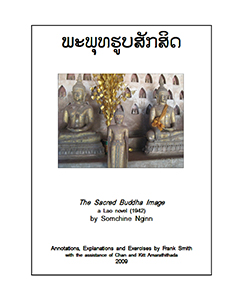
The first novel composed entirely in Lao wasn’t published until 1944. Somchine Nginn’s novel The Sacred Buddha Image is about a Lao-French detective looking for a stolen Buddha image. This book was published amid a change that fell over the country. In some areas, the people were forced to adopt Thai language and culture while the French were trying to emphasize nationalism. It eventually set the Lao people to fight for their own independence, which ultimately ended with a communist government. There are a lot of sentiments regarding their identity that comes out in their literature. During the Vietnam War, there were many pieces written about the war and its effects. However, as a country under a communist rule, literature is required to reflect the approval of the government. To go against the government isn’t a safe thing to do, and authors who chose to criticize their government must often do so from outside the country. Regardless, there have been many efforts to preserve Lao literary traditions and to raise the literacy rates across the country as an effort to appreciate their own written histories and voices.


Up next: music and dance