Showing posts with label Buddhist art. Show all posts

Thursday, April 2, 2020

THAILAND: ART AND LITERATURE

Thai art can be traced back to its early days that have been discovered, from earthen pots dating to 2300 BCE to archeological findings dating to much earlier. As Buddhism became the established religion in Siam, as it was called prior to the early 20th century, Buddhist art became one of the main art forms and may have even depicted the style in which people were portrayed. Statues and sculptures in Buddha-like poses were commonly built, from small ones that can fit on a desk to the reclining Buddha at Wat Pho in Bangkok, measuring at 45m x 15m (147ft x 49ft).


Ceramics held many purposes, many of them for holding water and food preparation. However, different ethnic groups had their own styles of formation, materials they used, and ornamentation/design. And these things also changed through time, too. Many of these used a variety of red and black clays, and some may or may not have used glaze. In the early days, these ceramics were often traded with their neighbors. In more recent centuries, ceramics were painted with bright colors and gold on top of the glazed enamel.


Traditional painting in Thai art is for the most part influenced by Buddhism. It also tends to be two-dimensional. But it wasn’t all solely Buddhist-related materials: there were plenty of paintings depicting life at the time and folklore stories as well.


Thailand has some unique architecture for both common homes and for their temples (called wats). Traditional houses were built on stilts to allow for flooding during the rainy seasons and used as storage at other times. Wat architecture has changed throughout the centuries but all have an enclosing wall, which is designed to close it off from the secular world (isn’t that the point of all walls?). Regardless of its era, wats are typically highly decorated with carved designs and can be elaborately painted (often with gold).


Early literature in Thailand is almost exclusively written in Thai and mostly in the form of poetry. Although it was a highly developed artform, many works were lost when the Ayuttahaya fell in 1767. The epic poem of Thao Hung Thao Cheuang (although Laos takes claim for it) was one whose style was unique among other forms of poetry in Thai and Lao literature and would go on to influence the greater literary styles of Southeast Asia. Most prose at this point was basically just historical accounts, court records and the like.

Scene from Ramakien

During the 1400s and 1500s as Buddhism and Hinduism spread into Thailand, the Thai language borrowed influences from Indian languages such as Sanskrit and Pali. Poetic styles were also expanding to include different styles like using humor to portray different moods. Thailand did have one epic story called Ramakien, which was basically their rewritten version of the Hindu story Ramayana. (Apparently, there weren’t many plagiarism laws back then, huh.) It played a huge part in creating the dramatic arts that are known today.

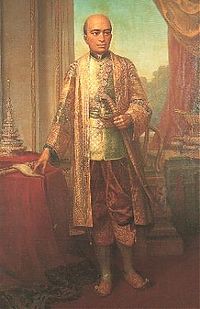
King Rama II
The Ayutthaya period saw quite a bit of expansion in poetry and several epic works came out of this period. King Rama II, who ruled after this during the early 1800s, wrote quite a bit of poetry and plays himself, so it was no surprise that he supported poets and the arts in general. He wasn’t the only king who was a writer: King Rama V and King Rama VI were also writers, both mainly in prose.
Duanwad Pimwana
During the 20th century, the literary trend started shifting into more light literature. However, longer works of a more serious nature have promoted some authors into the limelight. A few authors of note include Duanwad Pimwana (award-winning female novelist, poet, journalist), Siburapha (newspaper editor, novelist, human rights activist), Prabda Yoon (filmmaker, novelist, magazine editor, translator), Chart Korbjitti (award-winning novelist and short story writer), Khamsing Srinawk (writing as Lao Khamhom, short story writer and novelist), and Pira Sudham (novelist, short story writer, poet).

Up next: music and dance
 

Thursday, October 29, 2015

LAOS: ART AND LITERATURE


Laos is a showcase of Buddhist art and sculpture from one side to the other.  Most Buddhist art is typically made from metals like bronze, gold, and silver. Many of the larger and more elaborate Lao sculptures were looted by the Siamese over several centuries and taken to Thailand. Likewise, one of the largest gold sculptures found in Phra Bang was originally thought to have been cast in Sri Lanka even though some of the images suggest a later Khmer origin. Sculptures used a variety of other mediums as well including brick-and-mortar and wood. Most of these statues are of Buddha himself and either show him sitting in a meditative state or reclining. One of the most popular places to see great examples of these Buddhist statues (and Hindu statues as well) is Buddha Park, located in Vientiane. The park was created in 1958, and most of the statues here are created from reinforced concrete. 


In 1970, workers in a construction site unexpectedly discovered a kiln and ceramic works. They ended up finding several kilns in this area, and topographic imaging shows there may be several hundred kilns here. 


Textiles and other handicrafts are also an important part of Laotian art. Arts such as paper-making, basket-weaving, embroidery, tapestry weaving, and woodcarving have been passed down generation to generation. Dragons and other mythical animals are often common themes in their artwork. 


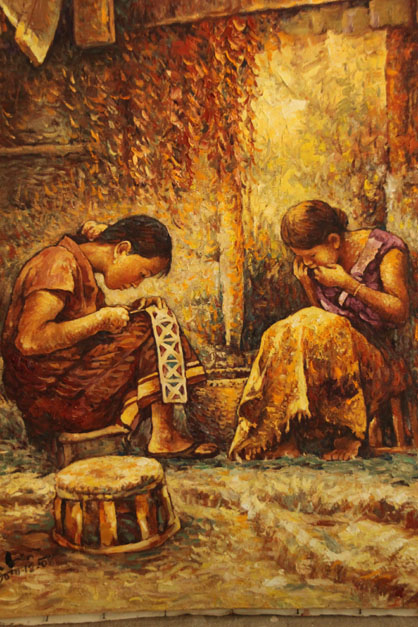
The French introduced European-style painting and sculptures as well. One of the first things they did was open up art schools around French Indochina to teach drawing, painting, metalworking, and other arts. Some artists were lucky enough to travel to France to continue their art studies. However, their society didn’t have a place specifically for this European-style art. These artists ended up painting mostly realistic paintings of their own land, people, and culture for the sake of the (mostly French) tourists. 


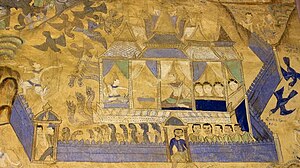
Laos has a long history of literature and storytelling. Many of the early stories were epic tales of a folkloric nature. Some of the largest and most well-preserved of these epic poems include the stories of Sin Xay, Thao Hung Thao Cheuang, Phra Lak Phra Lam, The Rocket Festival, and others. 

Mural showing Sin Xay epic in Thailand
There were also many Buddhist writings; however, most of them were written in Pali, the language of Buddhism. Some early writings were also translated and transcribed into Lao. Other religious writings, such as animist writings, were often written from oral histories and stories, but the ones that were translated and transcribed using a Khmer script. Other nonreligious texts (like court documents, histories, commerce documents) were often written in Lao or Thai.


After the French arrived, the French language began to be introduced into the country. However, it was only taught to the upper crust of Lao society who were able to afford the French parochial schools newly set up there. Only a few French scholars were interested in Lao literary traditions. 

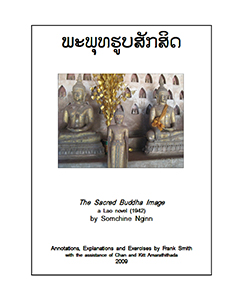
The first novel composed entirely in Lao wasn’t published until 1944. Somchine Nginn’s novel The Sacred Buddha Image is about a Lao-French detective looking for a stolen Buddha image. This book was published amid a change that fell over the country. In some areas, the people were forced to adopt Thai language and culture while the French were trying to emphasize nationalism. It eventually set the Lao people to fight for their own independence, which ultimately ended with a communist government. There are a lot of sentiments regarding their identity that comes out in their literature. During the Vietnam War, there were many pieces written about the war and its effects. However, as a country under a communist rule, literature is required to reflect the approval of the government. To go against the government isn’t a safe thing to do, and authors who chose to criticize their government must often do so from outside the country. Regardless, there have been many efforts to preserve Lao literary traditions and to raise the literacy rates across the country as an effort to appreciate their own written histories and voices.


Up next: music and dance

Thursday, April 16, 2015

INDONESIA: ART AND LITERATURE

Early art in Indonesia was pretty much relegated to being religious in nature. Generally speaking, it was more or less centered around Hindu deities and important stories; however, there are also plenty of Buddhist-centered art as well.  There were also decorative motifs as well, mostly with natural themes that include leaves, flowers, and local animals.


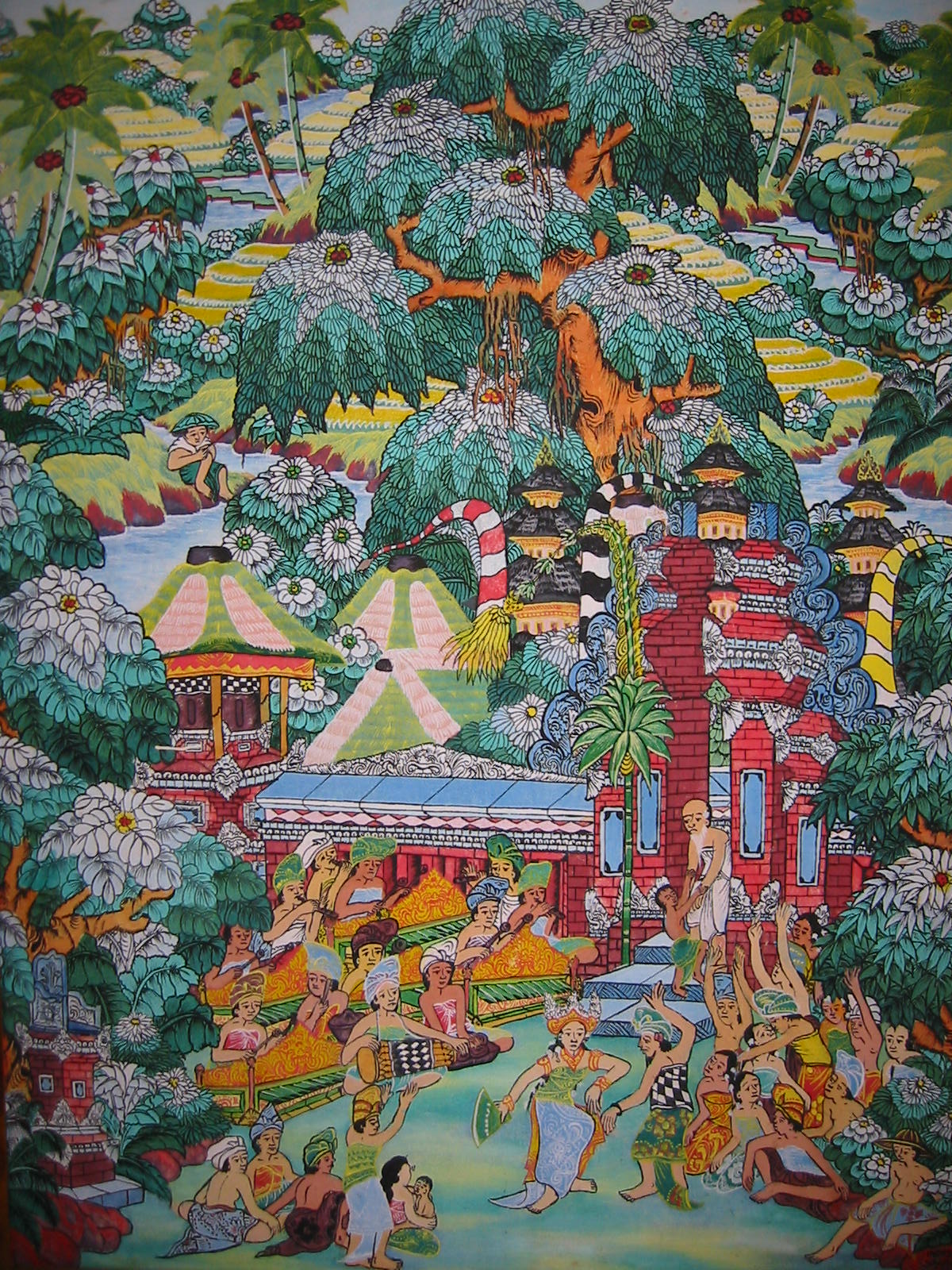
When the Dutch arrived, they introduced European art techniques to the native Indonesians. However, when the Dutch used the term “Indonesian painting,” it didn’t solely refer to paintings by Indonesians, but also for Dutch and other foreign artists who were living in Indonesia (called Dutch East Indies at that time) as well.  The late 1800s into the early 1900s saw a period of popularity in Balinese art. It was often considered one of the most vibrant styles of art in this area. 

by Inombong Sayad Ubud
During the latter part of the 20th century, Indonesian art began to become influenced by several styles of art, namely European-inspired abstract expressionism and Islamic-based art. As Indonesia began the search for a national identity among its multi-ethnic cultures, much of the frustration and self-finding sentiments were reflected through the artist’s paintbrush. 


Sculpture was also an important medium of art in Indonesia. There are many examples of sculptures dating back to the earliest of days. Each island essentially has its own culture and language and indigenous belief systems, so the styles can vary greatly from island to island, ranging from wooden sculptures to masks to sculptures similar to totem poles. With the introduction of Hinduism and Buddhism, artistic sculptures began to reflect this new reign of thought. Temples and shrines were the main sites for these religious-based sculptures of deities and other religious objects and symbols. The Temple of Borobudur in central Java is famous for its frescos of hundreds of stone buddhas. Other sites show a strong Hindu influence. Today, the majority of carvings and sculptures are in the form of souvenirs for tourists as well as elaborate folding screens.


Indonesia has some very unique architecture as well. Although much of it was influenced from India, there were also other notable influences as well. Probably the most well known style can be seen in the stilt houses.  Used in areas of Sumatra, Borneo, Minangkabau, Sulawesi, these stilt houses were elevated on poles for a number of reasons: to guard against flooding, to keep certain rodents out, and to give a cool place to work or store items. Many of these houses had highly peaked roofs called saddle roofs; it has points protruding upwards that looked as if someone pulled the roof toward the sky like taffy. Some of these houses (usually those belonging to a higher social status) are surrounded by highly decorated walls. 

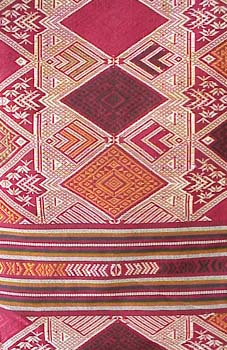
Example of songket


And of course, there were a number of handicraft-like items. Indonesia is famous for its cloth, and there are a few different types of traditional cloth that are produced here. The first one is batik, which utilizes a technique of using wax to create patterns on the cloth before adding the dye. Ikat is another type of dying process where either the warp fibers (lengthwise fibers) or the weft fibers (the ones that are being wove into the warp fibers) are dyed prior to weaving. Songket is a type of weaving that is commonly found in Indonesia but also in Malaysia and Brunei. This beautiful cloth is usually silver or gold threads wove into silk or cotton. The islands of Java and Bali are also well known for their making of the kris, a curvy-bladed dagger. Some people have a religious ritual that accompanies the making and use of this weapon, and the hilt (the handle) and sheath are often highly decorated. It’s also surrounded by special superstitions that it holds magical powers or that some kris are have good auras while others have bad ones. 


The literature of Indonesia is somewhat of a confusing term.  In general, it refers to literature not only in Indonesia but also includes Malaysia and Brunei.  And Indonesian literature is written in a multitude of languages: early literature was almost entirely written in Malay, but it also includes works written in Indonesian, Javanese, Sundanese, Batak, Balinese, Madurese, or even Dutch or English. Malay and Indonesian are very similar languages and different dialects of both languages are fairly intelligible to many speakers.


There were a lot of different periods of Indonesian literature.  Traditional literature was normally marked as being after the introduction of Islam, but before the modern period of the 20th century. Prior to this period, stories and histories were pretty much oral at that point. Then you also have older Malay literature, which was generally from around 1870 to 1942. During this time, many popular American and European novels were being translated as well as syair poetry and highly romanticized stories called hikayat.


The early 20th century brought about a lot of changes. First, the Indonesian language was introduced as a lingua franca, unifying all of the islands. Although Malay had commonly been used as a lingua franca, it was by no means a national language. The Balai Pustaka was formed; it was this government-sponsored agency that was responsible for promoting and publishing literature. It was in response against the Dutch; however, it came at the cost of much censorship. The first Indonesian novels were published during this time with the help of the Balai Pustaka.

From about 1933, an era called the New Literates emerged. Many of the young intellectuals began to sense a change in what was acceptable as literature. They knew a change needed to happen but distrusted the Balai Pustaka because it was run by the government. The answer came in the form of Indonesia’s first literary magazine, lasting into the early 1950s. By the end of WWII, Indonesian writers were focused more on their own independence and writing about the pressing political matters of the day; literature was far more realistic in style. 

author Remy Sylado
 
Short stories and poetry dominated through the 1950s, and by the mid-1960s, writers who were associated with leftist groups left Indonesia and began to write from abroad. The romance novel was the hot genre during the 1980s and 1990s, and previously quasi-taboo subjects such as femininity and gender identity became common themes in short stories and novels. 


Although there have been many foreign authors using Indonesia as the setting for their novels (such as The Twenty-One Balloons by William du Bois), there have been a plethora of authors that people on the Internets seem to mention.  I did find a nice list with comments from The Guardian dated in 2011, and it’s worth taking a look at here.  It’ll at least point you in the right direction for finding something to read.  As if you have that problem.

Up next: music and dance

Thursday, April 2, 2015

INDIA: ART AND LITERATURE

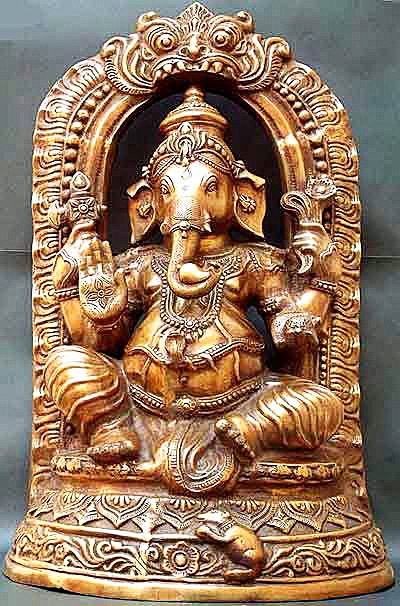
Early Indian art is highly influenced by religion, and it doesn’t matter whether it is Hinduism, Buddhism, Jainism, or Islam. In most historical religious art, stone (terracotta) and metal (gold, bronze) sculptures dominated. Animals were also important to Indian art. Many different types of animals have been depicted on rock art and rock carvings, and animals are often depicted as gods (as in the case of the Hindu god Ganesha which is seen as an elephant) or character traits. Some of the most famous rock carvings were of Hindu, Buddhist, and Greco-Buddhist art.  


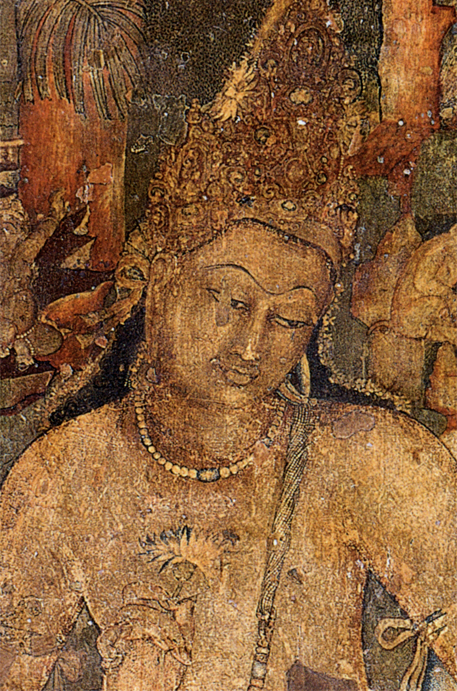
But that’s not to say that sculpture was the only form of art during this time, either. There are many examples of paintings that have survived for many centuries. A large number of these paintings were normally iconographic depictions of gods and religiously influential people.  And surprisingly, a good number of these were found on the walls of caves. 


During the Medieval period, art moved to the temples. Temples began to be the main place where art was viewed, and in many cases, the temple was the art in and of itself. The Great Living Chola Temples, the Badami cave temples, Shore Temple, and the Khajuraho Temples were great examples of this during this time. After the Medieval period, Islam began clearly settling in India and eventually sultanates took their hold. A new style of painting emerged, and subject matter tended to be either religious-based or showed everyday life. The most iconic of all Indian architecture, the Taj Mahal, was built during this period. Bidriware is a special type of metal work developed during this time around the area of Bidar. It’s basically a blackened alloy of zinc that has been mixed with tin, copper, and lead, and then inlaid with silver, bronze, or gold. The first layer of metal is darkened in order to highlight the sheen of the inlay. It produces a very attractive effect. 


When the British arrived, one thing they did was set up art societies and art schools in the major cities. They introduced the leading styles and techniques from Europe to the Indian art students. Through a renewal of nationalism, these art students took what they learned and applied it to creating paintings depicting a new European-Indian art style. Some of the most influential names in visual arts and a promoter of the arts in general came from one family: Abanindranath Tagore is often referred as the Father of Modern Indian Art; Rabindranath Tagore made several contributions not only in painting, but in literature and music as well; Gaganendranath Tagore is a painter and cartoonist who is counted as one of India’s first modern artists. 


After independence, a movement toward progressive, modern, abstract art emerged in Bombay (now called Mumbai). Although this movement didn’t last very long, it left its mark. Today, a variety of styles graces the modern Indian art scene. Because of India’s history, many different art schools brought their own ideas and influences to the table. Indian art is as diverse as its people and their languages, and art is viewed as an expression of their mind and soul. 


Indian literature, which refers to literature from India after independence and of the entire Indian subcontinent prior to that mark, can be written in any of the 22 recognized languages of India. The earliest works of literature were written in Sanskrit. Other languages began to slowly emerge in written literature, mostly as religious and historical poetry. One of the earliest Hindu texts was The Vedas.

The Vedas


Sanskrit literature really ran the gamut on topics of the day: epic poetry, texts on mathematics and geometry, texts on grammar, plays, and of course, the Kama Sutra. The Pali Canon is a group of texts written in the Pali language and serves as the basis for many Buddhist studies. It’s divided into three sections and is often referred to as the Tripitaka. 


Each language had its own pioneers in Indian literature, and some were more influential than others. Bengali writer Rabindranath Tagore was the 1913 recipient of the Nobel Prize in Literature. As a leader for Indian Independence through non-violence and peace, Mahatma Gandhi wrote exclusively in Gujarati. Kannada writers have received an astounding eight Jnanpith Awards and forty-seven Sahitya Academy Awards (both are awards given to outstanding works of Indian literature). Many of India’s Muslims write in Urdu, and Telugu and Tamil literature is often used in films as well as numerous short stories and poems.

Salman Rushdie


English language literature is also quite abundant. There are a large number of Indians writing in English, especially among the younger generations (perhaps to fare better on the international market?). Among some of the more well-known names are Salman Rushdie (who won the 1981 Man Booker Prize as well as being named Booker of Bookers; he also made news because there was a fatwa placed on him in response to his 1988 book The Satanic Verses), Arundhati Roy (winner of the 1998 Man Booker Prize), Kiran Desai (winner of the 2006 Man Booker Prize), and Aravind Adiga (winner of the 2008 Man Booker Prize). 

Hindi is the largest spoken language in India, although I’m now finding it doesn’t necessarily mean that most of India’s literature is written in Hindi. Devaki Nandan Khatri’s Chandrakanta is often considered the pinnacle of Hindi literature. Yet Munshi Premchand is touted as the most prominent Hindi writer overall. However, these two authors have paved the way for other Hindi writers. 

The largest Indian newspaper


Journalism is a big deal in India. The first printing press was painstakingly brought over to this country in the mid-1500s by Jesuit priests and mostly used to print hymnals and texts. English language newspapers and newspapers in other languages began to pop up, and by the mid-1800s, there were hundreds of newspapers spread across the lands. Of course, the British tried to censor what was being written at that time, and the people revolted. Today, there are thousands of newspapers with a couple hundred English-language newspapers in the mix. 


The Indian Film Industry is one of the most watched cinemas in the world. Often referred to as Bollywood (the B named after Bombay), this term often encompasses Indian films on a whole (at least in the US). That’s not an accurate assumption because many other styles of cinema (such as Telugu cinema and Tamil cinema) are not Bollywood films and are their own genre. Most Indian films include several songs and dances, and they generally tend to be family-friendly films. Likewise, movie music is a huge industry, and A.R. Rahman is probably one of the most well-known names in movie music. I watched the movie Slumdog Millionaire when it first came out, and I just recently found Dhoom: 3 on Netflix. My husband and kids sat down and watched it with me, and all of us absolutely loved it. (I can’t get my kids to sit down and watch a 22-minute kids television show, but they sat through this nearly 3-hour long movie. Now, THAT’S impressive.) In fact, my kids have been begging me to watch Dhoom: 2 for the past couple of days. I’ve also been seeing the movie Ek Tha Tiger everywhere I look, so I may have to look into this one as well. 

Up next: music and dance

Thursday, November 8, 2012

BHUTAN: ART AND LITERATURE

Most of Bhutan’s art reflects its Vajrayana Buddhist traditions. In many of its works there are various schools of art, but Buddhist themes unite them all.  In Buddhism, there are several divine beings that are revered, and each of them is attributed different colors, shapes, and objects that are associated with them.

Traditional arts have been passed from generation to generation. And certain regions specialize in certain types of arts. When the kingdom was first established, among the first items on the to-do list were the Thirteen Traditional Arts (known as zorig chusum). These are paper making, stonework, blacksmithing, clay arts, painting, bronze casting, wood/slate/stone carving, woodturning, woodworking, weaving, silver/goldsmithing, cane/bamboo work, needlework.


There are also other types of art that you’ll also find in Bhutan. Large-scale sculpture is popular, especially clay sculptures of religious images and figures. Another art form is sword making. Ceremonial swords are commonly given to those who are being commemorated for their outstanding achievements. Boot making is also especially important. It’s not only for ceremonial purposes, but the color signifies different social standings: orange is for ministers, senior governmental officials wear red, and regular people wear white boots. And since archery is the national sport, it’s no surprise that they also specialize in creating specialty bows and arrows. Depending on the season, and the type of sport and target used, different materials and designs may be utilized.  Jewelry making is also a popular art form, especially for women. Gold and silver is used in many pieces, as well as turquoise, coral, agate, and other gem stones.


Literature in Bhutan is almost all related to Buddhist ideologies. Even a lot of its written history is entwined with Buddhist history and its main players. There are actually several genres of literature in Bhutan, even though some seem somewhat similar to each other. Among these are dharma history (teachings of Buddha), religious biographies, historical chronicles, epics (like the ever popular Ling Gesar Gyalpo), folk songs, poetry (both religious and ornate), catalogues (lists of how to build dzongs [traditional style buildings], relics, etc.), and dictionaries.


Up next: Music and Art