One of the earliest
forms of art found in the Philippines is pottery. Pottery was a key element for
advancing a society because it allowed people to store and cook food. Early
pottery was made with clay, and they created a variety of pots and containers
for a number of purposes from food preparations (cooking, eating, storing food)
to ceremonial uses (urns). Over time, the styles and decorations changed on
each pot.
Filipino women are
also skilled in weaving. Some of the materials they use in traditional weaving
are the fibers from pineapple, cotton, bark cloth, and abaca (the same material
that also gives us Manila folders). Depending on what they are making, woven
baskets, mats, cloth, rugs, hats, and other items were commonly made.
 |
| by Fernando Amorsolo |
After the Spanish
arrived, they introduced European-style painting. In the beginning, the Spanish
brought along quite a few religious paintings and used them to teach the
islanders about Christianity. In turn, they also taught them how to paint. At
first, the Filipinos painted in the same style that the Spanish taught them:
only Christian/religious paintings. But around the 19th century, certain
Filipino artists who were wealthier than others began to branch out and break
tradition: they introduced secular paintings like Filipino landscapes and
Filipino subject, not European Christian themes. They began to paint
themselves, their culture, and their land. And as war hit their country during
the 20th century, they used painting and art as a means of
expression to deal with the pain and destruction of their country.
 |
| by Elito Circa -- because a painting of Filipino boxer Manny Pacquiao painted in human blood is exactly what the world was missing. |
A few artists of
note include Elito Circa (folk
artist who paints with human hair, blood, and body fluids), Juan Luna (painter, sculptor, political
activist during 19th century Philippine Revolution), Benedicto Cabrera (famous painter,
known as BenCab), Fernando Amorsolo
(famous painter of portraits and landscapes), David Medalla (sculpture, performance art, installation, kinetic
art), Augusto Arbizo (artist,
painter, curator), Rey Paz Contreras
(sculptor, famous for using recycled materials), Félix Hidalgo (famous painter of 19th century), Malang (cartoonist, illustrator,
painter), Ang Kiukok (painter,
worked in cubism, surrealism, expressionism), Lito Mayo (graphic artist, print maker, sculptor, art professor),
and Anita Magsaysay-Ho (counted as
one of the major painters in the Philippines—and only female included in the “greats”
list).
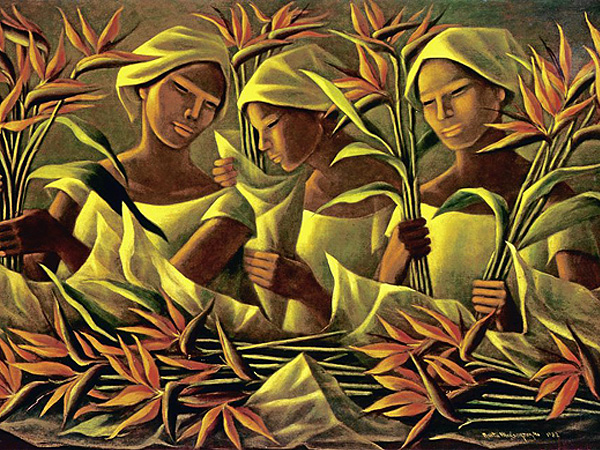 |
| by Anita Magsaysay-Ho |
Of the earliest
forms of literature, epic stories were one of the primary forms of
storytelling. Most of these stories were told by word of mouth and passed down
from generation to generation. Some of the wealthier families were able to
afford to have these stories transcribed down. One of the more famous epic
stories is Darangen, a story that originated from the Maranao people of the
southern island Mindanao.

Although I imagine there
was a certain amount of literature produced during the years the Spanish
controlled the country, most of the canon of modern literature was created
after the United States took over. As Filipino writers witnessed the
transformation to a new colonial period, much of the literature during the
first few decades were in response to the Spanish-controlled times. As the 20th
century progressed, the Modernismo genre took a prominent role, steeped in the
literary traditions of Latin America.

Notable authors
include Estrella Alfon, Francisco
Arcellana, Liwayway Arceo, Jose Garcia Villa, Peter Solis Nery, F. Sionil José,
Francisco Balagtas, Lualhati Bautista,
Cecilia Manguerra Brainard, Nick Joaquin, and N.V.M. Gonzáles.
Up next: music and
dance


