This was a recent article posted today on my local
newspaper’s website, the Indianapolis Star. I thought it was a pretty cool article. Apparently through CT scan technology,
art experts-turned-scientists have found that in these figurines from the
Democratic Republic of the Congo, it shows they have created what looks like
outlines of the digestive tracts inside the figurines. Even though it’s not
from Angola, it is nearby, and they really do resemble the Chokwe art I talked
about. And it’ll be a while before I get to the DRC, so I thought I’d post it
now. It makes me wonder if any Angolan figurines have the same digestive tracks
created inside. Who knows?
Thursday, April 19, 2012

Sunday, April 15, 2012
ANGOLA: THE FOOD
This meal went over WAY better, surprisingly, than some of
the past meals (even though I’ve enjoyed all of them, the other members of my
family have had some varying opinions on various dishes). And I do have to say
myself, that this was one of my favorites.
 |
| My daughter helping stir the batter. And, yes, those are cat ears. |
First of all, we turned on the soulful sounds of Paulo
Flores, an Angolan musician I forgot to mention in my previous post about music
(how did I forget about him!?). We started off, as usual, with the bread: a
corn and rice bread. It was a lot less complicated than other breads I’ve made.
You mixed all the dry ingredients, and then mixed all the wet ingredients
separately, which included me making rice before I got started. I usually use basmati rice, but this
time I used jasmine rice. It was a little stickier than the basmati, at least
the way I made it I guess. It did call for coconut oil, which I actually did find. The organic version was $8 and the regular version was $6, but it came in such a huge container, I couldn't justify buying it if I couldn't guarantee I would be using much of it again. Instead, I mixed melted butter, a little sugar, and some pure vanilla (I didn't want to go back out of coconut flavor). After that, you pour the wet ingredients into the
dry ingredients and stir it really well. I wanted to use a loaf pan, but the
one I had seemed really small. I’m not always the best foreseer of what’ll fit
into a space, but for once, I listened to that small voice of reason: I used
the larger round pan instead. It didn’t brown that much, and the consistency
was denser than regular cornbread, but the flavor was slightly lighter. It’s
definitely a dipping and sopping bread.
 |
| The bread as it came out of the oven. Just about perfect. |
 |
| The stew just prior to serving. Don't worry, I didn't drool into it. But I came really close. |
 |
| Grilled prawns that are neither grilled nor prawns. But the raw sauce was right on. |
 |
| The finished product! Kudos to me for making bread that looks like Spongebob. |
Up next: Antigua and Barbuda
Resources:
Angolan corn and rice bread: http://www.food.com/recipe/angolan-corn-and-rice-bread-367994
West African peanut stew: http://www.food.com/recipe/west-african-peanut-stew-438533
Grilled prawns with raw sauce: http://www.food.com/recipe/grilled-prawns-with-raw-sauce-456822
Friday, April 13, 2012
ANGOLA: MUSIC AND DANCE
While there are several types of music that are popular in
Angola, three main types come up: semba, kizomba, and kuduro. In many of these
styles, the dance and the music are one and the same.
Semba is a traditional style of music that actually has led
to other types, including the famous samba style of Brazil, as well as the
other two popular Angolan styles, kizomba, and kuduro. Its origin is from the
word “masemba” which means “touch of the bellies,” referring to moves in semba
dancing. The rhythms are led many
times by guitars, rather than drums alone. Although there is a variety of
percussion that is still used, mind you.
African music without drumming is like college without drinking (as in,
it can be done, but why would you want to?). One really famous semba musician
is Bonga. Because of his political view of Angolan independence, he was exiled
from Angola during the early 1970s. He ended up fleeing to Europe and traveled
between several different countries, yet kept up his music and recordings. His
album Angola 72/74 is a great collection, which includes the song “Sodade” that
was later made famous by one of my favorite musicians Cesária Évora (who I
could’ve sworn was from Angola all these years and was really excited to show her
music, but then I found out she was really from Cape Verde. So you’ll all have
to wait until next year or so). I found it on iTunes for $19.80, although you
can buy them separate (Angola 72 or Angola 74) for $9.90 apiece.
Kizomba is a blend of semba and zouk, a music style that originally
came from the French Caribbean. Kizomba itself seems to be popular mainly in
the lusosphere (a fancy word for all the Portuguese-speaking countries) and mainly
in the larger cities, such as Lisbon or Luanda.
The last one, kuduro, is something I knew of before I got to
Angola but didn’t know it originated from Angola. And since I’m a huge fan of
various degrees of separation of everything, here how it goes: we got the movie
“Fast Five” for Christmas because it was set in Brazil, and I went there
several years ago, and it had awesome cars in it (not to mention Vin Diesel),
and one of the actors/musicians featured was Don Omar who had sung the song
“Danza Kuduro” that was also sung with Lucenzo, a Portuguese musician (which
was on the soundtrack and happened to be my ringtone until I got an iPhone
today and can’t figure out how to change my ringtones to something I want). So,
that brings us back to kuduro. Kuduro itself takes traditional semba and
kizomba, speeds it up and puts a house/techno/electronica beat underneath
it. One popular kuduro band is
Buraka Som Sistema (which are actually from Portugal), and I just downloaded
their album “Black Diamond” this morning. Very good album, complex with
variety. I got the deluxe album (with the remixes) off of iTunes for $10.99,
but the regular album version is available for $5.99.
Kuduro dancing is a wild, athletic dance style that goes
hand-in-hand with kuduro music. It’s reminiscent of the styles of pop and lock,
capoeira, and breakdancing. (Although, breakdancing does have its origins in Brazilian
capoeira.) It’s really something to watch. My daughter was imitating what we
were watching, and I realized that I really find her some dance lessons. I
would’ve put up a video, but every time that I actually looked at her, she got
embarrassed and stopped. Le sigh.
Anyways, this video by Buraka Som Sistema not only highlights kuduro music but
also has a lot of dancing.
Up next: THE FOOD!!
Resources:
Wikipedia: “Music of Angola” “Semba” “Kizomba” “Kuduro”
“Bonga” “Breakdancing”
Wednesday, April 11, 2012
ANGOLA: ART AND LITERATURE
One of the most recognizable pieces of art styles in Angola
is the native mask. There are different kinds of masks for different purposes,
and of course different tribes have their own versions. There are masks for
births, deaths, marriages, seasonal changes, and other milestone ceremonies. Most
of these masks are made of different kinds of wood, ivory, ceramic, and other
materials. Shields, drums, and small sculptures are also popular mediums as
well. Some of these can be fairly elaborate. Some of the most common ones are
from the Chokwe tribe. I thought some of them looked pretty scary, but my
husband thought those were the best ones and wanted to cover the living room
with them. He would think that.
Today there is also a lot of painting and sculpture of
various mediums. Because a lot of cultural arts went by the wayside during the
years of civil war and were highly censored as well, a lot of contemporary art
portrays a pro-Africa and pro-Angola sentiment and many are a reflection of
their social and political views. Today there are many local and national art shows that
display artwork from various Angolan artists. Other forms of art that are also quite popular are basket weaving and textiles. One of the identifying common
threads I notice among Angolan paintings is the wide array of color and
contrast. I think the use of contrast is important to Angolan art, showing one
way of life that coexists with another way of life. This is also true in
literature (keep reading!).
The art of story-telling goes back many generations, long
before the ability to write down these stories. Of course, this is true for
most areas, so Angola is no exception to this. But in recent times, one of the
most widely known and prevalent poets is Angola’s first president Agostinho Neto. It was really hard to find some of his poems, but I finally searched
“poemas de Agostinho Neto” and came up with a lot of websites in Portuguese.
(See, it pays off to be bilingual, or trilingual, or well, I suppose I could
probably call myself a quasi-polyglot.)

I did find out that I do have something in common with him: we are/were both part of interracial marriages. After he was studying in Portugal, he married a white Portuguese woman named Maria Eugénia da Silva the same day he graduated.

One of his poems called “Fogo e ritmo” [“Fire and rhythm”]
really struck me. I loosely translated it, more or less, to understand it
better (although there were a couple words that didn’t quite make sense to me;
perhaps there was a different meaning I don’t know of? Perhaps a
difference between Angolan Portuguese and Brazilian Portuguese perhaps? Perhaps just the result of not studying for a while?):
“Sounds of shackles in the streets/ Songs of birds/ Under
the humid greenery of the forests/ Newness of a sweet symphony/ Of the coconut
trees/ Fire/ Fire in the pasture/ Fire about the heat of the plates of Cayette/
Wide roads/ Full of people, full of people/ In exodus from all parts/ Wide
roads for the horizons closed/ But roads/ Open roads above/ Of the
impossibilities of the arms/ Bonfires/ Dance/ Tam tam/ Rhythm/ Rhythm in the
light/ Rhythm in the color/ Rhythm in the movement/ Rhythm in the bloody cracks
of bare feet/ Rhythm in the nails stripped/ More rhythm/ Rhythm/ The painful
voices of Africa!”
To me, this represents the perseverance of Angolans. To me, this
poems talks of the hardships of the people: those who are prisoners, those who
are displaced, those who have lost loved ones, and their belief in a higher
source to get them through all of this on their journey to finding peace and a
better life. But there is the rhythm of life that keeps them moving. The use of
rhythm as a musical term goes to show how music is also so engrained in the
lives of Africans on a whole, sometimes to the point where they don’t even
think of it as music, just a way of life. (Keep reading when I write about music next.) But his use of seemingly opposite
comparisons and descriptions creates a dichotomy of Angolan life between its
people and land (“Sounds of shackles in the streets/ Songs of birds” or
“Newness of a sweet symphony/ of the coconut trees/ Fire/ Fire in the pasture”).
It’s a glimpse at the fire of life that even though there are hardships of
unbelievable depth, the rhythm of life keeps them together and keeps them
pushing forward, that even though things are bad, you can still enjoy the
beauty of the land, the notes of a song, the kindness of a smile.
Up next: music and dance
Resources:
Fogo e ritmo: http://www.sitedeliteratura.com/Poesias/A_neto4.htm
Monday, April 9, 2012
ANGOLA: HOLIDAYS AND CELEBRATIONS
 |
Angola has several public holidays during the year; however,
only a two of which are religious-based (Christmas and Easter). A little more
than half of its population practice some form of Christianity introduced from
the Portuguese, while the remaining 47% follow various indigenous belief
systems. Two holidays celebrated in Angola are movable holidays: Easter and
Carnival (celebrated the days before Lent starts).
|
January 25: Luanda’s Day. Luanda is one of the oldest cities
in Africa (436 years old this year [2012]). The day is celebrated with lots of
music, dancing, food, art displays, and several walking and bus tours of the
city.
February 4: Day of the Armed Struggle. This is held in
memory of the Baixa de Cassanje revolt (1961). Workers at a cotton plant
started to protest for better working conditions. While this was going on, some
of the workers started burning their ID cards and even physically assaulted the
some Portuguese traders who were on the plant grounds. Instead of dealing with
those who were directly involved, the Portuguese authorities responded by
calling for an air raid – on twenty
nearby towns, killing a vast number of people. Most estimates are between 400
and 7000, depending on who’s giving the estimate.

Usually mid-late February: Carnival. Carnival in Angola is celebrate much
the same as in other locations, probably more closer to how it’s celebrated in
Brazil or like Mardi Gras in New Orleans, Louisiana (USA). There are parades
with floats and people dance and are dressed in quite elaborate costumes. At
night there are huge parties all over, and from the looks of it, people will
dress in all different kinds of costumes – making it look more like a Halloween
party. And of course, the less clothes the women wear, the more popular they
seem to be.
March 8: International Women’s Day. A day acknowledged and celebrated in
176 countries, it’s a celebration aimed at supporting women and women’s issues
and connecting with women all over the world.
Late March to late April: Easter. Like most Christians in
the world who celebrate Easter, Christian Angolans will celebrate by attending
Easter service at church. Many families spend the time with each other, eating,
and celebrating much like other areas that celebrate Easter.
April 4: Day of Peace and Reconciliation. This marks the end of the Angolan Civil
War. There are usually soccer games and religious services. It’s a day
surrounded by talks of peace and especially for peace in the future as well.
May 1: Labor Day. Businesses are closed on this day. It’s a time to spend with families and
friends.
May 25: Africa Day.
This is a day in remembrance of the colonial days and for Africans who
have died in the struggles for independence. Many of the Africans countries that partake in the Africa Day celebrations will
have a number of cultural arts displays, music concerts, and soccer
games.

June 1: International Children’s Day. Many non-for-profit and government organizations
help to promote good health, literacy, and education while trying to fight the
problems that poverty, homelessness and orphanhood that has arisen from years
of civil war.
September 17: Agostinho Neto’s Day/National Heroes Day. This is in celebration of Augostino Neto’s birthday. He was the first president of Angola and was also a reputable
poet as well.
November 2: All Soul’s Day. This is a day of giving alms and spent in remembrance of
those who have already passed away. Many churches will pray for the dead with
the intention of helping them to get out of purgatory.
November 11: Independence Day. Since many of the indigenous
arts were banned during the war, there are often displays of music, dancing,
and visual arts.
December 25: Christmas. You’ll find many of the typical
European Christmas traditions in Angola as well. Schools close, and you’ll find
carolers and decoration-clad buildings.
Angolans love to celebrate with many parties lasting from Christmas on
through New Years. One of the traditions around this time is to eat a sweet
cake called bolo-rei (king-cake) that is formed like a crown. It’s full of
raisins, nuts, and fruits and was introduced by the Portuguese. The cake is
usually made with a fava bean (whoever receives this slice has to make the cake
next year) and a surprise (whoever receives this slice gets good luck for the
next year). It sounds to me an awful lot like a fruitcake. Maybe the surprise
is that this was actually last year’s bolo-rei??
Up next: Art and Literature
Resources:
Wikipedia: “Public Holidays in Angola” “Agostinho Neto”
“Angolan literature”"Carnival"
Children’s Day: http://aglobalworld.com/holidays-around-the-world/international-childrens-day-world/
Day of Peace and Reconciliation: http://aglobalworld.com/holidays-around-the-world/peace-reconciliation-day-angola/
Saturday, April 7, 2012
ANGOLA: THE LAND AND THE PEOPLE

Angola: the land of both rainforests and grasslands, of both
age-old African traditions and contemporary European modernities. Where for
every one kilometer of paved roads, there are nine kilometers of unpaved roads;
where you are closer to nature only to witness human destruction against it. Situated
in southwest Africa, it’s surrounded by Namibia, Zambia, Democratic Republic of
the Congo, and the Atlantic Ocean.
Angola is a former Portuguese colony, so most of the people
speak Portuguese (the official language), and that makes me happy since I’ve
studied Portuguese for years. However, many Angolans also speak native
languages as well, the most widely spoken being Umbundu, Kimbundu, Kikongo (all
of which are Bantu languages).
After declaring independence from Portugal, Angola spent
over two decades in civil war, leaving the country in economic turmoil. Still considered one of the poorest
countries in the world, much less Africa, it continues to struggle with basic
services for its people, such as access to clean water and medicine. While the
countryside itself is filled with valuable minerals and gems, such as diamond,
copper, gold, and uranium, there is little money to which develop a viable
mining industry.
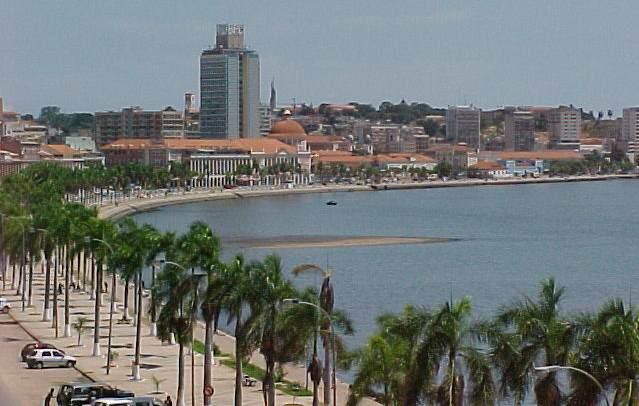
The country itself is almost twice the size as the state of
Texas (US), and it’s capital is the coastal city of Luanda. While the city
itself has about 5.1 million people, the metro area has about as many people as
New York City. It actually is the 3rd largest Portuguese-speaking
city in the world, behind São Paulo and Rio de Janeiro (both in Brazil).
The country has a vast array of geographical features. There
are rainforests in the northern regions and savannas and grasslands stretching
across the central plains into the south. Angola is one of the few countries to
have an enclave. An enclave is an area of land that is separated from the main
land by another country, like Alaska is for the United States. Angola’s enclave
is Cabinda, which is separated by the Democratic Republic of the Congo. The
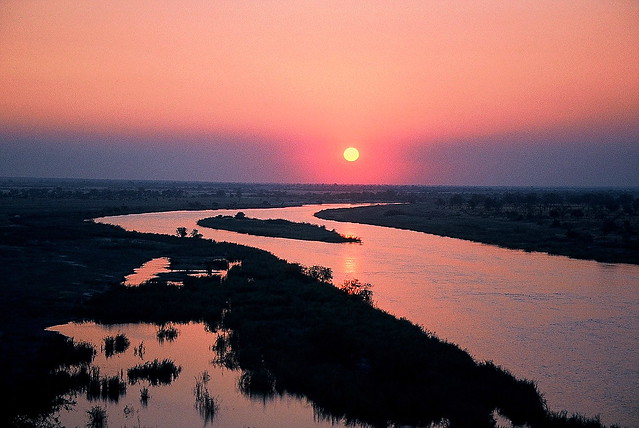
Zambezi River and branches of the Congo River snake their way into and through
Angola and across southern Africa. Angola is having a problem with soil erosion
and the siltation of the river systems, which is one of the main causes of
water pollution and lack of clean water. Desertification and deforestation are
also causing problems for biodiversity.
A plethora of socioeconomic and health factors plague the
country. Lack in education funding is evident with only two-thirds of the
population over age 15 being able to read and write. Only half of the
population has access to clean water and sanitation. Over 200,000 people are
living with AIDS, and there are very few doctors available in the country.
Angolans are at a high risk for major diseases such as typhoid, sleeping
sickness, malaria, and hepatitis A. In fact, over a quarter of its children are
reported underweight. That being
said, maternal mortality rate and infant mortality rate are also among the
highest in the world. Early 20s is considered middle age, with the life expectancy
being 54.
Life is especially hard for most Angolans, and it’s often
the subject of its music and poetry. But their culture is not just theirs but is
influenced by everyone who has passed through as well. And what you can also
feel is their spirit that has led them to push though and carry on, to sustain
and persevere. It’s a spirit that connects them to nature, to the land, to the
sea, and to their ancestors. It comes out in their poetry, their art, their
music, their dance, and their food. It’s Angola. And I’m really excited to
venture through this.
Up next: holidays and celebrations
Sunday, April 1, 2012
ANDORRA: THE FOOD
Finding good recipes for Andorran food is like trying to
find paperwork on my desk. Theoretically, it’s there; I just have to sift
through a lot of other stuff to find it. And even at that, who knows what kind
of condition it’s in. As I searched on what was out there, I found recipes that
were lacking details, like how long to bake something, or had wrong
measurements (like the difference between a centiliter and a milliliter almost
had me using a little less than a gallon of oil! Good thing I double-checked
that recipe.) But I made like a
jazz musician and improvised.
First we made the coques, an Andorran flat cake. (The recipe
I was originally working with was terrible – I could deal with the European
measurements, but some of them were actually wrong. See note above.) Coques can
be either sweet (with sugar or fruits) or savory (with meats and cheeses on
it). I decided to go with a sweet bread. The recipe was a little different
than any of the others so far – it had me make a batter and then tear up pieces
of rolls to add into the batter. Obviously my helper loves the camera.

I think the dough was supposed to be a lot
drier, but I ran out of flour and had to work with what I had. It still was
enough to form it into the rectangle shape that coques are traditionally
formed. After it baked I brushed some melted butter on top and used powdered
sugar (it actually called for icing sugar, but at this point I was NOT running
back out to the store) and cinnamon on top. It turned out it was a hit with the
family. They sang praises to me, danced in my honor, and threw flowers at me.
And it was good.

Next, we made stuffed mushrooms with sausage. I ended up
making a few substitutions. The recipe called for morels, but in Indiana (even
though we had a record warm month for March), it’s still a little early to find
morels at the store. I settled with white mushrooms. The recipe also called for
botifarra sausage, which I researched and found out that it was similar to
linguiça sausage. (I ate a lot of linguiça when I was in southern Brazil. It’s
a very filling sausage.) But I had a little trouble finding linguiça where I
was and had to look up what some substitutions for that, and I came up with
mild chorizo, which you can amply find in Indiana (and for cheap!). It also
called for cognac, and I had to go with the best, Rémy Martin. It turned out
really well. I liked it. The only problem is that chorizo is a very oily sausage,
and some of the oil would seep out of the mushrooms.

Now came the meal. In almost every article I read on
Andorran food and cuisine, one dish was almost always mentioned: trinxat. It’s
from a Catalan word meaning “to slice.” It’s basically kale and Swiss chard
(something I bought for the first time) boiled with potatoes. I thought the Swiss chard was pretty, and I did tell my daughter it was red because farmers poured blood on the soil, so it can soak up the blood to be high in iron. (It is April Fool's Day, you know.)

Then you cook
bacon in olive oil and set the bacon off to the side. After that you take the
oil off the heat and put peeled chopped garlic into the oil to infuse it. I had
never heard of infusing oil, but I did it for the first time today. I gave
myself a pat on the back AND a gold star. Once the oil has been sufficiently
infused (how long that takes for real, I have no idea. I left the garlic in
there for 1-2 minutes.), take the garlic out and pour it over the mashed potatoes/kale/Swiss
chard mix. Then crumble the bacon on top. I thought it was really good and
quite filling.

I couldn’t help but think about what national dishes are. It
always seems to me, like with the trinxat, that many dishes that are considered
“national dishes” are the ones that came from poor people. These are the dishes
that use ingredients that are abundant and are prepared in such a way that
stretches what people already have. Using the bacon grease and the infused oil
is a very old way of adding flavor to vegetables that don’t have a strong
flavor to begin with, yet are hardy to grow in abundance. Just like the use of
putting the torn rolls is an old way to reuse stale bread (like how French
toast got its start). These kinds of dishes prove the resilience of a people,
that just because we may not have a lot, we can make something good out of what
little we have. It reminded me of the
end of the movie Ratatouille, where
the food critic goes back to his childhood memories just from tasting the
simplistic countryside dish the movie is named after. These are the dishes that
bring us all together in the commonality of surviving whatever tough times
befall us.
Next country: Angola
Resources:
Coques: http://www.celtnet.org.uk/recipes/miscellaneous/fetch-recipe.php?rid=misc-coques
Stuffed morels with pork: http://www.andorra.ad/en-US/Resources/Pages/MURGUES_FARCIDES_AMB_CARN_DE_PORC.aspx
Trinxat and coques: http://www.rxx.co.il/TextPage_EN.aspx?ID=8620741
Subscribe to:
Posts (Atom)