Sunday, January 19, 2014

ECUADOR: MUSIC AND DANCE


The most popular form of traditional music is called Pasillo, often considered the national style of music. It’s also brought in the use of a lot of European music as well, such as the waltz.  However, each village and town added its own flair and styles to it. In its waltz form, it’s generally is accompanied by guitars, mandolins, other string instruments, as well as the rondin and other types of flutes, like the rondador (a type of panflute). There is also a dance that’s associated with this as well.


The Pasacalle is a form of dance, related to the genre known as passacaglia, characterized by an ostinato bass line (one that generally repeats the motif at the same pitch).  Yarabi is another type of traditional music that is characterized as being sentimental and is one of the more popular styles in Ecuador. There are two types of Afro-Ecuadorian music. The first type is called marimba because of its reliance and usage of the marimba in their music (one of my favorite instruments).  The other type is called bomba, a fast-paced style using guitars, the guira, and sometimes bongo drums.


I found a few popular musicians from Ecuador on Spotify.  One that I found was Daniela Guzmán.  She’s a pop musician who’s quite popular. I like some of her music. The first track on her self-titled album is probably the best in my opinion. 


Another musician I found is called Fabrikante who mixes beat box with a cappella vocal harmonies. I'm actually not quite sure if it's a group or if it's just one guy who re-records his own voice over multiple layers. It’s kind of cool and innovative, which is probably why I like it.  I can definitely tell some African influences here in places.  The album I was listening to is called “Memoria y Profecía de Doña Petita Pontón.” This video is a little weird though.  


Up next: the food

Friday, January 17, 2014

ECUADOR: ART AND LITERATURE


Ecuadorians come from many places. Many are of European heritage, namely Spain, Italy, France, Germany, and Lebanon is you extend a little further.  And there are many who are of an African heritage as well, about 10% or so.  But the majority of people are of Amerindian descent or some kind of mix of Amerindian and something else.  And all of these backgrounds have their influence on Ecuadorian arts. Regardless of their back ground bright colors are universal.


Quichua peoples in the Sierra region of the country are well known for their paintings on sheepskin canvases.  The people of Tigua were especially known for this.  They were also known for their highly-decorated painted masks and drums.  Their painting styles are characterized by their bright colors and geometric shapes, although commonly painted scenes include the countryside, everyday life, festivals, religious themes. Common landmarks are also notable objects portrayed in art, such as the volcano Cotopaxi, which is one of the highest active volcanoes in the world.  Nowadays, you can find their work all over, and especially in the touristy areas. 


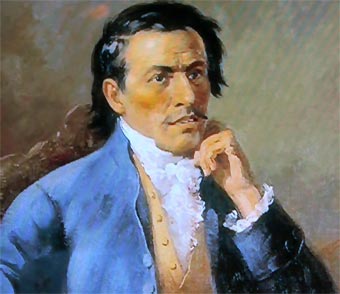
Literature in Ecuador is mainly written in Spanish.  One of the early writers to emerge from colonial Quito is Eugenio Espejo.  People found his works inspiring when it came to the fight for independence from Spain.  Horacio Hidrovo Velásquez from Manabí is another novelist and poet whose works have been made into a few films.

Eugenio Espejo
However, there is one city in central Ecuador, which is the home to three writers: the city of San Juan de Ambato.  It became known as the “City of Three Juanes.”  Juan Montalvo (prominent outspoken liberal, at odds with the government so much, he was exiled several times. He founded several literary and political magazines, and was an enemy of writer Juan León Mera), Juan León Mera (essayist, politician, painter, he was famous for his novel Cumandá and for writing the words to the Ecuadorian National Hymn), and Juan Benigno Vela (received his law degree, was friends with Simón Bolívar and Juan Montalvo.  He was quite active in the political scene, but also wrote for political newspapers, as well as wrote the constitution and several other public law documents.  He died blind and deaf.).


Up next: music and dance

Wednesday, January 15, 2014

ECUADOR: HOLIDAYS AND CELEBRATIONS


New Year’s Day (January 1):  On New Year’s Day, people still are partying far into the early hours of the morning.  The streets are quiet, a drastic change from the revelries of the night before.  Almost all of the businesses are closed and few people are out.  Of course, if I were out partying until the sun came up, I’d crash too. 


Maundy Thursday / Good Friday (varies):  Special Maundy Thursday services are held at church, and some people participate in the washing of the feet.  People in Quito will often visit the churches in the historical district.  A large colorful procession is the main event on Good Friday.  Some people carry heavy crosses along the way.  A special Good Friday mass in held, and people make a special meal made of 12 different grains and codfish to signify the 12 disciples of Jesus.  While many countries view Holy Saturday with graveness, Ecuador approaches it as a day of glorious celebration. Easter is also a day of celebration, beginning with services at church and following with a special luncheon and hunting for Easter eggs. 

Sorry, but the pointy hoods are creepy.  Like a purple KKK. With abs.  
International Worker’s Day (May 1):  This day celebrates the worker and is often used as a day for addressing current labor issues and labor achievements.  Ecuador has about 123,000 refugees from Colombia, escaping the violence in that country.  It’s also a stop in the drug trafficking trade, and there are some reports of child labor, forced labor, and human trafficking. 

The Battle of Pichincha (May 24): This battle was the last battle that took place when Ecuador was fighting for its independence from Spain.  It happened on a volcano called Pichincha, about 3500 meters (11500 feet) above sea level.  School kids will often participate in local parades and sometimes the military joins in as well.  The kids with the highest grades will often carry the flag during the procession.  This holiday tends to be centered around celebrating Ecuador’s history and displaying national pride. 


The Birthday of Simón Bolívar (July 24): Simón Bolívar is the military leader who is the one responsible for winning the independence for not only Ecuador, but also for Venezuela, Panama, Colombia, Bolivia, and Peru.  He’s often characterized as a national hero. There are often military parades and school parades with brightly colored traditional wear, complete with brass bands and dancing and waving flags.

Declaration of Independence of Quito (August 10):  Quito is where the independence for their country started. This was the day when people decided enough was enough.  It came at a time when Napoleon had invaded Spain and overtook the throne. Ecuadorians more of less took advantage of Spain’s instability, and over the next year, there were several battles, but eventually they did officially declare their independence.  Generally, the celebrations last most of the month of August, and include music concerts, parades, cultural displays, and local festivals. 

Guayaquil
Independence of Guayaquil (October 9): This is the day that a group of patriots in Guayaquil overtook a military base just after midnight and detained some of the high-level commanders until dawn and then signed their declaration of independence.  Guayaquil is now a center for arts and culture and nicknamed “The Pearl of the Pacific.”  The city pretty much has a citywide party and everyone’s invited!

Flag Day (October 31): This is a day in honor of the Ecuadorian flag.  Flags are displayed from people’s homes and businesses all around. 


All Soul’s Day (November 2): This holiday blends religious beliefs with traditional beliefs.  It’s kind of similar to the Day of the Dead festival that takes place in other Latin countries where people honor those who have passed on before us.  It’s a common day to visit graves, do any maintenance, refresh flowers, etc.  One tradition is to make a sweet bread called guaguas de pan, or bread babies (which we will be making later).  These pieces of bread are shaped like a swaddled baby and decorated with icing.  It’s almost always accompanied by a purple drink called colada.  It’s like a smoothie mix of various fruits and sometimes sweet peppers and a variety of other ingredients.  (I’m attempting to make this as well).


Independence of Cuenca (November 3): Primarily celebrated in Cuenca, this holiday celebrates the declaration of independence by the City of Cuenca.  Basically, the whole town shuts down and has one big party.  Schools and business close, music and dancing fill the streets, local food vendors serve savory treats, and arts and crafts are displayed and sold.

Foundation of Quito (December 6):  Also known as Fiestas de Quito, it’s a week-long party celebrating the founding of the city of Quito.  There are many activities and events going on all week, ending on December 6.  Some of the common festivities and events include bullfighting, parades, music concerts, block parties, flamenco dancing, marching bands, fireworks, and many people ride what’s called a Chiva, which is kind of an open bus with a band. 


Christmas Day (December 25): Christmas in Ecuador is a month-long celebration. Nativity scenes are put up everywhere.  Many people take part in novenas: public gatherings of prayers, hymns, and poetry, and it’s followed by hot chocolate and cookies (yes, hot chocolate in summer).  Christmas Eve is usually spent having an elaborate dinner with family, complete with stuffed turkey or chicken, rice with cheese, salads, local fruits, and of course wine.  Parents usually leave the children’s presents at the foot of their beds, and Christmas Day is spent giving gifts with family and friends. 

New Year’s Eve (December 31):  One tradition in Ecuador on New Year’s Eve is to get rid of the bad things. Some people will make scarecrow-like dolls in the likeness of people they don’t like (I have a few in mind) or notable people, and then at the stroke of midnight, everyone burns them.  Another tradition some men do is to dress up like women and beg for beer money.  (Kids will also dress up and beg for candy.)  Beer is a must-have for any New Year’s festivities.  Many people wear masks and attend parties, some of them held as street parties – and of course, fireworks are lit off at midnight. 

Up next: art and literature

Sunday, January 12, 2014

ECUADOR: THE LAND AND THE PEOPLE


In 1835, Captain Robert FitzRoy navigated the HMS Beagle out into the Pacific Ocean about 600 miles west of Ecuador to the Galápagos Islands. And on his ship was the famous naturalist Charles Darwin.  It was here that his observations in finding that certain birds and tortoises differed between the islands.  Much of his research here was included in his infamous work On the Origin of Species. (Fascinating book – I read it several years ago.)  Those tortoises, by the way, are the largest living species of tortoise in the world. 

This one named Harriet (which also happens to be my other name) lived to be 176 years old. 
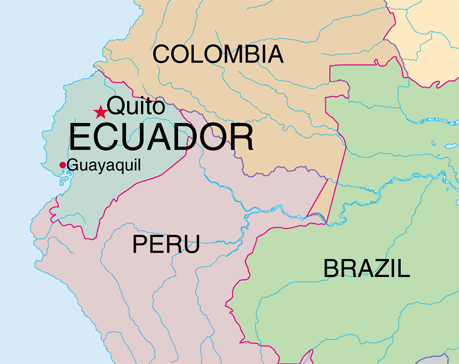
Ecuador itself lies in the northwest corner of South America, surrounded by Columbia to the north, Peru to the south and east, and the Pacific Ocean to the west.  The Andes Mountains run through the center of the country, separating the coastal regions and highlands in the west from the Amazon Rainforest regions in the east.  Ecuador gets its name from its location about a ¼ of a degree south of the equator.


Ecuador has a wide variety of climates: from temperate and dry in the Andes Mountains, to subtropical on the coastal and rainforest regions.  These vast changes in climate also contribute to a wide variety of flora and fauna as well.  Ecuador is considered one of the 17 countries who has the largest biodiversity – and per square kilometer, Ecuador has the most.  Because of its location close to the equator, the sun rises and sets pretty much the same time year round – around 6am and 6pm, give or take about a half-hour.


 The earliest inhabitants were the Incas.  They were actually several different tribes that came together from various areas of Central and South America.  While their cultures were similar, they all spoke different languages.  Compared with some of the nomadic tribes of the Amazon, the Incas developed into a hunting, fishing, farming, and gathering society.  The Spanish arrived, led by Francisco Pizarro, and tried to convert the Incas to Christianity, but that didn’t go over well.  Pizarro and his crew ransacked, pillaged, and burned down the town and killed many of the people.  Of course, the Spaniards also brought their own European diseases for which the Incas didn’t have any immunity to, causing a high number of deaths during the first years after colonization.  The city of Quito became an administrative city for Spain, later for the Viceroyalty of Peru and then for the Viceroyalty of New Grenada.  They did manage to break free from Spain and joined Simón Bolívar’s Gran Colombia.  In 1830, they broke away again and became its own independent country.  There was a lot of economic instability in the first years, and the government changed hands several times. But they did manage to abolish slavery in 1851.  At the end of the 1800s and lasting into the 20th century, Ecuador engaged in several fights over land and other issues with Peru.  Even up until recently, border disputes and fighting between Ecuador and Peru continued, and in 2010, Peru shut its border with Ecuador. 


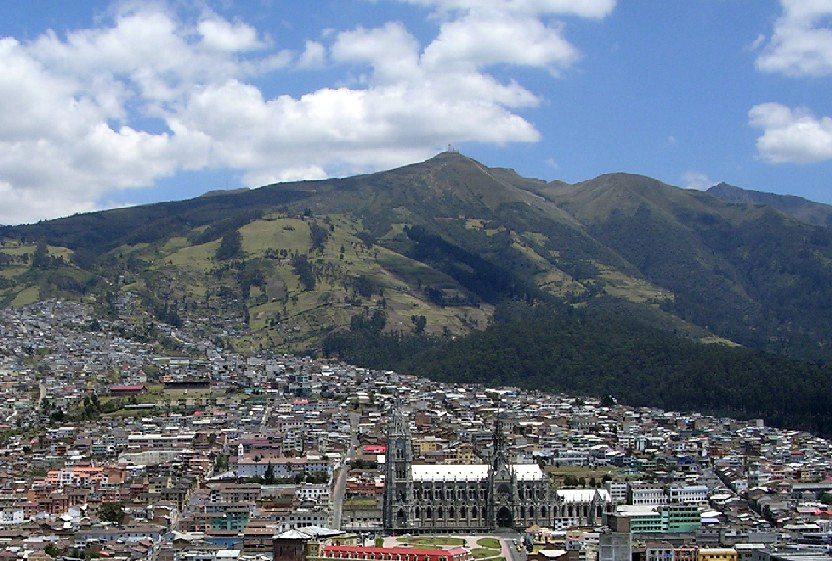
The capital city is Quito, or more formally San Francisco de Quito.  It’s considered the highest capital city in the world that houses the administrative, legislative, and judicial branches of the government.  (As opposed to the capitals of Bolivia, who splits those branches between the two cities.)  While Quito is the capital city, it’s not the largest city in Ecuador; that honor goes to the coastal city and cultural hotspot of Guayaquil.  Quito’s historic center is one of the best-preserved and least-altered cultural centers in the world.  It was also declared as the first UNESCO World Cultural Heritage Sites in 1978. 

Ecuador’s economy has more or less risen consistently since 2000.  That was the year that Ecuador adopted the US Dollar as their legal tender, abandoning the sucre.  Even though there were some rocky times, especially during the global economic crisis of 2008, it seems to have recovered: unemployment was around 4.8% in 2012, and the extreme poverty rate went from around 40% in 2001 to around 17.4% in 2011.  Crude petroleum accounts for about 46% of Ecuador’s exports.  They’re also a major exporting country of bananas and plantains, flowers, and cocoa, as well as shrimp, sugar cane, rice, cotton, corn, palm, and coffee. 


 In Ecuador, about 8% of the people don’t have a religion (atheists and agnostics). Of those who do, about 80% of them are Roman Catholic, 11% are Protestants, 1% is Jehovah’s Witnesses, and about 7% are other religions (mainly Buddhist, Jewish, Bahá’í, Muslim, and Mormon).  In some rural areas, indigenous religions may be practiced side-by-side along with Catholicism. 

The official language is Spanish, and it’s the language that most Ecuadorians speak.  However, a large number of them also speak Amerindian languages, the largest being Quichua, part of the Quechua group of languages. 


The New York Times published their “52 Places to Go in 2014” recently, and Ecuador came in #7.  Their recently refurbished train called Tren Crucero is proving to be a new and awe-inspiring way to see the country.  It starts in Quito and winds its way through the Andes Mountains and past volcanoes to the city of Guayaquil.  Cotopaxi National Park is also a popular side trip for great opportunities to see a lot of the local wildlife.  I think Ecuador would make a great trip, and perhaps, one day I can make it down there. 

Up next: holidays and celebrations

Sunday, January 5, 2014

DOMINICAN REPUBLIC: THE FOOD


If you don’t live in the Midwest of the United States, you haven’t experienced the maddening rush of going to the grocery store before a snow storm.  Waiting in line for 1-2 hours, stores struggle to keep the shelves stocked as people buy 4-5 loaves of bread and three cases of bottled water – like we’ll be snowed in for weeks.  People generally lose their minds at the first mention of the word “snow” – and if the word “storm” is following it, you might as well start handing out straightjackets, because it’ll be hard telling the normal people buying normal amounts of groceries from the people who think the world is ending.  The problem is that after the snow comes through today, the temperatures are supposed to bottom out – tomorrow, our high will be -12ºF with wind chills between -30ºF and -50ºF. We call it “Snowpocalypse” for a reason.  Well, I was one of those normal people just trying to buy groceries on the Saturday after I got paid.  Oh, I found the plantains, but there were absolutely no potatoes of any kind, onions, celery, chorizo, or bread (well, I found a couple loaves of cheap white bread, but I only bought one because I’m considerate like that). My husband went out in the snow today to a different store and got the things I couldn’t get yesterday.  He is such a brave man and must love me more than I know. He also brought me dark chocolate, so I know he’s a keeper. 

My almost spice cake
So, you can imagine how excited I was to cook food from the Caribbean today.  Maybe we can pretend that it’s warm and sunny.  The bread I chose was a sweet corn bread.  First I mixed the flour, yellow cornmeal, baking powder, cinnamon, nutmeg, and cloves together and slowly added the coconut milk and regular milk.  Then in a separate bowl, I creamed the butter and the sugar, and then beat in the eggs.  After this was all mixed, I slowly mixed the flour mixture that I did first into the creamed butter mix.  After I stirred everything to make it consistent, I poured it in a lightly greased bread pan and baked it for about 35 minutes.  Because of the spices that went into it, it almost tasted like a spice cake.  I really liked it – although it’s better when it’s warm.

The best new thing in the world
The main dish for today is called sancocho – also known as Seven Meat Hearty Stew.  I didn’t use all the meats listed – I pretty much had to choose what was available (so no goat meat) – I went with chorizo (that my husband thankfully went out and found later), stew beef, and pork loin.  I marinated my beef, celery, cilantro, oregano, vinegar, garlic, lime juice, and salt in a bag for 30 minutes.  Then I put it in a pot with oil and simmered for 10 minutes.  Then I added my pork and simmered for 15 more minutes, adding a little water. I added my chorizo next and simmered for another 15 minutes.  At this time, I added 2 cups of water.  Once it rose to a boil, I added in the some cubed sweet potatoes in lieu of a yam and some cubed plantains.  After this simmers for 15 minutes, I put in the remaining lime juice, corn, beef stock cubes, hot sauce, and orange juice and allow it to simmer until these are warm and tender.  This was the best thing ever. I’m definitely going to have to make this again.  I topped it off with some fresh cilantro which made it taste even better.

Kind of like my humor: a little dry. But always in good taste.
The side dish I chose kept popping up on all sorts of Dominican cuisine recipe sites.  Mangu must be some sort of national side dish.  I took a couple of plantains, peeled them, chopped them up, and boiled them until they were tender.  Then I mashed them like potatoes.  I took some of the bacon and fried it up. The only thing I could find was turkey bacon, and it didn’t fry up the same, nor did it leave any drippings that I was going to use to sauté the onions in. So, after I removed the bacon, I sautéed some of the shallots in some olive oil.  Although my recipe was a little vague, I served the mashed plantains with the bacon and onions on top.  My plantains got a little dry, but otherwise, the flavor was good. 

Perfect snowy day dinner
Even though we’ll probably be snowed in, at least we’ll have some pretty awesome stew to eat tomorrow and maybe I’ll pretend I’m on a nice, warm beach in the Dominican Republic.  And maybe I’ll also get lucky, and my job will close the office due to blizzard-like conditions. Personally, I’d really like to just stay home and make coffee and watch Les Misérables and maybe some old episodes of X-Files and Twilight Zone on Netflix.   

Up next: Ecuador

Saturday, January 4, 2014

DOMINICAN REPUBLIC: MUSIC AND DANCE


Two of the most popular forms of music to come from the Dominican Republic are merengue and bachata.  Merengue tends to be played in 2/4 time and can be played anywhere from moderato to presto.  Most often merengue music will feature the güira (a metal scraper), the accordion, and the double-headed tamboura.   Of course, merengue bands today will often use electric instruments as well and can also utilize styles from other musical genres such as salsa and rock.  Oftentimes, the choruses of these merengue songs will be in call-and-response form.  The lyrics to these songs generally utilize a certain poetic license, especially irony and double entendres. 

Güira
Starting in the 1960s, merengue today also has a dance that is associated with the music as well. During the time that Rafael Trujillo was president, he declared merengue music and the dance associated with it the national music and dance of the Dominican Republic.  In merengue dancing, the couple holds hands, faces each other standing close, and sways from side to side. Even though the dancers will separate, do twists and turns, they will always return to holding hands and facing each other.  Even though the tempo may be quick, the upper body generally stays calm.  It’s thought that this dance and the music may have originated from Africa and was brought over through the slave trade. 

Bachata music started in the poorest areas, the shantytowns. And because of that it had a bad connotation in the beginning; however, it has become loved by all Dominicans, regardless of their socio-economic status. It emerged as an offshoot of Cuban bolero music and is heavily dependent on guitars (namely lead, rhythm, and bass guitars), bongos, and güiras. 

I’ve discovered and re-discovered several Dominican musicians and bands.  One of the most famous bands for bachata is Aventura – the only one that I had known previously.  I had downloaded a song by them featuring Don Omar years ago. 


One rock band that I discovered is Toque Profundo, but all I could find available was a few songs.  I really like their style – they almost remind me of how Linkin Park used to be back in the day.  I wish I had a whole album. 


One CD that I did find through my library is by Rita Indiana y Los Mysterios.  This group took native Taíno drumbeats and tribal music and merged it with modern rock. I listed to the entire CD while driving home through a snow storm, and I have to say that I like this. It seems kind of far-fetched in the worlds of music, but it works somehow.  A couple of other bands that I came across that I liked were Fulanito, Projecto Uno, and Ilegales. 


And of course, as someone who has studied piano since the age of 14 and studied it in college even, I’m always drawn to piano music, especially jazz piano.  And if you combine jazz piano with Latin jazz, you come across Dominican jazz pianist Michel Camilo.  While I really liked the album called What’s Up?, my library didn’t have it, so I checked out Mano a Mano instead, which is also very well done. I also listened to it driving to work through a snow storm. 


Up next: the food


Wednesday, January 1, 2014

DOMINICAN REPUBLIC: ART AND LITERATURE


Dominican art shows the all vibrant colors and shades that the Caribbean offers.  Painting has long been the dominant form of art in the Dominican Republic since the 1800s.  And generally the styles mimicked the trends in Europe at the times they were popular.  The early styles of neoclassicism and romanticism of the 1800s eventually became realism and impressionism of the early part of the 20th century. Common scenes during these times tended to be landscapes, still art, portraits, and historical depictions. Some of the artists emerging from this era were Celeste Woss y Gil, Jaime Colson, Yoryi O Morel, and Darío Suro. 

by Yoryi Morel

The country went through another change during the 1940s when President Trujillo opened up their country to accept refugees from Spain escaping the Spanish Civil War.  A number of these refugees were artists.  Many subjects reflecting the conflicts in Europe became commonly painted during these times, based on the influences from these newcomers to the island.  For the next couple of decades after this, Dominican artists turned their efforts to creating paintings that show social and political struggles, how tough life really is, and to make a point about it.  Many of these utilized modern techniques, genres, and styles, such as abstract art, geometrical shapes, and cubism.  Some of the main artists from this era include Paul Guidicelli, Clara Ledesma, Eligio Pichardo, Cándido Bidó. 
by Eligio Pichardo
Much of the architecture is based on European styles, and some of these buildings still standing are among the oldest in the Americas.  The Dominican Republic is home to the oldest fortress, the oldest monastery, the oldest castle, and the oldest cathedral in the Americas – all located in the Colonial Zone and has been declared a World Heritage Site by UNESCO.  The use of mahogany and thatch is something that originally was used by Taíno people for construction of their homes. Now, mahogany, thatch, and even hammocks are now used in combination with Spanish-style architecture. 


The world of fashion is not the same without the Dominican Republic’s own Oscar de la Renta. While he was born on the island (and eventually became a US citizen), he studied in Spain under famous designer Cristóbal Balenciaga (I first came across his name when I listened to the musical Kiss of the Spider Woman, based on the novel by Argentine author Manuel Puig). He also went to work in Paris before starting his own line.  Although he eventually did establish his company in New York, he would often donate money to his native Dominican Republic for various causes and charities. 


One of the most famous authors from the Dominican Republic is the author of a book I read years ago (and still have on my shelf): Julia Alvarez.  Her most famous novel is How the García Girls Lost Their Accents.  I really liked this book.  This book did for Dominican-Americans what Amy Tan’s book The Joy Luck Club did for Chinese-Americans.  Although Alvarez was actually born in New York, she spent her first ten years living in the Dominican Republic.  Her family was forced to flee the island back to the US after her father participated in a failed coup of the Trujillo administration.  Her time there was part of the basis for this book and the inspiration for a lot of her writing.


 Junot Díaz (whose birthday was yesterday) was born in the Dominican Republic but now teaches writing at MIT (Massachusetts Institute of Technology) and works as an editor at the Boston Review.  Díaz also wrote the book The Brief Wondrous Life of Oscar Wao (2007), which won the Pulitzer Prize for Fiction the next year.  Like Alvarez, he moved to the US to the state of New Jersey when he was about six years old – his father was already working there when he joined him.  He’s written other short stories and is the recipient of numerous awards. 


Pedro Mir was an important poet and writer in the Dominican Republic, the son of Cuban and Puerto Rican parents who immigrated to the DR.  He started publishing some of his poems in the newspapers, but it wasn’t until a friend of his took some of his poems to an established writer at the time who saw the potential for Mir to be the next huge social poet of their time.  In 1984, the Dominican Congress honored him with the title “Poet Laureate of the Dominican Republic,” and has received many awards for his works. 


 Up next: music and dance