Wednesday, June 15, 2016

MARSHALL ISLANDS: ART AND LITERATURE


Long before modern maps, the islanders of the Marshall Islands would map out the ocean swells and islands using sticks and shells. These stick charts as they’re called use to sticks and fibers to map out the major swells in the ocean and the shells mark where the islands are located that caused changes in directions. This was used as a way for the islanders to navigate their way to other islands. What you end up with is almost a modern, Frank Lloyd Wright-esque frame of sticks tied at various angles and curves. Some can be small and other can be quite large. It’s rather fascinating. 


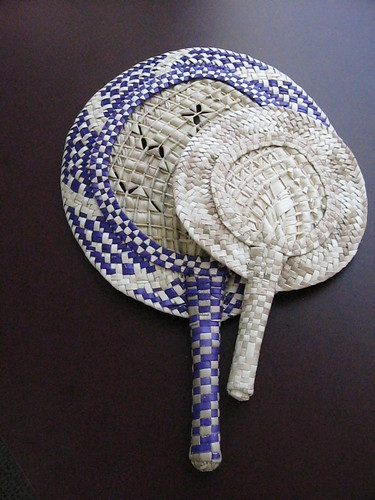
Much of their art is tied to handicrafts and especially woven arts. Popular items include baskets, mats, purses, hats, fans, and wall hangings. Each of these are made from natural materials found on the island, including coconut fibers, pandanas leaves, and shells. 


Locals also develop an array of products using coconut, from detergents to hand creams. Coconut is very good for your skin and hair and is environmentally safe. Not to mention quite plentiful on the islands. 


Another part of their culture, especially before the arrival of the Europeans, was tattooing. Both males and females were tattooed, although the designs and body parts that were tattooed vary slightly between the sexes. Different designs signified different family clans and ranks within the family. The Marshallese also stretched out their ear lobes, some as large as three inches. Sounds like they were punk before punk was punk. 


The early Marshall Islanders told their stories orally. Most of these stories were legends and stories used to explain their world around them, but some stories also told of historical events. Today, many of these oral traditions have been retold and written down. 


The Marshall Islands have also served as the setting for many European writers, some who either lived there for a while or had visited the islands. No doubt these islands had a lasting impression on them. A few notable writers who have written about the Marshall Islands or used it as their setting are Jane Downing, George Lewis “Louis” Becke, Rudolph von Scheven, and Ernest George Moll. 


There isn’t a large canon of literature from the islands. Although Marshallese is the official language, and certainly used in the language of government documents and so forth, most of the books I’ve seen mentioned are written in English. However, if you’re interested in folktales, one book to read is called Marshall Islands Legends and Stories by Daniel A Kelin II. This book contains 50 stories collected from the local storytellers.


Up next: music and dance

Sunday, June 12, 2016

MARSHALL ISLANDS: THE LAND AND THE PEOPLE


I have long criticized how US History classes taught history in the United States. The main complaint is that there is a lot of focus on the American Revolution and the Civil War, which are important no doubt. We should study those events, and to be fair, I do remember studying other battles and historical happenings as well. But as I got older, I started learning more about things in our history we either skimmed past or never talked about at all. And the Marshall Islands are one. 
 
The islands are named after John Marshall, a British explorer and captain of the Scarborough, which visited many of the islands in the South Pacific in 1788. The people who actually live there call their island Jolet Jen Anij, or Gifts From God.  


The Marshall Islands are located in the South Pacific, north of Nauru and east of the Federated States of Micronesia. These islands are roughly halfway between the Hawaiian Islands and Papua New Guinea, although it’s probably a little closer to Papua New Guinea. The climate here is hot and humid with a definite rainy season and a dry season. The problem the Marshall Islands face is two-fold: for a country that is surrounded by water, they need water. Too often, the islands are faced with drought and don’t receive enough freshwater through rainfall. The other side of this is that because of climate change, rising sea levels are threatening the existence of the islands and atolls, much like what Kiribati and the Maldives are going through. 


Much of the earliest records have been lost to history. Alonso de Salazar, a Spanish explorer, was the first European to spot the islands in 1526. A few years later, another Spanish explorer, Álvaro de Saavedra Cerón, visited more of the islands and gave them all Spanish names. However, like what happened with Christopher Columbus, the indigenous peoples had no immunity to the nasty European diseases they brought with them. A couple hundred years later, the British arrived under the guidance of John Charles Marshall and Thomas Gilbert (the namesake of the Gilbert Islands, now part of Kiribati). It wasn’t until a Russian explorer and a French explorer came through a few decades later and named them after Marshall. The Spanish naturally fought to maintain control of the islands, and sovereignty was granted to them, but they quickly sold them off to the Germans as a protectorate. The Germans took control of many other nearby island groups during this time. During WWI, the Japanese took control of many of the islands as a means of taking over German territories. By the beginning of WWII, the Japanese had established schools and airbases, preparing for the onset of war. In 1944, the US captured and occupied the islands. From the end of the war to the late 1950s, the US tested 67 nuclear weapons near the Bikini Atoll in the Marshall Islands. The US compensated the Marshallese nearly $759 million over the period of about 40 years. In 1986, the Marshall Islands finally gained its independence and were officially known as the Republic of the Marshall Islands (or RMI). Since 2008, the Marshall Islands have strongly pushed for climate change talks and have struggled with the effects of this, namely in rising sea levels and drought.  


The largest city in the Marshall Islands, Majuro, serves as its capital with only a little less than 28,000 people (half of the country’s population). The Majuro Atoll consists of several smaller islands, which includes the large communities of Laura and Djarrit. The largest industry here is the service industry. There are a few K-12 schools as well as a couple of colleges/universities. There is some air service between the islands and other countries, and the Majuro Atoll acts as a major port for the area. Because it’s only 10 ft above sea level, it lacks the infrastructure necessary for any large development. 


Because of their environment, it doesn’t lend well for agriculture or natural resources. However, they do have some small commercial farms for coconuts, melons, breadfruit, and tomatoes. They also depend on the service industry as well, mostly in processing fish, some handicrafts, and processing coconuts for copra (the meat) that is used partly for coconut oil. There is some research and experimentation on trying to use coconut oil for energy use, while working to make wind and solar energy readily available and more reliable. Otherwise, the country depends heavily on foreign aid because its imports are greater than its exports; it also utilizes the US dollar as its currency. 

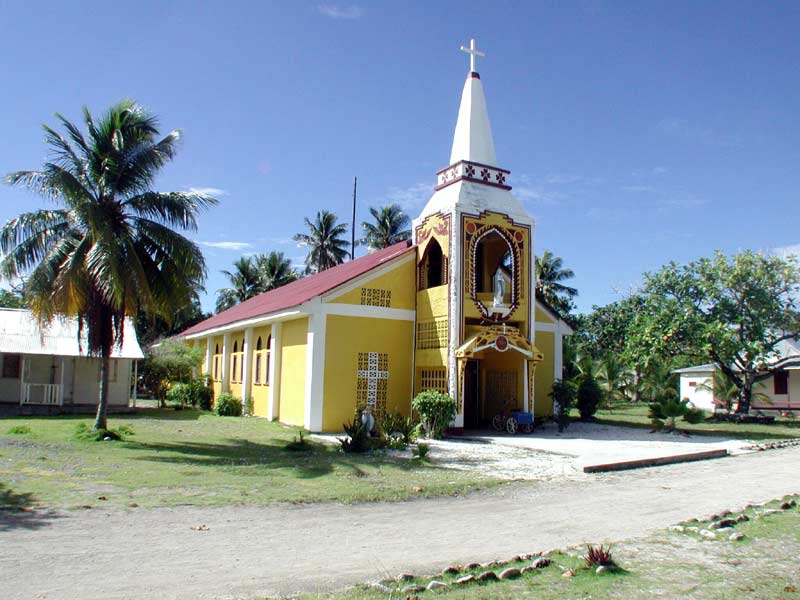
Like other countries who were once governed by European countries, the majority religion is Christianity. There are several denominations present in the islands, the largest being the United Church of Christ. However, Baha’i and Islam are also represented here as well; the first Muslim mosque was built in 2012. 


The vast majority of the people here are of Micronesian descent with a little Japanese mixed in perhaps. Because of their history with the British and the US, English is often spoken and understood, although their official language is Marshallese (locally known as Ebon). There are 34 atolls in the Marshall Islands, and they’re divided into the western atolls (called Ralik) and the eastern atolls (called Ratak). Marshallese has two dialects divided on these same lines. Marshallese is written using Roman letters, although diacritical marks are used on some letters. 


The atolls of the Marshall Islands average about 7 ft above sea level, and one atoll, the Kwajalein Atoll, is the largest coral atoll in the world. There are over 1100 smaller islands and islets that are uninhabited. Although some of the islands’ existence is threatened by rising sea levels, one island in particular no longer exists thanks to the US. The island of Elugelab was blown up in 1952 when US Armed Forces tested a hydrogen bomb on the island. In fact, many of those islands are still uninhabitable due to high amounts of radiation still on the islands, some 60 years later. It’s hard to believe we convinced them this was ok to blow an entire island off the map and poison their people. But, you know. The best we can do is learn about their culture to better understand the people whose islands we took over for a while.

Up next: art and literature

Sunday, June 5, 2016

MALTA: THE FOOD


Well, I thought I’d be able to snatch up a job really quickly, but that didn’t pan out how I imagined. I don’t get it, and I never do. However, I am working on starting a new business venture doing what I was doing before, except instead of writing a newsletter about commercial real estate, I’ll be writing about education, something a little closer to my heart. It just takes a little time to get started, I think. Hopefully by the time school starts back up, we’ll be fully ready to go. The kids start summer break this week, and I’m definitely ready for that. 

I snacked on these while I was waiting for everything to cook. I struggled to save some for everyone else.
What I’m also ready for is this Maltese meal I’ve picked out. The first thing I made was Pastizzi, which is like ricotta-stuffed puff pastry. I started out mixing 10-11oz of ricotta cheese, 3-4 Tbsp of grated parmesan cheese, 2 eggs, and parsley to taste (you can also add in anything else, like spinach if you wanted) until everything was mixed well. I bought some puff pastry sheets from the store and rolled it out, cutting out circles that are about 9 cm wide. I used a biscuit cutter, which made it kind of easy. I put a little bit of the ricotta mix in the inside of each circle, egg washed the edges, and folded it in half, squeezing the edges together, and egg washed them again. The recipe calls for a “medium to hot oven,” so I just set it for 375ºF. I laid each pastry on a parchment paper-lined baking sheet and put them in the oven for about 20-23 minutes. I didn’t get the egg wash put on some of them very well, and a few of them opened up a bit. But the flavor was good. I almost felt like I cheated with this one because I bought my own puff pastry sheets instead of making it. But puff pastry takes a while to make (if you want to make it right), and sometimes store-bought stuff helps. It certainly saves time. They were flakey, cheesy, and went very well with my meal.  

Surprisingly good. The recipe called for one can of tuna, and I ended up using two packets since one wasn't enough.
Next, I made a Maltese Tuna Pasta Salad. I boiled some tri-color rotini pasta until it was al dente and cooled it, putting it in a bowl. In the same bowl, I mixed in two packets of tuna, some diced red bell pepper, some diced onion, some capers, some chopped cherry tomatoes, sliced black olives, some salt and pepper, and a pinch of dried mint leaves. Then I sprinkled the salad with olive oil and balsamic vinegar. I was supposed to add in a little fresh-squeezed lemon juice, but I forgot. I mixed this up and put it in the refrigerator to chill. Everyone really liked this except my son who has all of a sudden decided he doesn’t like cold pasta. I think it could’ve used a little more balsamic vinegar, but my husband told me it was fine. 

I was glad this turned out really well. It was quite tasty and will make a good lunch for tomorrow.
My main dish for today is Bragjoli, which is like a beef roll-up. I bought four cubed steaks from Aldi and beat them until they were flattened out. In a small bowl, I mixed in some chopped bacon, some chopped hardboiled egg, parsley, salt and pepper, and some bread crumbs. With a spoon, I spread some of this mixture onto the flattened cubed steaks and rolled them up, securing them with toothpicks. When each of them was rolled up, I fried them slightly in olive oil to help seal them, even though it didn’t work all that great. I moved them to the outer edges of the skillet, and I added in some chopped onions in the hot olive oil before adding in some basil, some oregano, a little garlic powder, a little tomato paste and diced tomatoes and let it simmer together for a few minutes. Spooning the tomato mixture on top of the beef and adding in some water to cover halfway, I let it simmer for 20 minutes. Then I added in the peas and let it simmer for another 45 minutes or so. This had a good flavor. The tomatoes thickened up toward the end, and the meat surprisingly wasn’t too tough. The egg and bacon on the inside wasn’t quite as pronounced as I thought it was going to be, but when you did get a piece of bacon, it was really good. 

Another big surprise. I was worried how the anise would taste with the potatoes, but it turned out pretty good. Who knew?
To go with this, I made Maltese-style potatoes, or Patata il-Forn. I peeled and chopped up some potatoes and put them in a casserole dish that I greased with butter. I sprinkled in a little olive oil and stirred to coat. Then I seasoned the potatoes with salt and pepper. True Maltese-style potatoes are seasoned with fennel seed, but my husband absolutely hates fennel seed, so I read that a good substitution is anise seed (another one is caraway seeds), both of which I have. So, I used ground anise seed and mixed it throughout really well. I baked these for nearly 45 minutes in a 400ºF oven, until they were crunchy on the outside, but soft on the inside. These were really good. I used small golden potatoes and kept the skins on. They were quite soft, and not so much crunchy on the crunchy side, but that’s ok. I kept the anise seed light, and I think it was better. 

Overall, this was an excellent meal. Definitely recipes to repeat.
I thought this meal was really good. And I certainly learned a lot about this country, besides where it is. But the thing that fascinated me the most is their language. I knew absolutely nothing about it before hand. As a cross between Italian and Arabic, I can somewhat hear the influences of both languages when I listen to it spoken. Granted, I have no idea what they’re saying, but I can hear the sounds. (I studied some Italian diction in college as a requirement for being a voice principal music major.) But I think it’s interesting. I never know what I’ll learn about when I come across these countries. Maybe that’s why I keep doing this.

Up next: Marshall Islands

MALTA: MUSIC AND DANCE


The most well-known style of traditional music in Malta is called Ghana. No, not like the African country. It’s actually written with a horizontal line through the top half of the H. And the ‘Gh’ is silent, so it’s pronounced “AH-nuh.” Now that you’ve thoroughly wrapped your head around the word itself, what is it? 

Well, there’s two types: formal and informal. Both types are essentially the singing of rhyming verses. But let’s start with formal ghana where there are three sub-categories. Bormliza, named after the city of Bormla where it was popular, is characterized by male singers singing as high as they can in a soprano register without breaking into falsetto. It’s seldom practiced now. Ghana tal-Fatt is a more of a ballad: recounting stories, folktales, or legends. It can either be sad or humorous. Spiritu pront is a style originating from informal song duels. In these duels, the singer has to know a wide range of socio-political topics as well a keen command of the Maltese language. The singers in these duels, which last about an hour, must respond in a rhyming poetic style, and the singers are accompanied by three guitarists.


Informal ghana uses both men and women performers and often utilized day-to-day scenarios, such as peasant life and farming. This informal style of music was a form of gossip among women as they did their housework, but it was also just a way to pass the time while working. This style of singing and housework went hand-in-hand. 


The cuqlajta is a percussion instrument. It’s closely related to a ratchet or clapper. Another instrument is known as the ilqarn, which is essentially made of a horn. These horns had a variety of functions. The bedbut, zummara, and the flejguta are types of flutes or wooden whistles. They also played the tanbur, a type of tambourine, and the iz-zaqq, a type of bagpipe played here made from the skins of animals. 


Outside of various functions, the Maltese make quite a big to-do over the carnival festival. Introduced by the Italians during the 1500s, carnival quickly made its way as one of the most important holidays in Malta. Typically, the festivities last during the week before Ash Wednesday and include late-night parties, masked balls, parades with elaborate floats, marching bands, competitions in a variety of categories (fancy dress, grotesque masks, music, etc.), people dressing in costumes, and a number of other events. It’s also a time for music and dance. One dance that is danced during this time is the parata. The parata is based on a light-hearted war reenactment of when the Knights were victorious over the Turks in 1565. A court dance known as the il-Maltija is also performed during carnival time. 


As small as the country is, there have been quite a few musicians to come from Malta. Not to mention the number of Eurovision Song Contest winners and high-ranking participants from Malta. I came across a lot of Maltese musicians on Spotify. They have quite a few indie rock bands, like Beangrowers, Chasing Pandora, and Stalko.


Rock and alternative rocks I listened to include Bitterside, Insurgence, NoSnow/NoAlps, Red Electrick, and Winter Moods.


I even found a couple of metal bands. Abysmal Torment and Beheaded were both the type of metal bands that are really intense with a lot of screaming. 


I came across several pop and dance/electronica artists such as Fabrizio Faniello (more of a pop singer), Jo Micali, Miss Roberta, and Tenishia. 


There were several musicians I came across that didn’t really fall into one of the categories above. Some of them played more of a traditional sound like Kantilena and ManuTapu. Renzo Spiteri makes music based on pitched percussion instruments; some of it almost sounds gong-like. He utilizes other instruments as well, like flutes, but it almost gives it an East Asian or Southeast Asian sound, like something you might hear in a Buddhist temple or something at times. It was very relaxing. Although Roger Scannura was born in Malta, he has studied, performed, and recorded Spanish flamenco guitar since the early 1990s. He has a song called “Marissa” which is my daughter’s name (minus one S). 


Up next: the food

Wednesday, June 1, 2016

MALTA: ART AND LITERATURE


Much of Malta’s art is highly connected to the art of Sicily and Italy. The earliest temples of the Neolithic period incorporated intricate bas relief designs and mainly consisted of spirals and nature designs. Of course, they were extremely influenced by Roman art. Not only did architectural styles make their way as far as cathedrals are concerned, but frescos and decorative mosaic floor tiles as well. 


The artist Caravaggio stayed in Malta for over a year and completed at least seven paintings while he was there. He also inspired a number of Maltese artists during his stay as well. The Baroque period and the Rococo period brought along a renewed push in painting and sculpture in Malta. Each art period had its own characteristics; the Neo-classical movement promoted religious themes while the Romantic period saw a push toward nationalism. 


During the 1920s, the National School of Art was built and established by Parliament. After WWII, modern art movements from throughout Europe and other areas of the world began to make its way into Malta, and they were studied and emulated. 


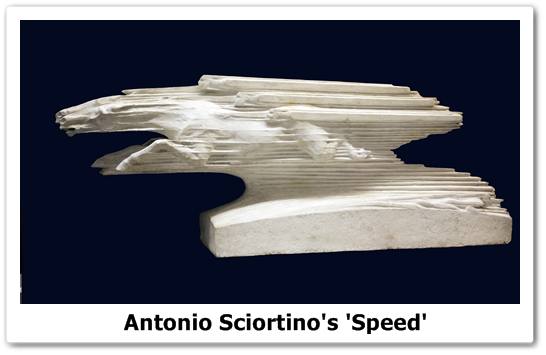
Some famous artists from Malta include Antonio Sciortino (sculptor), Melchiorre Cafà (sculptor), Amedeo Preziosi (painter), Giuseppe Calì (painter), Francesco Maltese (painter), Antoine Camilleri (painter, stamp designer, teacher), and Emvin Cremona (stamp designer, painter).

The Lords Prayer in Maltese
The vast majority of literature from Malta is written in the Maltese language. The earliest works were in the form of poetry and typically were either praise aimed for royalty or religiously themed. The Lords Prayer and catechistic texts were commonly read during the 1700s, and they were also translated into Italian, the other language used in Malta.
 
Mikiel Anton Vassalli
One patriot named Mikiel Anton Vassalli, who wrote in the Romantic style, introduced a new identity in writing, a nationalism if you will. The first Maltese newspaper wasn’t published until 1839. Although poetry has been used for many centuries, the first true epic poem written in Maltese wasn’t written until Giovanni Antonio Vassallo did so in 1842. Twenty years later, the first history book was published, and the first novel a year after that. As far as the novel goes, Malta still modeled much of its literary styles after Italian traditions, but quickly developed their own voice. 

Before the 20th century, there was a major social distinction between the use of Italian and Maltese. Italian was the language of literature, government, trade, and high culture, whereas Maltese was the vernacular, what the people used as everyday language. A shift began during the 1800s with a push toward a national identity and Maltese began to make its way into other aspects of society. 


Several writers have emerged from Malta, such as Pietru Caxaro (poet, philosopher), Ruzar Briffa (poet), Marjanu Vella (writer, poet), Anton Buttigieg (poet), Dun Karm Psaila (poet), Ray Buttigieg (poet, composer), Pierre J. Mejlak (short story writer), Francis Ebejer (novelist, dramatist), Immanuel Mifsud (poet, novelist), Joe Friggieri (poet, philosopher), Oliver Friggieri (poet, novelist, philosopher), and Carlo Gimach (poet, architect).

Up next: music and dance

Sunday, May 29, 2016

MALTA: THE LAND AND THE PEOPLE


When I was in high school, I took an interest in old films. As an aspiring actress at the time, I watched these old films not only for their story, but to watch their acting. In 1998, AFI (American Film Institute) put out a list called “100 Years…100 Movies,” revising the list in 2007. The Maltese Falcon ranked in at #23 but dropped to #31 in the updated version. It took me years to figure out the word Maltese referred to things and people from Malta, and it took me a few more years to figure out where Malta was. And unlike the Maltese Falcon in the film, the country of Malta is very much a real place. 


Although it’s not quite certain, but the name Malta is thought to have derived from the Greek word for “honey.” In fact, the name the Greeks gave for the island group is Melite, which means “honey sweet.” Other variations were based on the Greek word. However, some historians think it may have also come from the Phoenician word for “port” or “haven.”


Malta is an island group located in the Mediterranean Sea. The Italian island of Sicily is to the north, Tunisia is to the west, and Libya is to the south. The Greek island of Crete lies to the east much farther off. Although there are several islands included in this archipelago, only the largest three islands are inhabited: Malta, Gozo, and Comino. Obviously the country of Malta has a Mediterranean climate, which means that it has mild winters and hot summers. Like the Mediterranean island nation of Cyprus — which is about on the same latitude — Malta enjoys a high number of sunshine hours during the year. It averages twice the number of sunshine hours that northern European cities have. 

The site of a bombed out Opera House during WWII.
The earliest people living in the Maltese Islands probably arrived from Sicily (and more than likely the Sicani, the ancient people from Sicily.) Many of the temples and pottery found on the islands resemble examples found on Sicily. The Phoenicians, the Greeks, and the Romans all traded with Malta and each had their turn controlling parts of the island groups. It was mentioned by several historians, and was even mentioned in the Bible as the area where Paul and Luke washed up after being shipwrecked. They took the opportunity to spread Christianity to the islands, and it has remained Christian since then. During the Middle Ages, the Byzantine Empire took over the islands. They brought along Islam, irrigation techniques, fruits, cotton, and the Siculo [Sicilian]-Arabic language that would later become the Maltese language. Finally the Norman Conquest pushed its way into the area, and Catholicism was reinstated as the Muslims were pushed out. It was then ruled by the House of Barcelona, and Napoleon captured the islands during the late 1700s. The Treaty of Paris granted Malta to the British Empire, and the islands played important roles in both WWI and WWII. Malta finally gained its independence in 1964 from the British. It remained neutral during much of the Cold War and later joined the European Union and the Eurozone. 

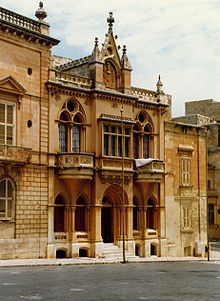
Malta’s capital city is Valletta, located on the island of Malta itself, making it the southernmost European capital. It’s also known as The Most Humble City of Valletta. This ancient city shows evidence of the multiple changes in its history through its architecture. In the midst of these old cathedrals and palaces are buildings with modern architectural styles on modern infrastructure. The city is known for several festivals that run throughout the year. The city of Valletta is one of the densest historical cities in the world (so if you’re not a fan of being close to your neighbors, it might not be the best city for you). If you love old cities with a lot of charm, by all means, please visit. 


Before 1800, Malta mainly depended on cotton, tobacco, and a few other exports. When the Suez Canal opened, this small country saw an increase in its economy as a trade port. By the end of the 1800s, their economy was starting to falter, and by the onset of WWII, it was in serious trouble. Limestone is a major resource for Malta (like my home state of Indiana). Being an island limits its energy resources, but because of the number of sunlight hours, it has the potential to utilize solar energy even though it's not being used as much as it could be. Malta has been a popular place for film production because of its climate. The first film was filmed there in 1925, and now the government provides incentives for film companies to film in the islands. It’s also a tourist haven for obvious reasons. Today, Malta and Tunisia are discussing the possibility of oil exploration in the sea between the countries.


The constitution declares that Roman Catholicism is the state religion, although freedom of religion is also somewhat apparent. Religion may be taught in public schools, but students have the option to opt out. Even though Roman Catholicism is the dominant religion in Malta—with nearly 95% of Maltese who consider themselves Catholic—there are also Protestants, Muslims, Jewish, Buddhist, and Baha’is practicing in Malta as well. 


The Maltese language is the official language in Malta. It’s an interesting language, a cross between Sicilian and Arabic with significant borrowing from Italian and French. It’s only been the official language since 1934; before this, Italian was the official language of Malta. However, because the British also controlled the island for a long time, English has a quasi-official standing in the country as well. The vast majority of Maltese residents are bilingual in Maltese and either English, Italian, or French. 

No, you are not allowed to walk across. 
I will venture to guess that most Americans don’t know where Malta is (I at least knew it was in the Mediterranean somewhere), but this tiny European country has been the setting of many books, films, and historical events. Calypso Cave is thought to be the cave Homer mentioned in The Odyssey. Although cars drive on the left in Malta, there are many areas that are only accessed by walking. Known for its beaches and craggy coastlines, Malta is definitely one underrated place people don’t know enough about.

Up next: art and literature

Monday, May 23, 2016

MALI: THE FOOD


Well, it’s been an interesting past couple of weeks to say the least. My job is on hiatus as we look for a new owner. So, I’m kind of back on the job search, but I’m also looking into venturing into creating my own e-newsletter on education. Not to mention all of the other things my family is involved in that I have to take care of. So, there’s quite a bit of stress at the moment. But I’ve always been the type of person who leans on two things when I’m stressed: music and food. Luckily for me, I have this blog. 

My pie-cake, with cryptic cracks and everything.
Because things ended up being so busy this weekend, my cooking was divided on two different days. I made a cake called Gâteau de Semoule aux Agrumes (Semolina and Citrus Cake) first. The first thing I did was zest an entire lemon and an orange, then I squeezed all the juice from each into the same bowl as the zest and set it off to the side. In a large bowl, I measured out about 1 1/8 c of white wheat flour (it was what I had on hand). In a small saucepan, I brought 500 mL (about 2 c) of milk to a boil, and just as it started to boil (or in my case, boil over), I took it off the heat and slowly poured it into my flour, trying to stir at the same time. It pretty much became thick right away, so thick that I didn’t need to put it back on the burner to thicken up like the recipe suggested. At this point, I just stirred in the orange and lemon zest along with the juice and a ¼ tsp salt into the dough. Then I cracked 4 eggs (stirring in one at a time) into the dough. (My son helped with this part. I’m just glad there are no eggshell pieces included!) I wasn’t sure how much honey I was supposed to add, so I just poured enough honey to empty the honey bear’s head (maybe a 1/8 – ¼ c?). So, after stirring everything together to make a smooth batter, I poured this into my greased springform pan (I don’t have a Bundt pan for some reason, which is what the recipe called for). This baked for about 35-38 minutes in a 350ºF oven, chilling it in the refrigerator (the recipe said for a couple of hours, or you can leave it in there for a day and a half like I did). I drizzled this with a little more honey before serving, and it was very good. My husband thought it tasted a little like lemon meringue without the meringue. It was definitely more pie (without the crust) than cake; the consistency was more on the level of a cream pie or a very dense pound cake. And to be honest, I was a little leery about the citrus and honey combination, but it seemed to work out quite nicely.

If this is what the food is like in Timbuktu, sign me up (when it's calmed down, of course).
Today will be a day of stews. The first stew is Couscous de Timbuktu. I cut up my stew beef into small cubes and browned the meat along with some minced garlic. When it was browned, I added in my spices: a little rosemary (in lieu of fennel seed, and I added in a little oregano as well), cinnamon, salt, cardamom, cayenne pepper, black pepper, cumin, ginger, and nutmeg. After stirring in the spices, I added in a can of stewed tomatoes and enough water to cover everything. I let this simmer for about an hour before adding in my onions. The recipe called for pureed dates, but didn’t want to spend that much and still have to puree them myself. So, I substituted some pureed prunes and apples that I found in the baby food aisle. Once I stirred these in, I let it cook for another 30 minutes, topping it with chopped parsley and serving it on top of instant couscous. I really liked this, and so did my husband. (He liked it better than the other stew I made.) It was very aromatic. I thought the flavors blended quite well (yes, even those nasty prunes), although I added a little flour at the end to help it thicken faster. It just goes to show that when flavors cook together, they change.

Who can't resist a good peanut stew. This vegetarian version was actually pretty good!
The other stew I made is Tigua Dege Na (a vegetarian stew in peanut sauce – shhh, don’t tell my husband it’s vegetarian). I started out sautéing my onions and garlic for a few minutes until they were translucent. Then I added in a large can of diced tomatoes, tomato past, chicken broth (instead of vegetable broth – vegetable broth tastes gross to me), peanut butter, a little cayenne pepper, salt, black pepper, a couple bay leaves, and some diced up squash. The recipe called for one acorn squash, but they seemed kind of small, so I bought two. Once I brought all of this to a boil, I added half of a 10 oz bag of angel hair cole slaw mix (it’s basically just the cabbage). I cooked this down for about a half hour, stirring it frequently to keep the peanut butter from sticking. I served this over rice. This one surprised me. My daughter thought it was really good. The acorn squash I bought a few days ago was not quite ripe – it was the consistency of a potato, or an apple even! But it made it better for my husband who hates squash because “it’s slimy,” as he says. Even after cooking down in the stew, it was still the consistency of a potato, which I liked. But you really couldn’t taste any of the squash flavor anyway because the flavors of the tomatoes and peanut butter were far more overpowering. So, there was that. The cabbage helped to thicken it up a bit. I thought it makes a fantastic vegetarian stew (minus the chicken broth, but let’s be real, could a vegetarian really taste it anyway?).

I was rather excited about the jalapeños in this bread. However, I'll need to keep working with it.
Finally, to go with these stews, we needed bread. I had a hard time finding an actual bread recipe that wasn’t quite duplicated. The problem is that I found all kinds of mentions on the Internet about a bread called Ngome bread, but everything I found just mentioned the same two or three lines copied and pasted from Wikipedia. But I did land on one page that offered a little more information, but it was more of a description rather than a recipe. I basically had to make up the measurements. So, here’s what I came up with (this may be the closest thing to a ngome recipe on the Internet – brace yourself!): I mixed 3 c of millet flour with 3 Tbsp vegetable oil. Then because millet is kind of bland in and of itself, I mixed in 1 Tbsp chili powder, 1 tsp black pepper, ½ Tbsp salt, and 3 Tbsp minced jalapeños. After stirring this up, I mixed in a cup of water and combined all the ingredients. Once I added in enough water so that it held together and enough flour to make it pliable enough to form into a ball (I felt like I had to add in quite a bit), I divided the dough into eight balls. I flattened each ball as I heated up my griddle with a little oil, frying each flatbread until it was browned on the outsides and letting it cool on a plate. Here’s what my problems were: The dough started out too wet (I may have only needed about ¾ c of water), but in order to make it stop sticking to my hands, I had to add flour, which in turn made it want to crack and break apart, although it felt like holding wet sand at the beach. The spices and the jalapeños helped, but it was still a very dry bread – great for dipping and sopping, as they say. I’ve never worked with millet before, but I think it has a very earthy flavor, similar to quinoa flour or masa harina. And perhaps I used a little too much oil because the last ones browned up better than the first ones. To be honest, I wasn’t even sure what this was supposed to even look like, so I really was flying by the seat of my pants on this one. This version was not my favorite bread, but perhaps it might be able to be worked into something better. It’s a good start anyhow. 

Altogether, it was a pretty good meal. You can never go wrong with a good stew.
While I was making the Couscous de Timbuktu, I started thinking about a news report I heard about a few years ago that when Islamic terrorists made their way to Timbuktu in early 2013, they completely raided the place, burning down buildings and killing anyone who resisted. One story that got me was how they torched the libraries — and not just any old library: these libraries held ancient documents and manuscripts dating back from the 1200s that were not just important to Mali’s heritage but world heritage as well. They covered a variety of subjects: medicine, women’s rights, culinary arts, biology, astronomy, history, and a number of other topics. These manuscripts were important because it dispelled the myth that “black African” history was mainly oral before Europeans arrived. It’s unknown how many of these manuscripts were destroyed. But one highlight is that I also read about a dedicated and very courageous group of librarians who moved as many books as they could to basement and sub-basement passages and to auxiliary buildings, and eventually out of the city in order to save these literary relics. Over the course of eight long months, they worked tirelessly saving history; in the end only about 4000 of the nearly 400,000 scrolls and books were destroyed. These people are truly my heroes.


Up next: Malta