Tuesday, July 14, 2020

TURKMENISTAN: THE LAND AND THE PEOPLE

I downloaded this new trivia game the other day, and although I’m really good at world capitals, I’m not so good at world flags. And I’ve always been weak at identifying flags, probably because so many of them look very similar. The main ones I know, but there are only so many colors, and I think some countries got lazy in creating their national flag. I mean, there’s only one country now (Jamaica) that doesn’t have red, white, or blue somewhere on their national flag. But some countries at least took some time to come up with a flag that’s unique, and Turkmenistan is one of them. So kudos to their creativity teams, although it’s really hard to duplicate from memory, I suppose.


The name Turkmenistan is derived from Turkmen + stan. Turkmen, as a Turkic ethnic group, means “almost Turk” and -stan is a Persian ending meaning “land of.” There are a couple other theories as to its origin. While it was under Russian rule, they changed its name to Turkmen SSR but was also commonly called Turkmenia.


Turkmenistan is located in Central Asia, surrounded by Kazakhstan to the north; Uzbekistan to the north and east; Afghanistan to the southeast; Iran to the south; and the Caspian Sea to the west. The vast majority of the country is covered by the Karakum Desert, and the other parts are covered by the Great Balkhan mountain range and the Kopet Dag range. For most of the year, its climate is arid desert with subtropical temperature range and has milder, wetter winters.

Saparmurat Niyazov

Originally, this area was inhabited by Indo-Iranians but was taken over by the Oghuz tribes who were a Turkic group from around Mongolia. The term Turkmen first referred to those from the Oghuz tribes now living in Turkmenistan who converted to Islam. The Seljuk Empire took over in the 10th century and was later defeated, only to have the Mongols do the same thing a century later. By the time the 16th century came along, a couple of Uzbek khanates were quite influential in Turkmenistan, and Turkmen soldiers helped out Uzbek soldiers quite a bit. However, one particular Turkmen group wasn’t really having it anymore and got under the Uzbek military’s skin enough to be kicked to the curb. Turkmenistan was also known for doing its part in the slave trade that spread across Central Asia. So, there’s that. In the late 19th century, Russia took an interest in Turkmenistan and moved right in. Not only did they pull in Turkmenistan as a territory, but they included the Uzbeks as well (talk about being in the wrong place at the wrong time). They changed over to being the Turkmen Soviet Socialist Republic in 1924, and a decade later, the Russians had killed off what part of their cultural nomadic lifestyle they had left. As Turkmenistan was preparing itself for its independence after Russia broke up in 1991, it found itself being run by the communist leader Saparmurat Niyazov. His guy had such a strong motivation of independent nationalism with a cult of personality to match (he even wrote his own religious book that he made people practically memorize). So, it’s no surprise he made himself president for life. He ended up having a lot of terrible, garbage policies and ideas he implemented (you don’t say!), especially ones that centered on a one-party system, strict censorship rules, human rights issues, and stuff like that (he once closed down all the hospitals outside of the capital and all the rural libraries; like, this guy’s nuts). He died in 2006, and a new guy took over and had a lot of work to do to undo what his predecessor did.


The capital city is the south-central city of Ashgabat (also spelled Ashgabad, Ashkhabad, Ashkhabat, or Aşgabat); it’s really not that far from the Iranian border. It means “city of love” or “city of devotion.” With about a million people today, it started out as an ancient wine-making village along the Silk Road (I can see why it’s the city of love now). Today, it has several universities, shopping areas, theatres, parks, sporting venues, and museums.
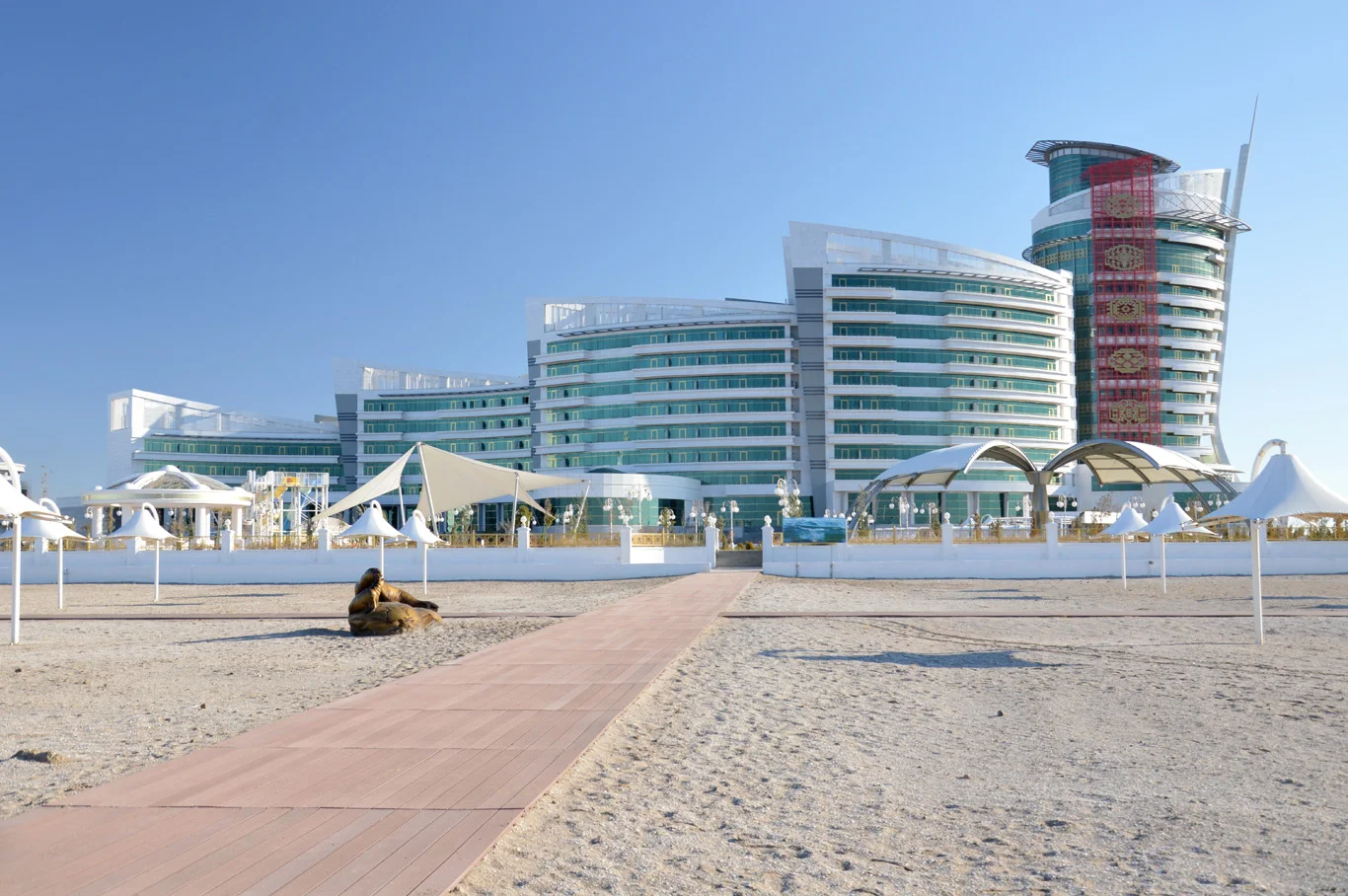

Turkmenistan has a lot of natural gas and oil reserves. Even at that, they generally have a pretty high unemployment rate. Some of their problems lie in that they’re landlocked without an adequate way to export. This was especially true about 20 years ago, although I think they have some better trade deals now. And for such a long time, government corruption wasn’t really helping their economy either. Agriculture is also fairly important as well, and especially cotton, which is one of their biggest exports. In an effort to build up tourism in Turkmenistan, medical tourism has been on the rise. Their new president Gurbanguly Berdimuhamedow (what a name!) also had put in a lot of money into building up a touristy area called Awaza (which seems named after the worst typing exercise). It was his attempt to build up a Dubai-like tourist zone along the Caspian Sea and has also been likened to a “Turkmen Las Vegas,” but some reports have shown that, like the real Las Vegas, it’s not quite all as advertised.


Nearly 93% of Turkmens are Muslim, while 6% are Christian. Of the Christians that are there, most adhere to the Eastern Orthodox Church, and more specifically the Russian Orthodox Church; however, there are several other denominations of Christian churches represented throughout the country, probably mostly in the capital and other larger cities. There’s also a small following of Baha’i in Turkmenistan that has been present since the religion began. During the Soviet years, pretty much all religions were wiped out altogether.


Turkmen is the official language, not surprising. It’s related to Turkish and Azerbaijani. However, Russian is still used as a lingua franca in many cities as a way to communicate between different ethnic groups. There’s also quite a few Uzbek speakers in Turkmenistan as well, which makes sense given its close proximity and history. Pockets of other languages are spoken throughout the country based on ethnic groups.

Indoor Ferris wheel

I am all about weird claims to fame, and Ashgabat does not disappoint. They claim to have the highest Ferris wheel that’s enclosed, the fourth-tallest freestanding flag pole, and the Ashgabat Fountain, which has the most fountain pools in one place. And on top of that, the Guinness Book of Records included Ashgabat in 2013 for having the highest concentration of white marble buildings. And the city is also where Turkmenistan Tower is located, which has one identifiable mark: a large octagonal star. Dubbed the Star of Oguzkhan, it is the world’s largest architectural image of a star, according to the Guinness Book of Records. So, there’s something for everyone here!

Up next: art and literature

Sunday, July 5, 2020

TURKEY: THE FOOD

The heat and humidity is finally here, and thankfully the 4th of July has finally passed. Last night sounded like a war zone across much of the city. I saw posts of everyone carrying on with their festivities --barbecues and parties and fireworks and shopping-- as if we’re not in the middle of a pandemic. Unbelievable. We stayed home this weekend, like we do every weekend. (Except this weekend, we watched the Hamilton movie, and now my heart is full!)

Black and white, just like my family.

I had trouble narrowing down recipes from Turkey, so I had to split this between two days because I picked so many. Plus, I had a three-day weekend so I had some extra time. For the bread, I made a Turkish Ramadan flatbread called Pide. I put my flour in a bowl and mixed a package of yeast into it. Then I added in some warm water and stirred with a fork, adding in some warm milk after that and doing the same. I added in a bit of softened butter and olive oil, working that into the mix before adding in the sugar and salt. Then comes the hard part: I kneaded it for like 10 minutes before turning it out onto a floured surface and kneading for another five minutes. Then I let it rise for about two hours while covered with a piece of wax paper that I sprayed with cooking spray instead of using a damp cloth. After that, I removed the cloth and divided them into two with a knife and shaped them into loaves (you can pick either oval or round. I picked round). With that knife, I cut a slight circle into the dough about an inch around the edge and then did a criss-cross pattern in the middle of it. In a small bowl, I whisked together a little plain yogurt and an egg yolk and brushed it on top of the loaves generously and sprinkled some black sesame seeds and white sesame seeds on top (the recipe calls for nigella seeds, but I didn’t have any, and I thought the black and white seeds would look cool). I baked this at 430ºF for 30 minutes or until it was golden brown. This was actually really good. It was soft in the middle, and although it was browned on the outside, the crust was very soft. The nuttiness of the sesame seeds was quite subtle.

I have this say, this was so gouda. (Sorry.)

My main dish today was Karides Güveç, or Turkish Shrimp and Vegetable Casserole. I boiled my shrimp (I used fully cooked frozen shrimp) in salted water for a couple minutes and then took it off the heat and rinsed them in cold water to keep them from cooking any more than that. Then I cleaned and diced some onion, garlic, green peppers, tomatoes, and mushrooms. I heated a little olive oil in a saucepan and fried my onions and garlic a bit before throwing in the green peppers. After that sauteed for a few minutes, I added in my tomatoes, mushrooms, a little tomato paste and some salt and pepper along with a pinch of crushed red pepper flakes. I let that simmer down until most of the liquid was gone, stirring often so it didn’t stick to the bottom. Then I added in my shrimp to this and stirred everything really well and transferred the whole thing to a casserole dish. Before I put this in the oven, I covered it in grated cheese: the recipe calls for fresh Turkish kashar cheese, but I just grated some fresh smoked gouda. I set this to broil on the top rack in the oven, so that the cheese starts to bubble. This was really good, and the smoked gouda really added to the dish. That was probably my favorite part.

Not too bad, even without the orzo.

To go with this, I made a Turkish-style rice pilaf with orzo, except not with orzo. (The stores are still a little shaky on how they’re stocked, and my husband couldn’t find any at two different stores. Since I wasn’t using that much, I just broke up a handful of spaghetti into orzo-sized pieces. Not the same, but it’ll do.) In a shallow saucepan, I melted some butter and oil together and added in the bits of pasta to it. I stirred this continuously until it was a dark golden color. Then I added in my uncooked rice and stirred it all together until it was coated in the oil. Then I slowly added my chicken broth to this and a little salt and pepper. I brought this to a boil, stirring a little, and then I turned my heat down and put the lid on it. When all the liquid was gone, I removed it from the heat to let it continue steaming (without taking the lid off, of course). Then I stirred it up a bit before serving. Despite the fact that this was using pieces of broken spaghetti, it was quite good and went well with the shrimp and vegetables.

It's ok no one liked them. I ate the rest for breakfast today.

But yesterday, I made a couple of dishes, too. For dinner, we had Mücver, or Turkish Zucchini Fritters. I actually saw these in a polyglot group, and they looked so good that I HAD to try them. And keep in mind there are a ton of variations on these, too. I made mine by grating a zucchini and putting it in a mixing bowl along with some shredded carrots, feta cheese crumbles, a little dill, a little mint, and a little salt and pepper (next time, I’m adding in some cumin and spring onions). I stirred in one egg (you might need two, depending on how watery your zucchini is) and then stirred in the flour. My recipe didn’t call for enough flour, so I added enough to make a light batter around the vegetables (otherwise, it won’t fry up right, as I found out with the first batch). Then I took a little vegetable oil and heated it up, dropping spoonfuls in the skillet and flattening them into a patty. Once one side was browned, I flipped it to brown on the other side, and then let it drain on a paper towel. I don’t really know what they put on them, if anything, but I did put a little bit of ricotta cheese on top and it was good. Knowing that no one else likes zucchini, I wasn’t surprised that I was the only one who liked these.

I ate three. Maybe four.

I also tried my hand at Lemon Turkish Delights. I think the real Turkish Delights are made with rosewater, but I don’t like rose-flavored anything since I think it smells like old-lady perfume. So, the lemon ones were a good alternative. I suppose you can make them whatever flavor you want if you can find an extract to use. And this recipe was also probably not traditional, since I made it in the microwave. (But it’s also 90 degrees here, so not using my oven/stove any more than I have to is a great thing.) In a 4-qt Pyrex bowl, I whisked together some cornstarch and water until it looked like milk. Then I microwaved for 2 minutes and whisked again with a fork. I microwaved it again for 3 minutes and whisked again. At this point, it was starting to feel like glue. Then I added in a bunch of sugar and some corn syrup. I put it in the microwave for 5 minutes, but I didn’t watch it close enough and it boiled over and made a huge mess out of everything. So, I paused and had to clean up this sticky mess. It felt like a toddler had been here. And that toddler was using a hot glue gun. Then I microwaved it for 3 minutes, pausing every time it got close to overflowing. And then I whisked again. Then I did another 3 minutes in the microwave, and you guessed it, whisked again. At this point it’s starting to get really thick, and I added in a tablespoon of lemon extract and a little bit of food coloring (we had to go with orange because apparently the two stores my husband went to didn’t have yellow at all). I microwaved it for 3 more minutes and stirred and repeated that one more time for good measure. Then I felt like it was probably thick enough. I sprayed a loaf pan with cooking spray and poured it out in there, smoothing it out as best I could and let it sit at room temperature for two hours to firm up. After this, I turned it out and cut it into 1” squares. In an old butter cookie tin, I used wax paper and placed them in there, using another sheet of wax paper between the layers, and let it sit out for almost 24 hours to completely firm up. When it had set up, I mixed together a little bit of cornstarch and powdered sugar together in a bowl and gently tossed each of the candies into the powdery mix. This was my first time making candy (I don’t really count Brazilian brigadeiros as candy, but maybe I should. Who knows?), and I’ve always been a little cautious to attempt it, but I think it turned out pretty well. And they were quite tasty if I may say so myself. So, I can at least say I know how gummy candies are made (somewhat).

I loved everything about this meal. Like, really, really loved it.

I used to say that any country that was once part of the Ottoman Empire had some great food. And, well, I’m not wrong. I don’t know what it is, but I love food from this area of the world. And I’ve read that Mediterranean diets are among the healthiest for you (probably minus the Turkish Delights). And I made it through several lessons of Turkish Duolingo. I like it and am starting to get the hang of things. I may stick with it. Who knows? Maybe I’ll make that trip to Istanbul before my life’s up and see the real Bosporus.

Up next: Turkmenistan

TURKEY: MUSIC AND DANCE

Turkish music should get an Instagram since it was such an influencer. But like every influencer, they borrowed styles from a lot of other people around them. They have their own styles of course, but with bits and pieces they picked off of Greek music, Arabic music, Balkan music, Persian music, and other styles from Central Asia. But there has also been a ton of people influenced by Turkish music as well: from classical composers like Beethoven and Mozart to modern groups like Beats Antique (which draws from a broader “Middle Eastern” sound).

Early Turkish music had strong roots in the music from the Seljuk Turks. Much of their folk music is based on this but with parts of the larger Turkic style that included variations of Armenian, Azeri, Greek, Polish, Jewish, and Albanian music. Folk music thrived in smaller towns as well as larger cities, even leading to different regional variations. And the Ottomans certainly had their own influences on it music and created a few standards on which other genres grew out of.

The backwards flat means the notes been lowered by a quarter tone.

Ottoman court music is based on a traditional form of Turkish classical music using modes and scales called makams. And they actually used several different types of methods of musical notation, eventually adopting the Western style of notation. The main form comprises a prelude, an improvisation section called a taksim (or taqsim), followed by a postlude (seems kind of like a sonata form but on a larger scale like a concerto perhaps.

kemençe

Traditional instruments are somewhat ubiquitous to what’s also used in Balkan and Middle Eastern music. Some of the instruments you’ll hear in Turkish folk traditions include the ney (an end-blown flute), the tambur (a plucked lute with a long neck), the oud (a plucked lute with a short neck and without frets), a kemençe (a bowed fiddle), the kanun (a type of plucked zither), and a variety of drums. Of course, today modern Western instruments are also played along with traditional ones.


In the royal courts, the women of the family would all live in a separate house, called the harem. And using melodies based on the traditional makams, they developed a type of dance music out of this. I’d say that most people are aware of belly dancing, but probably aren’t aware that belly dancing is a style of dancing that was created by women for women. The dancer, known as a rakkase, is hardly ever seen performing in public. Very different from today’s standard of seeing belly dancers performing in restaurants and festivals (unless it’s part of another’s culture, perhaps).

I was able to find quite a few Turkish musicians on Spotify. The first one I listened to was Müslüm Gürses, famous for singing in the arabesque style of music but was also an actor as well. The key parts I took from this were the traditional styles drums and strings accompanying a melodic line. At times it reminded me of Indian music. He was pretty active in the music scene from the late 1960s to the early 2000s. Arabesque music tends to be about sadness, sorrow, and pain, so much so that scientists have studied the fact that apparently some of his fans would cut themselves with razor blades during his concerts. I mean, that’s pretty extreme. They do know it’s just a song, right?

Sezen Aksu has been dubbed Queen of Turkish Pop for a reason. Even NPR included her in the 50 Great Voices of the World in 2011. Her career spans many decades, and her vocal style has a very melodic quality to it. She’s been a voice for activism, outwardly opposing many of the policies of the current administration and serving as a gay icon in Turkey.

If you’re looking for a more modern style of pop/dance, that brings us to Tarkan. He was actually born in West Germany (back when that was a thing) and moved with his family back to Turkey when he was 14 years old. He began taking an interest in music as a child and it grew to what it is now, eventually performing with many internationally known musicians. Another world pop musician that falls in this category more or less is Mustafa Sandal, although some of his music may be a little softer.

Ok, so I came across several rap/hip-hop musicians. The first one I listened to was Ceza. He incorporates some traditional drumming and other instrumental elements into his music. I have to give him props because I’ve actually never heard Turkish rap, but I think it sounds great (and he can rap kind of fast at times). I’d also recommend listening to Sagopa Kajmer; it’s a little more chill from what I listened to the Ahmak Islatan album. Sansar Salvo livens things up with a kind of electronica/hip-hop sound but some of these rhythms seem overly syncopated and doesn’t seem to match the beat at times. Another hip-hop artist I listened to is Şehinşah, who tends to have faster melodic music behind the music and collaborates with others on his music.

There were actually a few older musicians I listened to and included because I’m a big fan of rock of the 1960s and 1970s, and their sound fit right in. The first was Cem Karaca, and the album I listened to a bit of seems all instrumental and definitely fits in nicely with other psychedelic bands. Both Bariş Manço and Moǧollar have more of a folk rock feel to their music.


And finally I landed on a couple of metal bands from Turkey, both of which I look forward to listening to a little more in-depth. Pentagram has quite a bit of melodic elements to them. (They actually go by the name Mezarkabul outside of Turkey.) They’re probably not as “metal” as some people might expect from metal. Although I do like that they sing in both English and Turkish. Another metal band that uses classical styles mixed with their music is Almôra. This symphonic gothic metal band has been around since the early 2000s, and I just have to appreciate that they’re a metal band utilizing women as main vocalists.

Up next: the food

Thursday, July 2, 2020

TURKEY: ART AND LITERATURE

Early Turkish art was influenced by several ancient cultures that included groups like the Hittites, the ancient Greeks, and later the Byzantines. You can see some of this in pottery and carvings and such. However, the first major influence on Turkish art was from the Ottomans.


During the Ottoman reign, there were artist workshops in the palaces, but they were physically located away from the main palaces. Apparently, they produced most of the high-end art that you see from this period, and may have been able to take other commissioned work from other people outside of the palace (everyone needs a side hustle, you know). However, pottery and textiles weren’t done in these workshops, though. For many of these artists at this time, these coveted skills were passed along from father to son.


The Ottomans, being highly tied to Islam, developed and promoted Islamic art. The architectural styles that stemmed from this include the use of highly decorative tiles. They also incorporated vaults, domes and semi-domes, arabesque-style walls, and columns in their buildings. Because Islam forbids creating any kind of human likenesses, many of the tile decorations are geometric in design and typically fills an entire space. They also tend to use quite a bit of color and sometimes outlined in gold or silver for a very elegant effect.


Islamic calligraphy has long been a type of artform throughout the Arab world, and Turkish calligraphers even developed their own style, like the mirror writing seen above. Usually drawn upon words and phrases from the Quran or other literature, it can be artistically drawn itself or incorporated into a larger picture. I’ve seen some examples that are absolutely outstanding. I can’t read any of it, but it’s so fascinating to see the creativity. Related to this is the tughra: a type of stylized signature the sultans would adopt as a way of formally signing their name. You never get a second chance at a first impression, I guess.


Turkish carpets, also called Anatolian rugs, is a knotted, pile-woven rug used as either a floor or wall covering. There are different kinds of rugs, like the kilim, that vary in their type of weaving, materials, and designs but all historically dominated during the Ottoman Empire, although it was a practice well before and certainly after that time.

The Tortoise Trainer, by Osman Hamdi Bey

Painting in the European style took a while for it to make its way to Turkey and was slow to become popular. Osman Hamdi Bey was one of the lone painters for a long time, active from about the late 1800s to the early 1900s. Not only was he considered a leading art expert, but he was also a successful archaeologist. And he really paved the way in museum studies, essentially leading the way in the profession of museum curators. He also holds the record for the most expensive painting sold in Turkey. As Turkey transitioned to a more officially secular country, painting and sculpture adapted and changed along with it as artists began to find their own styles.


Turkish literature was highly influenced by Persian and Arabic literature and also includes different Turkic languages. Early Turkish texts used a Perso-Arabic script, which changed over to using a Latin-based alphabet in 1928. It’s somewhat debated on how literary historians divide up Turkish literary eras, but it’s generally pre-Ottoman/Islamic, Ottoman/Islamic, and modern.

Karagöz and Hacivat

Poetry has long been a genre that has lasted since antiquity, relying on many Persian and Arabic styles. Much of their folk poetry used syllabic verses organized into quatrains, and their poetry was very much tied in with music. This folk poetry was mainly told and passed down orally and performed at minstrel shows. Written folk literature had quite a few characters from folktales that outlasted the test of time. One popular character is Nasreddin, a type of trickster character who would kind of play jokes on his neighbors. Another popular duo in Turkish literature was Karagöz, a kind of country bumpkin, and Hacivat, a more worldly city-dweller.

A page of divan poetry by the Azerbaijani poet Fuzuli

The Ottoman era saw the rise in Divan poetry that included quite a bit of influence from Azerbaijani poets and others. Much of Divan poetry is characterized by its lyrical style, but sometimes included romantic themes or narratives. Early Ottoman prose grew out of this style and had to include a rhyme scheme. Their prose included topics like travelogues, political discussion, debates, and biographies. As the Ottoman era entered the 19th century, there was a bit more Western influence in their writing styles, mainly from French literature. However, they were also developing their own national identity at the same time. Toward the end of the 1800s, writers started experimenting with a number of genres that were making their way throughout Europe: Romanticism, Realism, and playwriting.

Orhan Pamuk

As writers moved into the 20th century and their own transition to a republic, literature changed with it. In 1908, a group of people who called themselves the Young Turks opposed the increasingly authoritarian Ottoman rule. (Not to be confused with The Young Turks [TYT], a sociopolitical news commentary show hosted by Turkish-American Cenk Uygur). A genre of literature grew out of this pro-Turkish national identity movement that followed. After Turkey became a republic and their writing system switched over to being Latin-based, a new genre took over: social realism. Authors like Sait Faik Abasiyanik brought up topics like ethnic minorities and the poor and lower classes. One of the most famous novels from this period is Yaşar Kemal’s 1955 novel İnce Memed. Female authors also helped to bring Turkish literature into the modern era with novels like the Adalet Ağaoğlu trilogy Dar Zamanlar. Orhan Pamuk, part of the postmodernism movement, won the 2006 Nobel Prize for Literature. His novel Kara Kitap is one of his most recommended books.

Up next: music and dance

Monday, June 29, 2020

TURKEY: THE LAND AND THE PEOPLE

You might remember the old children’s joke: “How do you say hello in Turkey? Gobble, gobble.” There are probably a hundred dad jokes about turkey the bird vs Turkey the country. Speaking of the bird turkey, it’s one of the weirdest words when translated to other languages: it’s referred to as Hindi in Turkish (this reference to India or the city of Calicut [Kozhikode] is seen in at least a dozen other European languages); Greek, Khmer, and Scottish Gaelic refer to it as a “French bird or chicken”; Malay calls it a “Dutch chicken”; depending on the variety of Arabic, it can either be a “Greek, Roman, or Ethiopian rooster”; and Portuguese and Galician calls it a “Peru.” And the Japanese call it a “seven-faced bird,” which makes me wonder how much saké they were drinking before they named it.


The name Turkey (the country) came into English via Latin (Turquia or Turchia), which simply meant “land of the Turks.” Chaucer mentioned Turkye around the late 1360s. There were several various spellings over the next few centuries (as there were with a lot of words in English during this time) before finally coming up with the current spelling we have today. The Turkish name for their own country, Türkiye, wouldn’t be adopted until 1923.


Turkey is one of the few countries that spans across two continents: Europe and Asia in this case. About 97% of the country is in Asia, but there is one region called East Thrace that is in Europe. It’s surrounded by the countries of Greece and Bulgaria to the west; Ukraine and the Russia-controlled Crimean peninsula to the north directly across the Black Sea; Georgia, Armenia, the Azerbaijani region known as Nakhchivan Autonomous Republic, and Iran to the east; and Iraq, Syria, and the island of Cyprus to the south. The European side is separated from the Asian side by a series of waterways called the Dardanelles, the Sea of Marmara, and the Bosporus. (There is an excellent Turkish restaurant in Indianapolis called The Bosporus that is a favorite of ours.) These are also situated between the Aegean Sea and the Black Sea as well. The country sits on top of a fault line that occasionally causes earthquakes in the area. While their climate kind of varies depending on the region, summers are generally hot and dry while winters are milder and wetter.
 
Mustafa Kemal Atatürk

This country is one of the oldest regions in the world; people started moving into the Anatolian peninsula around 12,000 years ago. Göblekli Tepe is the oldest manmade religious structure that is now a UNESCO World Heritage Site. The Hittites were the first to create an empire here, and the Assyrrians came in later and claimed their own areas. Aeolian and Ionian Greeks settled on the coastal areas and founded several cities that include Ephesus, Miletus, Smyrna (now Izmir) and Byzantium (now Istanbul). During the 6th century, the Persian Achaemenid Empire conquered much of Anatolia, and these Greek city states weren’t having it. It later fell to Alexander the Great, which basically made it more Greek. When Alex died, the Romans took over and brought Christianity with them. In 324, Constantine I chose Byzantium as the new HQ for the Eastern Roman Empire and renamed it after himself: Constantinople (later to become Istanbul when the Ottomans took over, and a great They Might Be Giants song about it). It became known as the Byzantine Empire, which would rule the area until about the end of the Middle Ages. There were several Christian councils that held meetings in what are now Turkish cities. The Seljuks from Persia started moving into Anatolia and brought with them Islam. After the Seljuks were eventually defeated by the Mongols, the Ottoman Empire would take their place. The Ottomans would expand their territory, often butting heads with European and Persian forces. During the 1700s and 1800s, the Ottomans would go to war with Russia a number of times, to be followed by the Balkan Wars. Only the end of WWI would see the downfall of the Ottoman Empire. Once they were officially declared a republic, Mustafa Kemal was donned the first president and later named Atatürk, or Father Turk. Although they remained neutral for most of WWII, they joined the Allies toward the end. Turkey went through a series of military coups, and during the 1970s, they invaded Cyprus and still have a Turkish side of the island that hardly anyone recognizes but themselves. Last year, Turkey also invaded Syria, and Amnesty International has reported war crimes and human rights violations were a result of the invasion.


Despite what some people may initially think, Istanbul is not the capital of Turkey--it’s the more centrally located city of Ankara. The capital city, which literally means “anchor” in Greek started out as the city of Angora, whose name is preserved in a few animal names like Angora cats, goats, and rabbits, all known for their fur. The city is a mix of ancient sites and modern buildings. There are nearly 50 museums throughout the city along with restaurants, theatres, shopping malls, universities, and sports venues.


As a founding member of the OECD (Organization for Economic Cooperation and Development) and the G20, Turkey has the 13th largest economy by PPP (purchasing power parity). They have a strong automotive industry as well as banking, oil refining and petrochemicals, mining, electronics and home appliances, and food products. Women in the workforce were slightly under 29% in 2018, even though they make up slightly under half the population. They ranked higher in the service industry but only make up 17% of any executive position, making them the lowest among OECD countries.


Although declared as a secular country, the vast majority of Turkish people are Muslim, with Sunni being the largest sect, followed by Shia and a small number of Quranist. About 1% of people are spiritual but not adhering to any particular religion, while Christians, Jews, and any other religion make up a fractional percentage of the population. For many decades, there was a ban on wearing the hijab since it was viewed as political, but in recent years that ban was lifted. The Erdogan administration has strong feelings toward the Islamization of the country and has caused a lot of problems for the non-religious crowd. However, in 2014 the first atheist organization in Turkey was established, and one poll reported that almost 3% of Turks are atheist.
Turkish is the official language of Turkey. (I’ve been going through some of the beginning lessons on Duolingo; it’s an interesting language.) It’s spoken by the majority (around 85%) of the people as a first language. The Kurdish dialect known as Kurmanji (sounds like a knock-off of Jumanji) is spoken by almost 12% of the people, mainly in the southeastern corner of the country along the Syrian, Iraqi, and Iranian borders. Arabic (in the south) and Zaza (in the east) are also spoken in Turkey along with a number of other languages, including quite a few endangered languages.


One of the world’s most famous buildings is the Hagia Sophia in Istanbul. Originally built in 532 AD, it only took six years to finish it (compare that to Notre Dame in Paris, which took over a hundred). Through riot damage, fires, and bad design, its famous domed top had to be rebuilt a couple of times, but the final one has lasted nearly 1400 years (with a little tender loving care along the way). What started out as a cathedral was converted into a mosque as the Ottomans changed everything over to Islam. Today, it’s a museum and has been since 1934. I may not be religious, but I have a deep appreciation for the beautiful architectures and spaces that many religious buildings have.

Up next: art and literature

Sunday, June 21, 2020

TUNISIA: THE FOOD

So, I finally got a new vehicle. I was afraid that my old one was having transmission issues and it was discontinued anyway. So, I ended up opting for a brand new vehicle. Like, it had 22 miles on it when I got home. I’ve never had a brand new one, just ones that are a few years old. I’m still in sticker shock, but now maybe we can go check out some state parks while staying away from people.

I thought this was a tasty sandwich, even worthy of breakfast.

But today is not that day. Today is Father’s Day for one, and today is also a day for making Tunisian food! I started out making Fricassee. I’ve always thought fricassee is a different kind of meal, but this is different. It starts out with stirring together 1 ½ packets of yeast, about ½ c of water, and 1 Tbsp of flour together and let it sit for about 10 minutes until it was frothy. Then I added in 3 ¼ c of flour, 1 egg, 3 Tbsp oil, and a little bit of salt. I mixed it together and after I got it to the right consistency (I had to add a little more water and flour), I formed it into small oval-shaped buns and let it rise until it was doubled in size (about an hour?). Then I heated some oil in a skillet and fried them until they were golden. Once they cooled, I slit them open lengthways and filled them with tuna, Israeli salad (diced tomatoes, cucumbers, onions, green peppers, and feta cheese topped with a lemon juice/olive oil mixture with a bit of salt and pepper), hummus, and hard boiled eggs. I really liked this sandwich. My husband was sort of meh about it because he thought it would be better on a thinner bread. (But he loved the Israeli salad, though!) I thought it was like a fancy tuna salad sandwich, but the kids were also indifferent to it. Hm.

The green harissa sauce really made the dish. I love this stuff so much.

The main dish today is Tunisian Tagine, Couscous, and Green Harissa Sauce. This dish was originally made with chicken, but I opted for the vegetarian version today. In a large pot, I heated a bit of oil and added in two cans of chickpeas (or garbanzo beans, it’s the same thing) and some cauliflower that I broke up into small pieces. I sauteed them for a few minutes and then sprinkled it with a bit of salt, pepper, chili powder and sauteed it for another minute. Then I added in some diagonally sliced carrots and onions to the pot and let it saute until the onions were soft before adding in some minced garlic and ginger (I had to use ground). I kept sauteeing this for a few minutes. Then it came time to add in my spices: cumin, ground coriander, turmeric, cinnamon, and caraway seeds. After they have sauteed for a minute, it was time for the salt, sugar, diced fire-roasted tomatoes, some chopped dried apricots, and a bit more water. I brought it all to a simmer and stirred it a bit. Once it was simmering, I stirred in the couscous and mixed it into the vegetables and spices. Because I had instant couscous on hand, I skipped putting it in the oven for 15 minutes, I just kept it on the stove for about 10 minutes (which I forgot to turn my heat down and the bottom scorched a bit). While that was simmering, I made the harissa sauce. I placed some fresh parsley, garlic, and a jalapeño (with seeds removed for a milder heat level) into a blender and blended it until it was well processed (I added a bit of water, but then I realized I added a bit too much). I placed this into a bowl and added in a bit of plain yogurt along with a bit of paprika, ground coriander, and salt and stirred well. Once it was done simmering, I took it off the heat, garnished it with mint leaves, and served with the green harissa sauce. I actually thought this was really tasty and filling, a great vegetarian dish full of flavor. No one else had the same opinion. It ranged from “I don’t like the chickpeas” to “It was alright” to “Bye.” Everyone’s a critic.

I think I drank too much of this. So, so good.

Finally, I made a drink called Tunisian Citronnade that is perfect for this hot summer day. I peeled and deseeded about five lemons, sliced them into quarters and put them in a large bowl with a bunch of sugar and let it sit in the fridge for 4-6 hours. Then I took some of those lemons (with some of that syrup that formed) in a couple batches and blended them with some water and strained it into a pitcher. Then I took the juice of half an orange (in lieu of orange blossom water) and muddled a handful of mint leaves in it a bit. I added the orange juice and mint leaves to the lemonade and stirred everything together. The second batch didn’t get quite as blended as the first, so it was a little pulpy over all. I couldn’t taste the orange at all, but the mint was a nice addition. (Imma bout to add some tequila to it in a bit.)

I thought this was fantastic, even if I was in the minority on that opinion.

So, I was thinking about today’s youth while I was chopping vegetables. I wrote about how Tunisian youth are setting up their own radio programs to address issues that affect them. They’re taking control of things they can, and effecting change where they can. They’re voicing their opinions and learning the art of defending their position. Last night I read how a bunch of teens reserved tickets for the Trump rally today, but they had no intentions of going. There were huge sections filled with empty seats, and the venue was only about a third full to hear his racist rhetoric. Teens and twenty-somethings are going to take over this world and are determined to be heard. So, here’s a high-five to the tech-savvy teens out there making the world listen, fighting to good fight, and bringing us all together. I see you.

Up next: Turkey

TUNISIA: MUSIC AND DANCE

The thing about the musical style called malouf (also spelled ma’luf) is that even though it’s best known throughout Algeria, Tunisia, and Libya, it actually originated in the Andalusia region of Spain. But it’s not so crazy if you remember that at one time Spain was under the same jurisdiction as most of northern Africa. So, you know, what’s mine is yours. However, what was played back then is different now because of the influences from Berber and Turkish music and other local styles that has led it to gaining the status of being a sense of national identity in Tunisia. Today, malouf is performed at wedding ceremonies and circumcision ceremonies (I bet those are really awkward and weird).


Like other places in north Africa and the Middle East, the oud is also a staple of Tunisian music. There have been some minor differences in design over the centuries, such as the makers branding their name to the instrument, which was a practice that really only started in the 20th century and mainly in Tunisia. Anouar Brahem was a famous 20th century Tunisian oud player.


Besides malouf, a few other musical styles have made their way into Tunisian traditions. Mezwed uses traditional Tunisian drums called darbouka and a type of bagpipe called the mizwad. The lyrics are usually on themes of family and love but also controversial topics like racism and immigration. Another style of music that’s also tied with their national identity is salhi. This style has its roots in ancient Berber music.


Many of these musical styles also have dances that accompany them; dance plays an important part of their culture. The dance that goes with the mezwed style of music can sometimes send people into a trance. (What’s in that drink anyway?) Another type of traditional dance is called Nuba. This dance uses acrobats or sometimes jars of water. Of course, belly dancing is also seen in Tunisia as well.

F. R. David

One Tunisian musician hit the international stage. F.R. David’s 1982 song “Words” became a hit throughout Tunisia and Europe. It’s quite on point for 1982; it did fairly well on quite a few charts and was even used in a movie.

Saber Rebai

I listened to Saber Rebai. Unfortunately for me, I can’t read Arabic, so I don’t know the album title or any of the song titles. But what I listened to almost sounded like dance music. He’s a Tunisian of Yemeni descent and has won numerous awards for his participation in several international music festivals.


Latifa is a pop singer, and I listened to her album Aqwa Wahda. I really like her music. I can sometimes sense a bit of Western melody line, but it’s quite catchy and quite mixed with traditional vocal styles. It also seems like dance music to me.


Checkpoint 303 is a collaboration between Tunisian SC Mocha and Palestinian SC Yosh, producing their music on a nonprofit motive. It’s kind of an underground, avant-garde, activist-driven musical documentary, so to speak. The one I listened to was called The Iqrit Files.


In a completely different genre, I switched over the Myrath. Think: glam folk metal. I really like them. From what I’ve heard from their Live in Carthage album, I bet they’d be pretty awesome to see live. The band Ymyrgar is a pagan folk metal band, the first of its kind in Tunisia. They base their band name and musical style off of old Norse mythology. I plan on exploring both of them more.


When it comes to rock music, Sabri Mosbah should definitely be on the list. As both a singer and guitarist, he certainly adds a bit of rock, a bit of blues, and more than a touch of Tunisian vocal stylings to his music.


I did find a couple of hip-hop musicians. Balti was the first I listened to. I thought he had good background music, and his vocals were tight. I think Arabic lends itself to sounding good when rapped. Looks like some of his song titles are in French, English, and Arabic. Klay BBJ is another rapper I listened to. I really liked what I heard; in fact, some of it sounded like something I’d hear on the radio if it were in English. Apparently, he’s had some trouble with the police by voicing his unsavory opinion of police in some of his songs (one in particular was called “The Police are Dogs”). Another rapper who’s been at odds with the media over his promotion of Islamism is Psyco-M. I like his use of piano in his music. I’m always a sucker for a piano.

Up next: the food