Showing posts with label French literature. Show all posts

Thursday, August 21, 2014

GABON: ART AND LITERATURE


Gabon is globally known for its wooden masks. Each ethnic group has its own set of masks, with different masks representing different purposes. Masks are generally used ceremoniously, whether it’s for marriage, birth, funerals, harvest season, and other life milestones.  Although it would be relatively easy to buy modern materials, many of today’s mask makers stick to traditional methods by using local woods and materials to create their work. One of the most famous types of masks are the n’goltang created by the Fang tribes.


Not only do the Gabonese make these elaborate masks, but they’re also known for their face paint as well. The colors used are based on natural dyes, mainly white, red, and charcoal.

 Face paint is often used in Bwiti ceremonies. And apparently grass and leaves on your head is cool too. 

Reliquary figures of the Kota are another art form that has been preserved. Also called Bakota, their communities reside in the northeastern regions of Gabon.  These reliquary figures, mostly made from copper or brass, are an important feature in the Bwete religion.  These figures are viewed as guardians.


Every village values craft work because these are the items used in everyday life. Women – some professional craft workers, some not – make everyday objects with designs unique to their region such as mats, bowls, wall coverings, and other items for their families and the community.
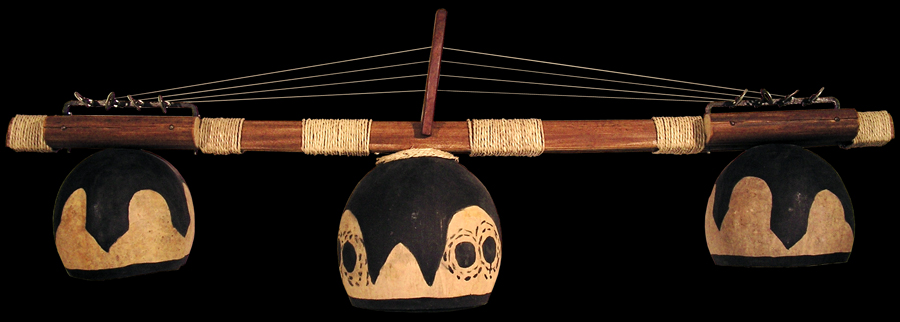
Mvett, also spelled mvet
The literature of Gabon has a relatively short lifespan. The older members of each tribe passed stories down to the younger members, retelling these stories for many generations. It wasn’t until the French arrived when written language became prevalent as well. However, it would take until the last 10-20 years before literacy rates would rise; today it’s about 89% (92.3% for men; 85.6% for women).  Even though there is a growing canon of newly written literature in French, there are “raconteurs” in Gabon working to keep the oral traditions alive.  Two of these traditions that are the most documented are the mvett of the Fang peoples and the ingwala of the Nzebis. The mvett not only refers to the musical instrument (similar to a berimbau of Brazil), but also the performer, and the style of epic poetry that is performed.

Bessora

A few of the more prominent Gabonese authors include Jean-Baptiste Abessolo (educator and short story writer), Angèle Ntyugwetondo Rawiri (novelist), Bessora (award-winning novelist, born in Belgium, daughter of a Gabonese diplomat), and René Maran (poet and novelist, born in French Guyana, lived in Gabon for a while).

Up next: music and dance

Thursday, August 7, 2014

FRANCE: ART AND LITERATURE


France is renowned for its contributions to the world of art. The earliest art is in the form of cave drawings. Some of the oldest and most famous of these are found in Pech Merle, Lascaux, Cosquer Cave, Chauvet Cave, and Trois-Frères Cave. Gold work and manuscript illumination were influenced by Celtic traditions of the fifth to eighth centuries. Romanesque art and Gothic styles were popular in French architecture from about 1000AD and 1200AD. Gothic painting didn’t appear until about 1200.

During the 1500s, Italian Renaissance influences on art began to seep across the border. Artists like Rosso Fiorentino, Nicolo dell’Abbate, Michelangelo da Caravaggio, Leonardo da Vinci, and others introduced adding mythological ideas into their art. As French artists moved through Classicism, Baroque, Rococo, and Neoclassicism movements, France and Paris especially was becoming a haven for artists all over Europe.
Renoir

After the French Revolution and the Napoleonic Wars, the face of French art changed drastically. Instead of being mostly influenced by Greek and Roman mythology and art, artists started looking beyond Europe to Asia and Africa. Probably the most prolific artistic style coming out of France is the Impressionistic movement.  Artists such as Claude Monet, Pierre-Auguste Renoir, and Edgar Degas paved the way for other artists to this day. The late 19th century brought another wave of art movements, such as expressionism and others, introducing artists such as Georges Seurat, Paul Cézanne, Paul Gaughin to the world and marking their place in art history and art museums. There were many artists who were born in other countries but moved to France to study art and ended up staying, such as Vincent van Gogh and Pablo Picasso.
Seurat was known for his pointillism. 
The 20th century brought forward the French counterparts of many of the modern movements: cubism, surrealism, avant-garde Dadaism (or perhaps, anti-art is the term), abstract art, expressionism, pop art, and everything in between and outside of it. Today, France has a plethora of art museums and art schools.  The Louvre in Paris is the most visited art museum in the world. The Musée d’Orsay also in Paris is another museum that ranks high on tourist must-sees. There are also many smaller museums showing works for a specific artist or a particular art period. In fact, there are even several textile and tapestry museums.
French literature is written in French, and mostly by people who are from France; however, writers from other French-speaking countries are considered Francophone literature. French literature dates back to the Medieval period; the most famous surviving pieces are epic poems and stories.

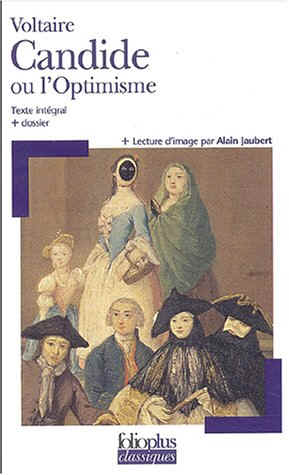
The 18th century brought along one of my favorite authors: Voltaire. He is most famous for writing Candide, and Zadig, or the Book of Fate, both of which I’ve read. I actually bought a copy of Candide when I was in Brazil so that I could have a copy in Portuguese. And of course, don't forget Leonard Bernstein's operetta of the same name (I have the soundtrack, too). Another famous name from this period of the Marquis de Sade, better known for lending his namesake to the word “sadism” or “sadist.” His most well-known work is Justine.
The 19th century would introduce many works that are now considered classics, many of which I read in college and afterwards. Some of my favorites include Honoré de Balzac (La Comédie humaine), Alexandre Dumas (The Count of Monte Cristo, The Three Musketeers [I’m reading this now]), Victor Hugo (The Hunchback of Notre-Dame [read it], Les Misérables [read it]), Gustave Flaubert (Madame Bovary [read it]), and Jules Verne (Twenty-thousand Leagues Under the Sea [read it], Around the World in Eighty Days [read it], Journey to the Center of the Earth).  Albert Camus is a 20th century writer that I enjoyed reading: I’ve read both The Stranger and The Plague. Gaston Leroux may not be a household name, but his work may be: The Phantom of the Opera. Collette’s novel Gigi was also made into a musical by the same name. One of my favorite 20th century French books is The Little Prince (or Le Petit Prince) by Antoine de Saint-Exupéry. I love this book and want to get a tattoo from this book. I also have this book in French, Japanese, and English.

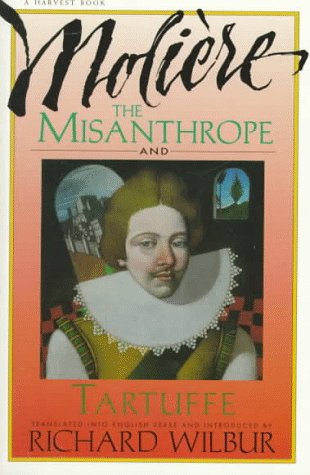
Molière is often considered one of the masters of comedy theatre, most famous for The Misanthrope (first performed in 1666). Pierre Beaumarchais is best known for his plays The Marriage of Figaro and The Barber of Seville. Mozart’s opera based on The Marriage of Figaro and Rossini’s opera The Barber of Seville remain to be the best-known versions of his plays. Edmond Rostand is probably best known for his play Cyrano de Bergerac, although his play Les Romanesques is best known by its musical version, The Fantasticks.

Of course, French writers also led their works toward the development of modern politics, philosophy, and science. Writers such as Blaise Pascal, René Descartes, Alexis de Tocqueville, and Jean-Paul Sartre were great influences on the current thinking of the time.
Up next: music and dance