Showing posts with label wooden masks. Show all posts

Wednesday, July 12, 2017

PAPUA NEW GUINEA: ART AND LITERATURE


One art form dominates when it comes to the art of Papua New Guinea: wood carving. Like in Africa, where the original people of this country came from, carved wooden masks are also commonly made here as well. These masks are tied to a number of religious purposes including masks designed for/against certain deities and ancestors.

The tongue sticking out just gets me.
Storyboards, like the ones I mentioned when I covered Palau, are an artistic way to depict the folklore and stories of the Papua New Guinean tribes. However, in other similar carvings, they make use of colors and decorate it with other natural elements like beads, feathers, grass twine, and shells. They also carve designs into their canoes as decoration.


One thing that binds much of their art is nature and the land around them. A variety of plants and animals are important representations in their indigenous religious beliefs. And since they have hundreds of ethnic groups and languages, there are hundreds of religious and artistic variations as well. The Sepik River Valley is one of the main areas in the country that has very deep traditional arts customs.
 
by Mathias Kauage
As far as modern artists go, there are several who have been quite successful in their field: Larry Santana (painter), Timothy Akis (batik, pen/ink drawings), and Mathias Kauage (woodcuts, drawing, painting; awarded Order of the British Empire for his contributions to Papua New Guinean art).
 
by Timothy Akis
Literature in Papua New Guinea on a whole really didn’t take off until the 1960s. The large part of literature up until the 20th century was of an oral tradition. With colonization and the introduction/establishment of English, it began to also be included as a language of communication. However, most writers write in both English and one of the many local languages spoken here.
 
Ulli Beier
Ulli Beier, a Jewish German writer and academic, helped establish creative writing courses and promote (or encourage, rather) Papua New Guinean literature. (He actually worked quite a bit doing similar literary projects in Nigeria.) Besides teaching at the university level and setting up a small poet society, he also helped establish the literary magazine Kovave. This magazine made it easier for up-and-coming writers to get noticed and published, like writer John Kasaipwalova (known for his satirical plays).


Other writers include Vincent Eri (famous for his 1970 novel The Crocodile; it was the first novel published in Papua New Guinea), Albert Maori Kiki (famous for his autobiography Ten Thousand Years in a Lifetime), Nora Vagi Brash (teacher, best known as a playwright), and Ignatius Kilage (4th Governor-General of PNG; famous for his novel My Mother Calls Me Yaltep).

Up next: music and dance

Wednesday, April 6, 2016

MALAWI: ART AND LITERATURE

Known as the “Warm Heart of Africa,” Malawian artists are definitely ones to show you their creative hearts. The earliest forms of art are its famous Neolithic rock paintings. The best example (perhaps because it’s the best preserved) is found at the Chongoni Rock-Art area, now listed as a UNESCO World Heritage Site. These paintings show the hunting and farming lifestyles of the ancient BaTwa people. 


Malawians have long preferred three-dimensional carving and sculpting to two-dimensional drawing or painting. Woodcarving not only had its practical functions in furniture and tools, but also in spiritual relics and honorary gifts to the community/spiritual leaders and as basic animal sculptures. Malawi has a wide variety of woods to work from; some are pretty common, while others are rare. 


Another item that is carved are masks. Wooden masks are not unique to this area alone; they’re commonly found across West, Southern, and Eastern Africa. But each culture has their own style and variation and are often worn ceremoniously. Typical masks here are made from wood and bronze and are adorned with feathers, beads, cloth, and even hair. They’re often worn by supposedly secret male-only groups (shhh, don’t tell anyone) and tied to their religion. 


Members of the community also create textile crafts, and these skills are passed on from generation to generation. People will often specialize in one particular skill like cloth dying or weaving and will work together providing the skills for others. One style many Malawian textile artists use is a wax print in designing their cloth. 

Linda Gabriel, poet
 
The earliest forms of literature were stories told orally. In Malawi today, most literature is written in English. During the first couple of decades after the country gained its independence, there was a push for a literary community. It was mainly the feat of some enterprising young college students at that time. And it did lift off of the ground. However, times have changed.

You should check out this blog post for the story behind this photo here.
 
Today with growing poverty and a dire need to only pay for the essentials, books become luxuries. Besides, with fewer children being able to afford to attend school, the literacy rate struggles around 64%. Publishers are few, and many are discerning as to what they publish in order to get the most out of what they think will sell. What’s being sold tend to be textbooks and NGO pamphlets as opposed to novels and poetry (novels and poetry are still sold, but not quite at the rate of the others). 


Most people get their books from the National Library Service; there’s one branch in all the major cities. However, the majority of their books are either donated as unsold copies from Western book publishers or used books from Western schools and such. 

Q Malewezi

Spoken poetry is quite popular in Malawi. Perhaps it’s a tie to being entertained; perhaps it’s a tie to their oral history. Whatever the reason, people are interested. There are also literary clubs popping up throughout Malawi, mostly tied to Chancellor College. Some established writers started various literary clubs, and often bring in authors from throughout Africa to talk to new writers not only about the ins and outs of how to write well and storytelling but the secrets of getting published and marketing their book as well. 
 
Shadrech Chikoti

There have been several influential writers not only in the literary culture of Malawi but in promoting literacy and writing in general.
One well known poet from Malawi is Qabaniso Malewezi. Another name that seems to keep popping up is Shadrech Chikoti. As a successful short story writer and novelist, his stories “The Beggar Girl,” “The Baobab Tree,” and “The Trap” have won several awards. He also started The Story Club as a means of bringing together writers and critics to talk about and promote Malawian literature. It has grown so much that there are actually two branches: one in the capital Lilongwe and another in the northern city of Mzuzu.

Up next: music and dance

Thursday, August 21, 2014

GABON: ART AND LITERATURE


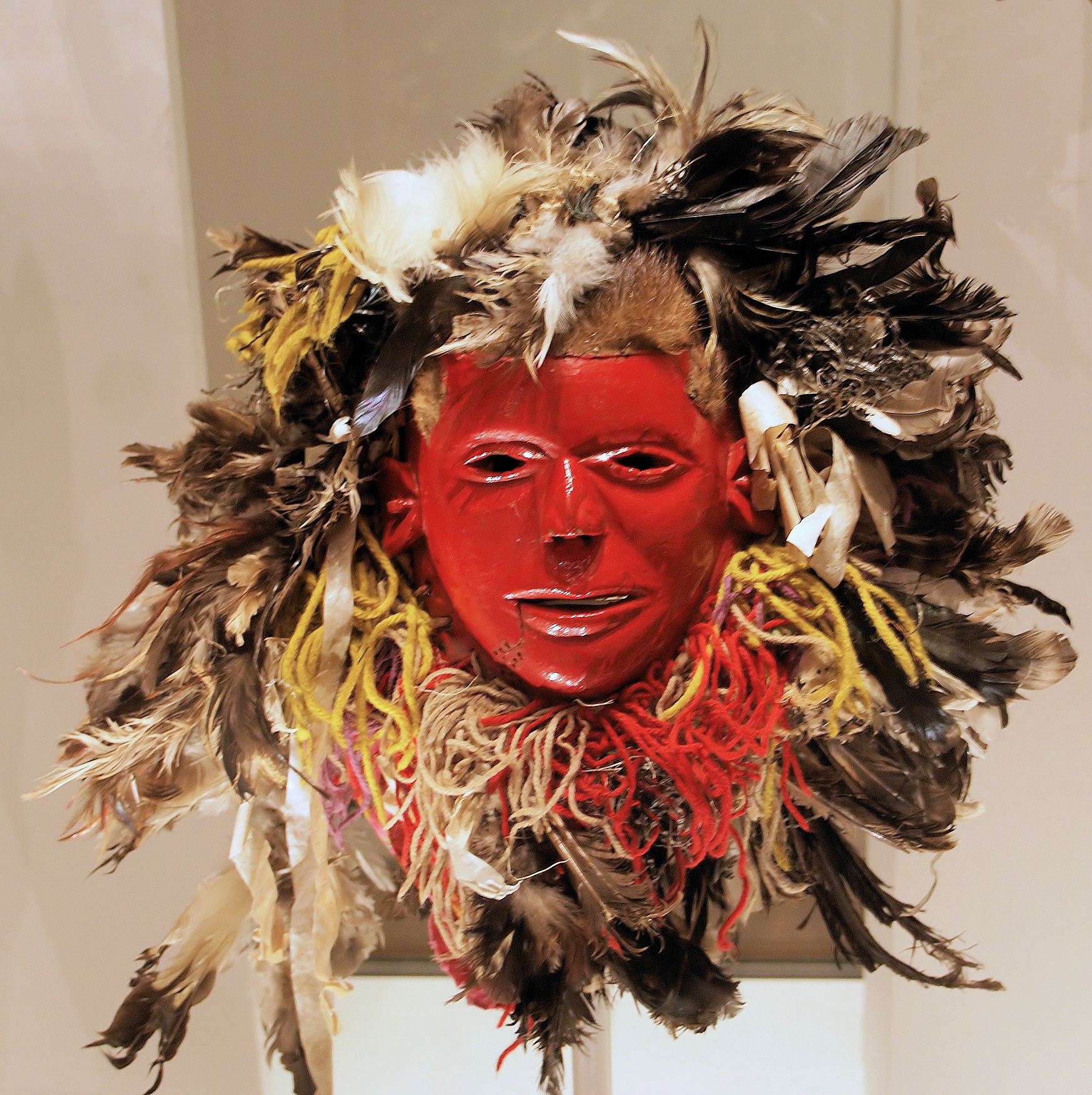
Gabon is globally known for its wooden masks. Each ethnic group has its own set of masks, with different masks representing different purposes. Masks are generally used ceremoniously, whether it’s for marriage, birth, funerals, harvest season, and other life milestones.  Although it would be relatively easy to buy modern materials, many of today’s mask makers stick to traditional methods by using local woods and materials to create their work. One of the most famous types of masks are the n’goltang created by the Fang tribes.


Not only do the Gabonese make these elaborate masks, but they’re also known for their face paint as well. The colors used are based on natural dyes, mainly white, red, and charcoal.

 Face paint is often used in Bwiti ceremonies. And apparently grass and leaves on your head is cool too. 

Reliquary figures of the Kota are another art form that has been preserved. Also called Bakota, their communities reside in the northeastern regions of Gabon.  These reliquary figures, mostly made from copper or brass, are an important feature in the Bwete religion.  These figures are viewed as guardians.


Every village values craft work because these are the items used in everyday life. Women – some professional craft workers, some not – make everyday objects with designs unique to their region such as mats, bowls, wall coverings, and other items for their families and the community.

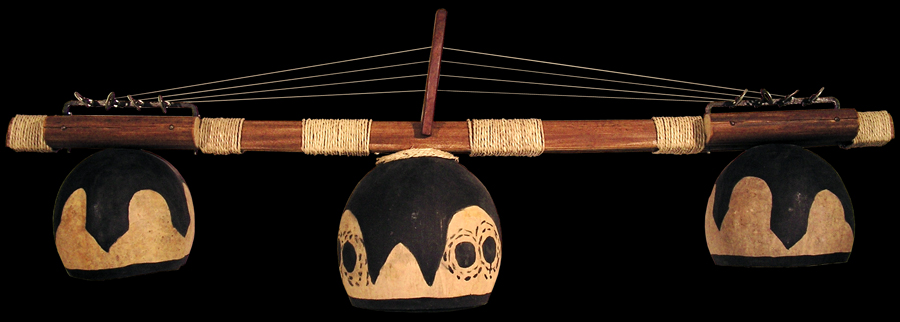
Mvett, also spelled mvet
The literature of Gabon has a relatively short lifespan. The older members of each tribe passed stories down to the younger members, retelling these stories for many generations. It wasn’t until the French arrived when written language became prevalent as well. However, it would take until the last 10-20 years before literacy rates would rise; today it’s about 89% (92.3% for men; 85.6% for women).  Even though there is a growing canon of newly written literature in French, there are “raconteurs” in Gabon working to keep the oral traditions alive.  Two of these traditions that are the most documented are the mvett of the Fang peoples and the ingwala of the Nzebis. The mvett not only refers to the musical instrument (similar to a berimbau of Brazil), but also the performer, and the style of epic poetry that is performed.

Bessora

A few of the more prominent Gabonese authors include Jean-Baptiste Abessolo (educator and short story writer), Angèle Ntyugwetondo Rawiri (novelist), Bessora (award-winning novelist, born in Belgium, daughter of a Gabonese diplomat), and René Maran (poet and novelist, born in French Guyana, lived in Gabon for a while).

Up next: music and dance