Showing posts with label Bohemia. Show all posts

Sunday, June 4, 2017

PAKISTAN: MUSIC AND DANCE


Pakistan’s music has pretty much borrowed the musical traditions from everyone around it: from India and South Asia to Central Asia to the Middle East as well as various Western styles. 

 
And because Pakistan is in the middle of many religious hotspots (not to mention they created their country specifically as a Muslim state), it’s no wonder that religious music is a significant portion of their traditional music. One of the most widely known types of religious music is called hamd. While it’s mostly used with Islamic texts, it’s also used by Christians in Pakistan as well. Hamd is actually a type of sung poetry that is aimed at expressing the singer’s love for Allah (or God). Naat is a similar form, except that it sings praises and love to the Prophet Muhammad. Qawalli is a type of music from Chishiti Sufis used as devotional music. This music is supposed to bring people to a spiritual trance-like state, known as wajad.


In other traditional forms, one of the big ones is called ghazal. The word is related to the word “gazelle.” This musical style consists of a poetic style of rhyming couplets, even though there are many strict rules to the actual composition of it. At the heart of the ghazal, the lyrics essentially point to the idea that even though there may be a separation or loss of a lover, there’s still beauty in that love. Typically, women have been excluded from qawalli. Many women have formed their own “women-only” gatherings to perform naats in these women-only dance and music parties.


Instruments used in Pakistani vary between a number of percussion instruments, wind instruments, and both plucked and bowed string instruments. Here are a few instruments you’ll hear: tabla (a set of two drums), alghoza (a pair of 6-holed flutes, one used as a drone, the other used as the melody), sitar (a guitar like instrument with a 4-ft long neck attached to a gourd), siroze (a kind of stringed instrument), a dhol (two-headed drum), chimta (a pair of percussive fire tongs—yes, that’s right), ghara (a clay pitcher used as a percussion instrument), iktara (a one-stringed plucked instrument), rubab (plucked lute with frets on a hollow body covered in skins), sarinda (kind of similar to a rubab), sarangi (stringed instrument played with horsehair bow), and harmonium (three-octave keyboard instrument).


Folk dancing in Pakistan is often performed to celebrate the dynamics of life changing events: weddings, birth, deaths. When it comes to dances, each ethnic group has their own specialties and variations. Punjab dances include the bhangra (pretty well-known), the luddi (danced at weddings), and the giddha (uses hand-clapping). In Balochistan, you’ll find the jhumar (slower, rhythmic dance) and the chap (male palm-clapping dance done for weddings). Some Sindh dances are dhammal (done at Sufi shrines), ho jamalo (well-known at parties), and jhumro (done by town ladies to honor a good crop). 


When it came to modern music, Spotify had quite a few Pakistani artists. The first one I listened to was Ahmed Rushdi. It definitely reminded me of the musical styles of India in its vocal lines and instrumentation. The song “Ko Ko Koreena” was a really big thing when it first came out. In fact, it’s often considered one of the first “pop songs” in Pakistan. Nazia Hassan was another musician/singer from this early time period. Her music has more of a Western 1970s pop sound to it.


Ali Zafar’s music has a traditional sound on top of what sounds like a quasi-modern drum beat. It has elements of electronic music, which gives it a dance feel to it. I thought it was kind of catchy. Hadiqa Kiani is as close to what I came to as pop. Her music definitely has some traditional styles and instruments used in it, but it’s clearly influenced by Western pop music. She’s got a couple of slower songs, but I’d say that most are pretty upbeat.


One of the more popular musicians is Atif Aslam. His music is clearly in the rock category, although there are songs that span a range of what rock means: from Bryan Adams-esque to Green Day-esque. He had several songs that were pretty catchy. Faraz Anwar is another rock musician, but his music leaned more toward a Yngwie Malmsteen-style merged with quasi-gothic metal rock maybe? I’m not even sure what specific genre you’d consider this. But I definitely feel like I should be wearing a black T-shirt and that this is probably way better live.


I would confidently place Junoon’s music as indie rock. Still utilizing traditional drums and even some vocalizations (with quarter tones and trills), but still strongly steeped in rock form. Noori is another band I really liked. Still in the indie rock category, but their music sticks out to me for being seemingly more Western than other bands. Perhaps not quite as high on the technical aspect of music, but good to listen to nonetheless.


I did find a hip-hop group called Bohemia. They had some good rhythms and flow; I liked what I heard. Another rapper I came across is Adil Omar. He rapped in English. Definitely based on traditional music styles, but updated and mixed. I liked this. Whatever he did is working.


Up next: the food

Saturday, April 4, 2015

INDIA: MUSIC AND DANCE


When I was in college, part of the canon of coursework for music majors was to take an ethnomusicology course. We didn’t get through the entire book, but we did discuss Indian music at length.  I think it was one of my first eye-opening looks at non-Western music. It was the first time it ever really occurred to me that this music wasn’t “weird” or “out of tune,” but that the world of music extends far beyond the concepts and practices of Western music (which is basically the theories and practices of only a handful of Western European countries).  

Ravi Shankar with his sitar.
Indian classical music is made of notes (swara) and microtones (shruti, or notes that are less than a half-step) as well as ornamentations (alankar). It also utilizes a type of improvisation built into a set of rules (ragas) and a set of rhythmic patterns in the percussion (tala). (I remember one of my assignments was to write a basic raga.) There are two main forms of Indian classical music. The music from the southern region is known as Carnatic music. This style tends to be more melodic and often utilizes variations of the main melodic line; however, the compositions themselves tend to be more fixed and avoid much improvisation. Music from the rest of India (the north, central, and eastern regions) is referred to as Hindustani music. Hindustani music is derived out of Hindu traditions and one characteristic of this style is the use of singing. It’s this type of music that is known for its improvisation and other features most associated with Indian music.

India has many traditions stemmed from its folk music. Tagore Songs are songs that were written by Rabindranath Tagore, the famous Bengali poet, artist, composer, and musician. Ganasangeet is a type of folk song that is steeped in social commentary; much of what is known was written during the British occupation. 


Dance is very important and highly tied to various folk musical styles and Indian culture.  Lavani, stemmed from the word for love, is a type of dance and style of music. This quick-tempo dance is mostly performed by women, using their saris as a prop. Dandiya (also called Raas) is a type of Gujarati dance where the dancers use sticks during the performance. You’ll see a lot of dance in Indian films – most Indian films are in the form of a musical. I’ve noticed that the dance in some of the most modern movies pulls styles that borrow from a variety of cultures: American hip-hop dance, Zumba and other Latin dances as well as their own traditional dance styles.


Just as there are style differences between Carnatic (southern Indian) music and Hindustani (northern Indian) music, there are also some differences in instrumentation and what instruments are used as well. Common instruments used in Carnatic music include the violin, the harmonium (a type of portable pipe organ), the venu (bamboo flute), the veena (a plucked string instrument, like a bowl-shaped lute), the gottuvadhyam (a 20- or 21-stringed fretless lute), and several types of percussion instruments. Hindustani music includes several of these but also the sitar (and several other similar instruments), the santoor (a 72-string hammered dulcimer in the shape of a trapezoid), the sarangi (a short-necked bowed string instrument, looks a little like an electric violin), a few different types of flutes, several types of drums and percussion instruments, and the shehnai (a wooden double-reed oboe with a metal bell on the bottom). 


Likewise, film music is a very important section of Indian music scene. Classical musicians, like the famous Ravi Shankar and others, found plenty of work in the film industry. I’ve noticed that many of the songs that make it into a film often rely heavily on orchestral strings and a complete battery of Indian percussion instruments; however, they also modernize their songs with synthesizers and often borrow from well-known international musical styles, like hip-hop and rock. Film composers (like A.R. Rahman) and film musicians also compete to get top films.

American and European musicians have had a crush on Indian music for a long time. There are numerous rock bands during the 1960s and 1970s who borrowed samples and used Indian traditional instruments in their own songs. George Harrison of the Beatles played the sitar in a couple of their songs, like “Norwegian Wood (This Bird Has Flown)” and “Within You Without You.” (Harrison’s sitar teacher was none other than Ravi Shankar.) The Grateful Dead and The Rolling Stones could not escape its influences as well. A plethora of hip-hop artists have used samples of Indian classical music including Timbaland, Truth Hurts, The Black Eyed Peas, and Jay-Z. 


Most of the pop singers have ties to film music. Some of the top names have made it to a moderate international recognition: Asha Bhosle, Bally Sagoo, Sukhwinder Singh, Lucky Ali, and many others. 


India has also produced a number of rock bands. I listened to a band called Indus Creek, which I really kind of liked their indie rock style. The band Kryptos is definitely a metal band with riffs that sound a lot like Megadeth. Motherjane is another metal band that incorporates Indian classical drumming into their music with melody lines that sound like 1970s US classic rock. As much of a mishmash fusion of styles this seems to be, it kind of works. Avial is a hard rock band that definitely makes use of the drone note influence from their classical instrumentation. I kind of like them. I never think of rock bands when I think of Indian music, but it has left me pleasantly surprised. I liked much of what I heard. 


And of course, there is a growing hip-hop movement, although some of what was labeled as “rap” is not necessarily be “rap,” but that’s ok, I guess.  Baba Sehgal is considered the first Indian rapper; however, when I listened to the album Abb Main Vengaboy, there was far more singing than rapping. I also listened to Rishi Rich’s The Lost Beats.  While it may not be correctly classified as rap by any means, it’s certainly a good album to showcase his mixing skills. I liked it. And maybe there is rapping somewhere on the album; I don’t know (I just skipped around here and there), but I could definitely see someone rapping on top of many of these songs. Raghav’s Storyteller album is a really good R&B album; I liked what I heard and want to listen to it more in depth later on. FINALLY, I came across an actual rapper: Bohemia. This Pakistani-American is best known for rapping in Punjabi. Another actual rapper I came across is IshQ Bector. Although he’s Canadian, he has sung on a number of film soundtracks and has acted in a number of televisions shows.

Up next: the food

Saturday, October 19, 2013

CZECH REPUBLIC: THE LAND AND THE PEOPLE


After I graduated from college a little over a decade ago, I had to figure out what I wanted to do with my bachelor’s degree in general music (non-teaching) and a minor in linguistics and English and Teaching English as a Second Language (although the last two were undeclared). I found this program – I forget the name now – where I could travel to one of three European cities to take a 4-6 week course that taught how to teach ESL and then they’d place you in a school somewhere to teach English. Since I was fresh out of college, I wasn’t able to come up with the money required for housing, tuition, and airfare to get to Europe. But when I was thinking about it, I wanted to do the program in Prague, Czech Republic. I was so serious about it, in fact, that I bought myself a book on learning Czech (I still have it on my shelf). I really do love the Slavic languages – I may start learning Czech next, right after I master Portuguese and Spanish. And as a music major, one of my all-time favorite composers is Antonin Dvorak, a Czech.


The Czech Republic lies in central Europe, surrounded by Germany, Poland, Slovakia and Austria.  The country itself is landlocked, but several major river systems and their tributaries meander their way through the country: the Elbe, Vltava, Ohre, Danube, Morava, Thaya, and Oder. These rivers either drain into the North Sea, Black Sea, or Baltic Sea. Rolling hills, forests, and farmland cover most of the countryside.  The climate is generally temperate with hot, rainy summers and cold, snowy winters – not unlike most of the Midwest United States.


The area now known as the Czech Republic once was the independent states of Bohemia, Moravia, and Silesia.  I’ve often used the term “bohemian,” meaning someone (especially artists, musicians, writers, etc) who live unconventionally.  (Actually, the term was originally French, in reference to the Romani people who they thought were from Bohemia. Some may have been, but many of the Romani or Roma people were from Romania and Bulgaria and other areas. The English term “gypsy” was from a belief that these tribes originated in Egypt, from a Middle English word “gypcian.”) The famous Duke of Bohemia, Wenceslaus I, is the subject of the Christmas carol “Good King Winceslaus.”  He was murdered by his brother in 935 AD after an argument and subsequently overtook the title.  The Black Death which took its toll on Europe during the mid-1300s, completely devastated Bohemia; some estimates say 10% of the population perished in this horrific outbreak. 


During the 1500s, it fell under the Hapsburg Empire, and later the Austrian Empire, and then Austria-Hungary. After WWI, these states together became Czechoslovakia (which is how I learned it growing up).  During WWII, Germany invaded Bohemia and Moravia and turned it into a protectorate.  The Nazis were brutal to the Czechs, killing many and shipping other out to kill them in other countries.  So it was natural that there was an anti-Nazi resistance towards their occupation.  Even after WWII ended, Czechoslovakia remained a Communist state until 1989.  The term “Velvet Revolution” is often used when describing the non-violent transition from a single-party state to a democracy.  Four years later, Czechoslovakia itself will be no more, but as the separate countries of the Czech Republic and Slovakia, also separating peacefully. Since then, the Czech Republic has enjoyed a growing economy and high quality of life.


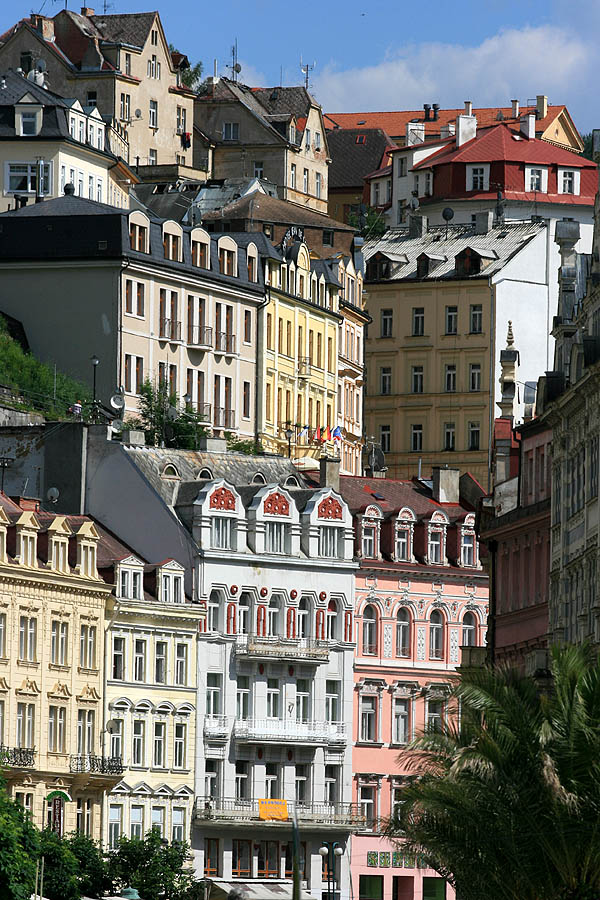
Sitting on the Vltava River, the capital city is Prague (called Praha in Czech), a city of around 2 million people if you count the larger metro area.  Prague is known for its architecture – from Gothic to modern – and especially for its cathedrals (one of its nicknames was “City of a Hundred Spires.”) Prague is not only the center of government, but also a center for the arts: from music and theatre to art and literature.  

Prague Castle
The Czech Republic is highly developed and has a high-income economy.  In comparison with other post-Communist states, the Czech Republic is one of the more stable ones today.  Its infrastructure is vastly improved with airports, railways, and extensively paved roadway systems. They also enjoy having one of the fastest Internet speeds and have the largest number of Wi-Fi subscribers in the EU (one more reason I should retire to live in Prague). The Czech Republic has long been a hot bed for scientific research.  Some of the more famous Czech scientists include such celebrities as Gregor Mendel (“father of modern genetics,” the only part of high school Biology that truly interested me), Jakub Krystov Rad (inventor of sugar cubes), Jan Jansky (discovered the classification of blood types), Josef & Karel Capek (invented the word “robot” – not exactly scientific for coining a word, but I’m including it), and Otto Wichterle & Draholav Lim (inventors of the modern contact lens – I thank them everyday).  Tourism is pretty important as well – the country in general has a fairly low crime rate. Castles (they have over 2000 of them!), cathedrals, museums, theatres, puppet festivals, and beer festivals are all pretty popular destinations. 


The official and most widely spoken language is Czech, a West-Slavic language. Before the 20th century, it was known as Bohemian in English. It’s closely related to and mutually intelligible with other Slavic languages. Actually, there’s a variety of Czech spoken in Texas which I had no idea existed, but apparently there were a lot of Czechs who immigrated there during the late 1800s.  However, there are a lot of other languages that are officially listed a minority languages: Slovak, German, Polish, Belarusian, Bulgarian, Croatian, Greek, Hungarian, Romani, Russian, Rusyn, Serbian, Ukrainian, and Vietnamese.  The vast majority of Czechs describes themselves as indifferent to religion, or just simply believes in a spiritual or life force outside of any kind of organized religion.  Of the remaining religious folk, the more people adhere to Catholicism while a smaller percentage is Protestant.


This country is surprising, and I’m in awe of what I didn’t know. For instance, 90% of Czechs graduate from high school, compared with only about 75% of Americans (and even the highest ranking state, Vermont, only graduated 85%) And I’m embarrassed to say that’s a 40-year peak for us.  Unfortunately, Czechs also have the second-highest death rate for cancer in the EU – but on the plus side, the Czech Republic has the most hospital beds per inhabitant in the EU.  Czechs also have a serious passion for mushroom hunting. I know a few who do this, but I never have gone mushroom hunting myself. I would have no idea what I’m looking for. I do know that I’m looking forward to making kolaches. There’s a place on the north side of Indianapolis called Kolache Factory, but I never went inside because I didn’t know what a kolache was. Now, I’m waiting to go after I make my own. I’m very excited about writing on the Czech Republic, the world’s largest consumers of beer.  I end this post as I grab me another cold one from the fridge.


Up next: holidays and celebrations