There’s a corner of
Africa where deserts blow across ancient roads. Trod on only by a few, much of
this land is as it has been for centuries: untouched. Ancient languages
intertwine with languages that were brought there. In a way, it’s the story of
Africa in general. But what makes Namibia different? Plenty.

Namibia is named
after one of the world’s oldest deserts, the Namid Desert. This desert runs
along the coast from Angola, across Namibia, and into South Africa. When the
Germans occupied the area, it was known as German South-West Africa, or later
as South-West Africa.

Located in southern
Africa, Namibia is surrounded by Angola to the north, Zambia to the northeast,
Botswana to the east, and South Africa to the south. Namibia actually is only a
hop, skip, and a jump (almost literally, although it might be a few hops,
skips, and jumps) from Zimbabwe along the Zambezi River. It also borders the
Atlantic Ocean to the west. Generally, the climate is arid to semi-arid
considering that the country is pretty much variations of desert. A particular
current in the Atlantic Ocean—the Benguela current—is responsible for the
lower precipitation among other weather patterns. Inland winds also affect
their climate, and they also experience a rainy and dry season.
 |
| The international face of a grandmother with a baby (taken of the San tribe). Some things are universal. |
Even before the
Bantu migration into southern Africa, the San, Nama, and Damara tribes lived in
and around what is now known as Namibia. Several centuries later, the Oorlam peoples,
a mixed race tribe who are related to the Nama, also began to establish their
place in Namibia. Not everyone was cool with them moving into the area, and
there were skirmishes and battles over it. Technically speaking, the Portuguese
were the first Europeans to land in this area. However, the Portuguese didn’t
really stay in the area long nor did they claim it for Portugal. The first
Europeans to come in and claim it as theirs were the Germans when they stepped
in to quash the tribal fighting during the early 1880s. The Germans renamed it
German South-West Africa (how original). Even though, the British took the port
of Walvis Bay as an exclave of South Africa, which they were administering at
that time. A few of the tribes decided they had enough of the Germans and
fought against them. Of course, the Germans didn’t take that too well and came
back like gangbusters: they killed off half of the Namaqua tribe and over
three-quarters of the Herero tribe. After WWI, the Germans handed over Namibia
to South Africa to do with what they wanted. It became more or less a “fifth
province” for them, and apartheid was extended into Namibia as well. During the
1950s and 1960s, there was quite a bit of talk of Namibia declaring its
independence from South Africa, especially since many African nations were
breaking their colonial ties during this time period. It wouldn’t be until 1988
when they finally broke free, even though South Africa would hold onto Walvis
Bay until 1994. For the most part, life after independence hasn’t been too bad,
with the exception of a few key events (like the refugees from Angolan Civil
War spilling over the border and a few dissenting political groups here and
there).

Namibia’s capital,
Windhoek (pronounced something like VINT-hook),
is almost right in the geographic middle of the country in the Khomas
Highlands. Before colonization, the city was known by its Herero name
“Otjomuise” and its Khoekhoe name “ǀAiǁGams.”
(Just a heads up-- Khoekhoe is one of the several dialects of what colloquially
known as “click languages.” They utilize symbols like | and ! to indicate
different kinds of clicks.) Both of these names refer to its hot springs. The
city began to grow and expand during the mid-1800s, and today stands as the
center of government, commerce, media, education, entertainment, sports, and
culture. Even as the country’s largest city, it only has about 326,000 people.

Because of
Namibia’s historical and cultural ties with South Africa, their economy also
remains tied with the country. The largest economic drivers are manufacturing,
mining, agriculture, and tourism. Bloomberg has named Namibia as one of the Top
Emerging Markets, even though the cost of living tends to be higher due to the
fact that much of their food supplies and goods need to be imported in.

The vast majority
of Namibians are Christian, and of those, about three-quarters are Protestant
(and half of those are Lutheran). However, like in many areas of Africa, there
are many who adhere to their indigenous beliefs at the same time. A number of
Christian denominations are represented in Namibia, along with a very small
Jewish community.
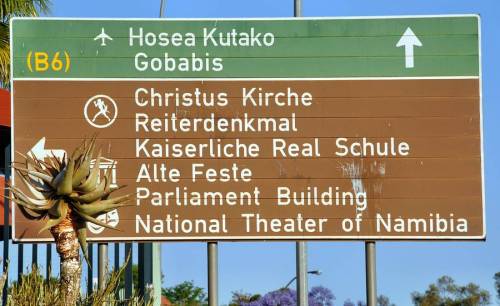
Before 1990, there
were three official languages: English, German, and Afrikaans. But then in true
sibling fashion, they thought they couldn’t be the same as South Africa. In the
end, now English is the only official language (even though, like, 3% of the
people speak it at home). Far more people speak German or Afrikaans at home.
These languages and ten other commonly spoken languages are listed as
Recognized Regional Languages.
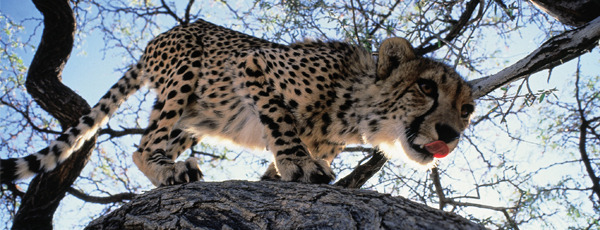 |
| Even in the wild, no cat can resist the sound of a can opener. |
For those who love
ecotourism and the great outdoors, Namibia is your place. Its population
density is one of the lowest in the world (second only behind Mongolia); it’s great
for people who hate neighbors. It’s also practically free of malaria and has
over 300 days of sunshine per year. Namibia has several national parks and
protected areas that promote conservation for both flora and fauna. They’re
especially known for their animal preserves, especially for elephants and
cheetahs. From canyons to dunes, Namibia’s landscape has a lot to offer. So,
let’s see what their people and culture is about.
Up next: art and
literature


