Showing posts with label landscape artists. Show all posts

Thursday, March 19, 2015

ICELAND: ART AND LITERATURE


Much of Icelandic art, especially early Icelandic art, reflects their pristinely bleak landscape and their mythology. Icelandic mythology is so closely related to Norse mythology that it’s pretty much the only thing that comes up when you search for it. Many of these gods and characters from Norse mythology are fairly well known: Thor and his hammer (who is also the namesake of the word “Thursday”); Odin with his one eye and pair of ravens who brings him information and gave the world the runic alphabetic; Freyja, a sorceress who wears a feather cloak; Loki, a shape-shifting trickster god; and many others. Many of these gods, demi-gods, and stories are depicted in Iceland’s earliest art. It’s not a mythology I’m too familiar with, but I find it fascinating. I think I’d really like to read more about it next.

 
With a dichotomy of mountains and volcanic lakes, it’s the perfect backdrop for landscape painting, which is certainly a popular style. Iceland has some of the most remote land in the world, much of it untouched by very few humans. There are many artists that have emerged who tried to capture the beauty of this island country: Thórarinn Thorláksson, Ásgrímur Jónsson, Jóhannes Kjarval, Jón Stefánsson, and Júlíana Sveinsdóttir.  During the early days, many artists went to study in Copenhagen and brought back their newly-acquired skills to Iceland. 
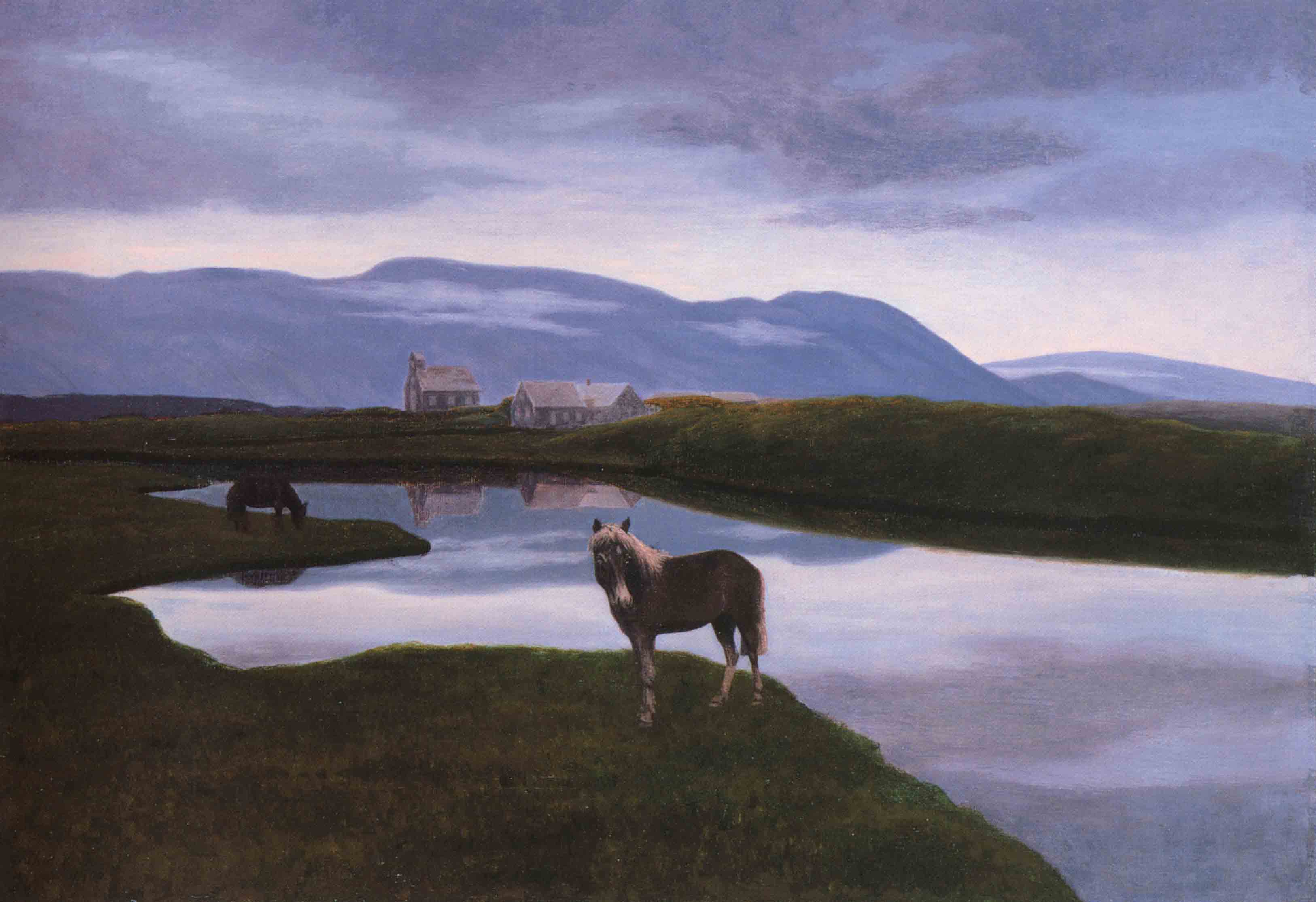
by Thórarinn Thorláksson
 

Following European trends in the art world, some Icelandic artists began to delve into abstract art during the mid-20th century.  Other artists gravitated toward a variety of modern styles such as cubism and fauvism. Of course, after a while, artists started to veer back to figurative art.  Svavar Guthnasson, Nína Tryggvadóttir, Gunnlaugur Scheving, Louisa Matthíasdóttir, and Einar Hákonarson are some of the more prominent artists of the 20th century.

I have no idea what this is, but it looks terrifying. (It might be a nightmare rendition of a walrus.)
 Early Icelandic literature was closely related to Old Norse literature. In fact a lot of it was written in Old Norse. Like much of the literature during this period, different forms of poetry was pretty much the most prominent form of literature. In Iceland, there were three main styles of poetry that emerged. 

The Eddas were important Scandinavian documents that were divided into two parts: the Poetic Edda, which were a collection of poems and stories from about the 10th century, and the Prose Edda, a collection of Norse mythological stories and Icelandic poetry. 

Skalds were Icelandic poets who mainly wrote about kings and nobility.  These poems were generally thought to be historically accurate since no one at this time would ever think about writing something untrue about their leader. (My, how things have changed, haven’t they?)
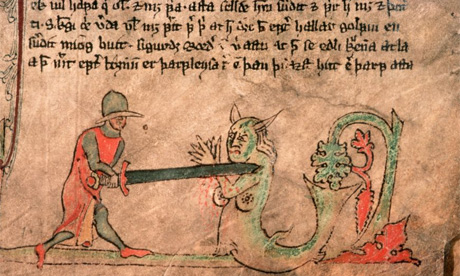
After this guy gets done, he can go attack that "walrus" above.
Sagas were long, extended poems that told epic tales of Viking voyages, historical battles, exploration, etc. Between the 9th and the 13th centuries, these sagas were the main source of information regarding the history of this area, even though sometimes the authors would add in some mythological features into the storylines. However, I’m pretty sure that most people can figure out that dragons don’t exist, so this part is clearly an embellishment. (Perhaps Brian Williams and Bill O’Reilly could’ve learned this better.)
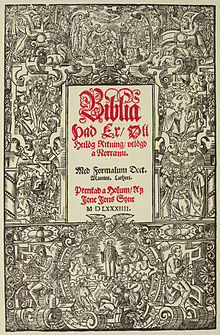


The first Bible translation was completed during the 16th century, as was a translation of John Milton’s “Paradise Lost” a couple centuries later.  (I read “Paradise Lost” many years ago, along with “Paradise Regained.” If you like long, epic poems steeped with deep religious themes, then by all means, read it. I read both, crossed them off my list, and moved on to books I enjoyed far more.)  There was a rise in sacred poetry as well as rímur, which is an epic poem that consists of rhymed alliterative verses of 2-4 stanzas.

 Starting in the 1800s, Iceland saw a literary revival. Jónas Hallgrímsson was considered to be the father of the short story in Iceland, and Jón Thoroddsen published the first novel here in 1850.  The romantic period was popular in Iceland as it was in other areas of Europe, and it was followed by realism and naturalism.  Einar Benedictson was a notable neo-romantic poet.  However, many Icelandic writers began writing in Danish during the 20th century including Halldór Laxness, the recipient of the 1955 Nobel Prize in Literature.  These days, crime novelist Arnaldur Indridason has reached international success with his works.  I do love a good crime novel. I think I’m going to have to see if my library (or the Kindle store) has any of his novels.

Up next: music and dance

Thursday, April 11, 2013

CANADA: ART AND LITERATURE


The indigenous peoples of Canada, now called First Nations, were the first producers of the arts as well. The most well known works from various peoples are the iconic totem poles. Not all of these cultures erect totem poles. Totem poles were mainly built by the tribes who lived in the Pacific Northwest, centered in and around British Columbia. Its use also spread south into areas of the US states of Washington as well as north into Alaska.  Most totem poles take about 6-12 months to complete, and the designs have different meanings: to tell a story, commemorate an important person’s life, etc.  Totem poles weren't considered sacred at all. There were even some called “shame poles,” built to ridicule someone or publicly call them out for things like unpaid debts, cheating, other scandals, etc. It was more or less the Hearts & Darts of their world.


Early art in Canada (after European arrival) was influenced by the church primarily.  Later, there was a period when the British soldiers who were stationed in the remote posts of the wilderness would paint the landscape and people they encountered during their time off which were sold back in Europe.

It would be really hard to discuss Canadian art without mentioning the Canadian Seven, a group of seven artists who painted mostly landscapes of the Canadian countryside. Their style was mainly large paintings that included bright colors drawing attention between light and dark. Although later the group expanded its membership to twenty-eight, the original seven members were Franklin Carmichael, Lawren Harris, A.Y. Jackson, Frank Johnston, Arthur Lismer, J.E.H. McDonald, and Frederick Varley.
 
Franklin Carmichael, "Mirror Lake"
Abstract art, non-objective art, and other forms of contemporary art (“art for art’s sake”) started to take root during the 1920s and 1930s. Today, there are a variety of mediums, and many use modern technology as a means of producing art, such as graphic design, photography, etc. There was also a return to regionalism and what they identify as a truly Canadian identity and tend to mix it together with European and multicultural influences on their art. In a way, their art mimicks what they see around them.


Canadian literature (called CanLit, like British Literature is called BritLit) is pretty much classified one of two ways (or both, I suppose if you want to really complicate things): either by region, or by genre. My search brought me to Canadian comedy, something which I’ve never really thought about. When I took looked at it analytically – as I do with everything – it tends to be built around satire (as in quasi-anti-Americanism, which I probably would find hilarious.  But we give it back, like the song in the South Park movie “Blame Canada”, so it’s all good), or absurdism (as in The Kids in the Hall, which helped me get through college), and even sometimes the grotesque absurdism of Tom Green (every country has one). Several comedians came out of Canada, such as Dan Aykroyd, Martin Short, and Mike Myers who became famous on Saturday Night Live as well as a myriad of movies. And we can’t forget the slapstick comedy of The Red Green Show (touring Canada during Fall 2013 and US in Spring 2014!) Please YouTube it if you have no idea what I’m talking about.


There are several Canadian writers who have soared to international fame. Among the most famous names are Michael Ondaatje (author of The English Patient), Margaret Atwood (author of The Handmaid’s Tale), Yann Martel (author of one of my favorite books, Life of Pi), Alistair MacLeod (who has ties to my home state of Indiana: he received his PhD from Notre Dame and taught at Indiana University for three years – always looking for those six degrees of separation). 


French-Canadian literature is also prevalent, especially in Quebec as well as other areas where French is spoken. The book L’influence d’un livre by Philippe-Ignace-Francois Aubert de Gaspé is often regarded as the first French-Canadian novel. However the period between WWI and WWII proved to be the rise and metamorphosis of French-Canadian literature into contemporary genres, including topics in psychology, metaphysics, philosophy, and sociology. Melodramas and comedies emerged during this time as well. Probably one of the most well-known authors would be Acadian author Antonine Maillet. In 1979, she won the Prix Goncout, a prestigious award given for the best in French literature for her novel Pélagie la Charrette, making her the first non-European to win the esteemed prize.


Up next: music and dance

Wednesday, July 18, 2012

THE BAHAMAS: ART AND LITERATURE


If there’s one word that can describe the cultural arts of The Bahamas, it would be vibrant. They put 110% into everything they do, adding life and color to the world around them.

When it comes to visual arts, there are several types of art you’ll find most common. Straw weaving goes back centuries to when they depended on the baskets and hats they made for day-to-day life. Baskets were necessary to carry fruits and fish and to store other dry goods. There is a particular method of weaving that makes them fairly sturdy. Across the islands, they all use the same methods of plaiting the straw, mostly from the silver palm. These methods have been passed down from generation to generation. Today, these straw goods are made mainly for tourists. I don't care -- this bag is cold!


The gorgeous landscape attracts many artists from all over the world, making it a haven for canvas painting. Some of the more famous painters to come from The Bahamas are Amos Ferguson, Eddie Minnis, Brent Malone, Jackson Burnside, John Beadle, and John Cox. Several of these artists also do sculpting and other mediums/styles.

I love this painting by Brent Malone. If you look close, you see both the conch shell and the person. 
Hand-carved stones and coral are also quite popular in The Bahamas. All of the pieces used are pieces of stone and coral that have broken apart from natural causes (erosion, etc.). These stones and coral are carved into sculptures, figurines, candle holders, jewelry, etc. Shell jewelry is also common, mostly from conch and some others.


Storytelling has been popular in The Bahamas and has its roots in African culture. It was especially popular before television became available in most households. Storytelling, like straw weaving, is passed down to the younger listeners. Many of the stories come from folklore. One common folklore figure is that of around Pretty Molly Bay. There are several stories that surround her, which range from a white woman who turns into a mermaid to a woman who haunts the beaches of Little Exuma Island. Other folklore stories involve “chickcharnies,” a tree-dwelling sprite, described as having three toes and red eyes. It’s said that they will hang upside down and reach down to turn your head backwards. I'm pretty sure I run into one every Monday. It's obviously the only explanation some days. 


There are a few notable Bahamian writers that have marked their way. One notable writer is Paul Albury. He is instrumental in writing about the history of the Bahamas. Dr. Gail Saunders is another historian from the Bahamas.  Susan J. Wallace writes about Bahamian folklore among other topics. Ian Strachan is a professor of English and has shown success as a novelist and playwright. Sidney Poitier not only is an exceptional actor but has also written several books.

Up next: music and dance

Resources:
Wikipedia: “Culture of The Bahamas” "Sidney Poitier"