Showing posts with label drums. Show all posts

Wednesday, September 2, 2015

KENYA: ART AND LITERATURE


Craftwork is quite popular around Kenya, and it’s important to note that every group of people have their own skills and artistic styles. Much of their art work may be tied to their region, their ancestry, and their religion. Although there are many areas hit hard by poverty, there is a sense of pride in their craft work. While originally, many of these crafts were designed as home wares, and certainly some of these objects still decorate Kenyan homes, but today many of the handicrafts and sculptures are made with the tourists in mind. Wood carvings are popular, and many of the most common items are of animals or people (especially the iconic African figures, such as a woman carrying a basket on her head).  Besides wood carvings, there are also soap stone carvings. Soap stone is a material that is often mined in the western regions of Kenya and has to be wet sanded and polished and dyed. 


Other handicraft objects include jewelry, especially brightly colored beadwork. They also use a lot of cowry shells, which has a special meaning in many of the Kenyan cultures. Maasai spears and shields are also popular items tourists buy, although a little more difficult to take home.


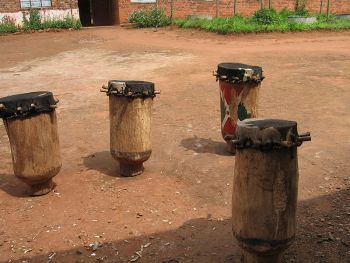
One art lies in the tradition of making drums. Drumming and percussion instruments are an important part of Kenyan society, and with this there are many different types of drums that are often decorated with geometric designs on the outside or with tassels and rattles. 


Basket weaving and gourd carving are not only beautiful, but it’s also functional. Baskets are various sizes and shapes are used to store food while gourds are mostly used for storing liquids. 


Kenyan literature is primarily written in either English or Swahili, the two official languages of the country, although you may also find books written in other local languages. Swahili was actually written in the Arabic script during its early days. The language was spread along the coastal areas by fishermen, and as trade with Oman and other Arabian countries ventured into the area, Swahili adopted many Arabic words into its own language. The Story of Tambuka (Utendi wa Tambuka) is one of the earliest examples of poetry from this area, written in 1728, and is an example of Swahili written with the Arabic script. As the Europeans arrived later, the language script was changed over to Roman letters as it is today. 


Swahili literature generally fell into three styles: poetry, novels, and drama. Because of the ties between Swahili and Arabic, there are a few similarities between the two styles of poetry, but they are essentially as different as the languages are. What started out as oral narratives soon became the early forms of novels, but these were generally in the form of histories and other nonfiction works. However, written fiction in Swahili didn’t really make its entrance until the 1940s. 


There are many Kenyan writers who have emerged in the literary field. When Ngugi wa Thiong’o wrote his novel Weep Not, Child, it was the first English-language novel published by an East African writer. Although he writes in English, he also writes in his native language of Kikuyu. Thiong’o is also known for his novels The River Between (which is required reading for schools) and A Grain of Wheat


Perhaps because of its exoticness or its picturesque view of what non-Africans view as being “African,” Kenya has long been the setting of many other books by authors from abroad. Quite possibly, the most well known of these would be Out of Africa by the Danish author Isak Dinesen (writing under the nom de plume Karen Blixen). If you want to read other books set in Kenya, you might also want to check out Coming to Birth by Margorie Oludhe Macgoye, The Flame Trees of Thika by Elspeth Huxley, and West With the Night by Beryl Markham.

Up next:  music and dance

Saturday, August 23, 2014

GABON: MUSIC AND DANCE


Gabonese folk music generally includes the folk traditions of the four main Bantu tribes that are in Gabon: the Fang, the Punu, the Nzebi, and the Obamba. They are mostly known for their music accompanying Bwiti religious ceremonies, especially that of the Fang and the Mitsogho. These ceremonies often use the powerful psychedelic tree bark of the iboga. This substance is illegal in several countries and is considered a Schedule I drug in the US (drugs that are basically considered illegal with no known medicinal value, although cannabis is on there, so…); in fact, it’s illegal to export it out of Gabon in an effort to preserve the sacred cultural ties to the plant. During these ceremonies, drums and the ngombi harp is played, heightening the effects of the iboga.


One instrument prevalent to traditional Gabonese music is the obala. (I had a lot of trouble finding any information on the obala; I kept getting hits for the city in Cameroun called Obala and the 1980s Croatian rock band called Daleka Obala. If you have any information on this instrument, please let me know about it!) The ngombi is a type of arched harp that is also used in traditional music, as well as the balafon (like a large xylophone with gourds used as resonators). Each instrument is designated to a specific rite or ritual within the Bwiti religion. This video is of Bwiti harp music used during an initiation. 


Dance traditions in Gabon were mostly used in religious ceremonies.  Different dances are used for different purposes and events (especially those that are tied to the Bwiti traditions), such as births, funerals, and coming-of-age ceremonies. Today, all kinds of dances –both traditional and pan-African as well as styles from Europe and the US– are taught and performed in clubs and dance troupes. The video below isn't of the best quality, but you can tell that the dance in this women's initiation ceremony uses rattles tied to the ankles of the women as they make quick movements with their hips and feet. 


During the 1980s, the African music radio station in Libreville, Africa No. 1, along with the first recording studio in Gabon, Studio Mademba, became the hot spot for up-and-coming musicians to record. Musicians across Africa and the Caribbean flocked to Libreville just to record here. However, during the 1990s, its fame dwindled, and cities like Abidjan, Côte d’Ivoire and Johannesburg, South Africa took its place as recording capitals.  


Although rock, hip-hop, and reggae from the US, the UK, the Caribbean, and other African countries remain popular, there are several musicians who got their starts in Gabon. One of the most famous musicians in Gabon is Pierre Akendengué. He had traveled to France for treatment of an eye disease that would leave him blind. It was in France where his classical guitar studies would transfer to his music. He released several albums and only returned to Gabon when he challenged the government for censoring his music. Their response was to make him a government advisor. I listened to his album Destinée and Africa Obota/Nandipo. Both are really relaxing to listen to. I listened to it for hours.


Artists such as Hilarion Nguema, and Patience Dabany, and Oliver N’Goma have a very typical pan-African sound to their music. It tends to have a prominent percussion (albeit, some of it is synthesized), horn lines, and smooth melodic vocal lines. I’ve noticed that in the vast majority of African music I’ve heard, the vocal lines generally tend to stay within the primary key of the song.


I was immediately drawn to the voice of Annie Flore Batchiellilys on her album Mon Point Zérooo. Her alto voice intertwines with the choral harmonies, accompanied by strings and acoustic guitars. One song uses J. S. Bach’s “Prelude in C Major” as the background music. (That was the first piece I ever played in a recital.) The sultry sound of jazz guitar is what drives me to keep listening. The YouTube description on this video says she's from the DRC, although I thought I found her name on a list of Gabonese artists. Regardless, I still love her music, and I'm sure her music is played in Gabon. 

Up next: the food

Saturday, March 2, 2013

BURUNDI: MUSIC AND DANCE

Music in Burundi is closely tied to its rich history of storytelling and folklore.  Various musical traditions are also closely linked with that of Rwanda.  For Burundians, music is an expression of the soul.

Probably the most important instrument is the drum.  It is the central aspect to Burundian music.  One type of drum that is popular is the karyenda, made from hollow tree trunks.  Actually, popular isn’t even the word: it’s much deeper than that. It’s a national symbol and is even – for some – elevated to a quasi-divine level.  In the very early years of independence, the karyenda was shown on the flag and the coat of arms.  The karyenda along with another drum called a rukinzo follow the kings wherever they go.


One of the more famous groups who reached international fame is the Royal Drummers of Burundi.  Their techniques have been passed from father to son for generation upon generation. Singing, chanting, and dancing also accompany the drumming as well, with some of the drummers also dressed with spears and shields. They have three albums out and have appeared with several other big names in the music industry throughout the years, including Joni Mitchell and Def Leppard. Keep watching to the end -- the way they end their concerts is to pick up the drums and balance them on their heads all while still playing. 


Only a few musicians from Burundi made it to fame outside of the country. Éric Baranyanka is one musician who comes from Burundian royalty. Ciza Muhirwa is another. But probably the most well-known is Khadja Nin. I found a copy of her CD at the library and I really, really like it. There are times when her music reminds me a bit of Sade, taking on characteristics of pop mixed with African rhythms and flavor.


Different kinds of dance accompanies singing, especially mass singing.  Dances are used to mark different life events and other important events, such as wedding celebrations, the birth of a child, when the crops are ready, war dances, meetings where young guys meet young girls, and then there’s just dancing for entertainment. Different regions have different kinds of dances and variations of dances. And the Hutus and Tutsis often share many types of dances. If you notice, the dancers are wearing those rattles on their ankles that I mentioned dancers from Burkina Faso also wear. 


Up next: the food!