Showing posts with label pearl diving. Show all posts

Saturday, October 21, 2017

QATAR: MUSIC AND DANCE


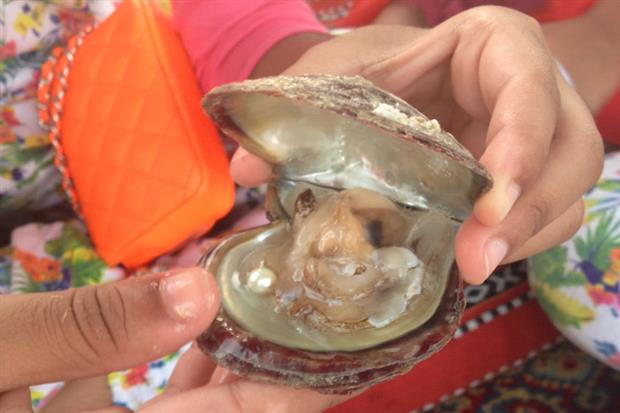
One of the most common types of folk music in Qatar is that of sea shanties. And in particular, work songs that were created for the pearl divers. These songs were sung only by men which encouraged everyone to keep in a routine while working and to give them something to focus on during the long, tedious days. They would have different songs for the different activities they were doing, each activity with a different rhythm. Group singing was an important part of the job, and each boat had its designated lead singer. In a way, I suppose the lead singer is the one responsible for production?


Women also had their music as well. Most of their traditional songs were also work songs, except theirs were about gathering crops and cooking. Of course, they also developed songs for when the pearl divers came to shore as well. Whenever a ship would come in, they would gather and break into song. (That happens at my work sometimes, too. But it’s usually met with mixed reaction.)


Many of the instruments used in Qatari music are similar to that of nearby countries. Instruments generally fall into three categories: strings (oud, rebaba), percussion (cymbals, tambourines, tabl, tus/tasat, galahs, and a variety of drums including the al-ras), and wind instruments (ney, other types of flutes)


The Qataris have several dances that accompany their music. One dance that is still danced in Qatar is the ardah. This is a men-only dance, where two lines of men face each other. Sometimes a few dancers may don swords, because you know, swords are cool. The actual music behind this is generally just percussion and spoken poetry. The ardah is actually performed across the Persian Gulf states, and there are two types: land ardahs and sea ardahs. But the Qatari ardah is somewhat of a mix of the two styles. Women only have two dances that are performed a couple times per year. The al-moradah dance is generally before Eid al-Fitr and Eid al-Adha. Dancers find a place off the beaten path and wear their best embroidered clothes. All women, despite where they fall in social class, gather to dance this dance. Although it’s somewhat fell in popularity since the 1950s, it’s sometimes performed at weddings. The other dance, al-ashori, is almost solely performed at weddings.  The lyrics are typically based on nabati poetry and are accompanied by the tabl drum. 


There weren’t too many examples of modern music from Qatar. Popular music is still pretty censored and restricted, I gathered. However, there was one musician, Naser Mestarihi, who has ties to Qatar. This Jordanian-Pakistani musician was born in Qatar and has worked with both a metal band called Asgard Legionnaires along with producing his own rock album. To me, it was definitely a hard rock album, with a few elements of 80s hair bands like Whitesnake, Cinderella, or Def Leppard. Not only do they do hard rock, but they also show a softer, more melodic side to them as well. I actually really liked the music, and they sing in English, so that’s a plus for me as an English speaker. It’s the type you can rock out to in your car with the windows down. 


There is also a small but growing rock band following in the Doha area. Although there aren’t as many bands that are widely known outside of the area, there are several smaller local and amateur bands that entertain locals and expats alike. And for the most part, these bands are made of ex-pats and foreigners living in Qatar. One of the problems is that there aren’t that many places to play a gig, but that’ll chance, I hope. Most of these bands end up doing covers of familiar songs because that’s what tourists know. I found a few bands on YouTube like Yema, The Exiles, Cronkite Satellite, and Sector 9 (a Lebanese band based in Qatar).


Up next: the food

Sunday, October 15, 2017

QATAR: THE LAND AND THE PEOPLE


It’s a weird word how we spell it in English. It violates that one rule about a q always being followed by a u. And how do you pronounce it? I’ve heard it pronounced as “cutter” for years and even pronounced it that way for a long time. However, I did a little research earlier and found a clip from NPR’s “All Things Considered” about the pronunciation of Qatar and came to the conclusion that it’s most likely pronounced as “kuh-TAR,” rhyming with “guitar.” 


Roman writers were well aware of this peninsula, and Pliny the Elder is credited as the first European to give it the name Catharrei, possibly named after some town. However, Ptolomy was the first to draw a map of the area and label it as Catara. During the 18th century, it was labeled as Katara, and today it was changed to reflect a modern Arabic spelling.


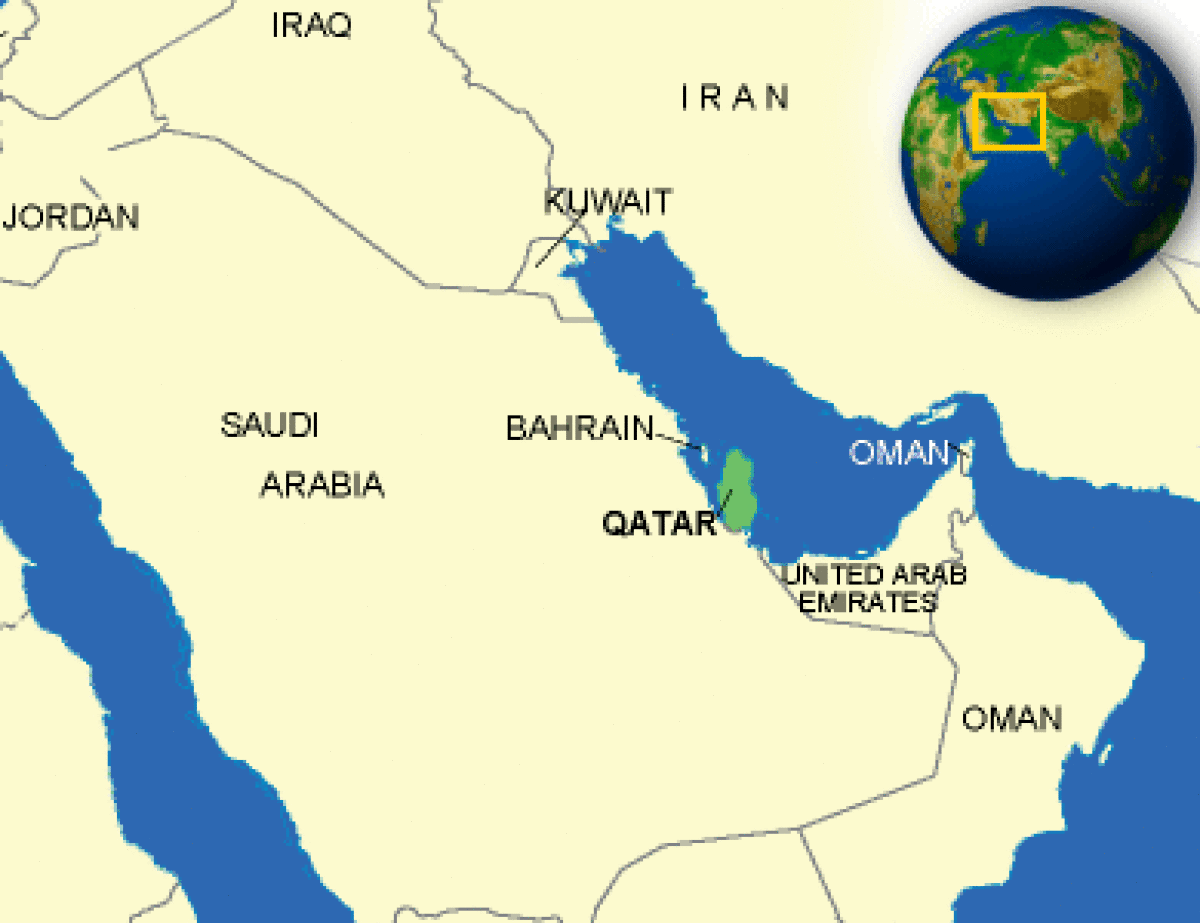
The country of Qatar is a peninsula that juts out into the Persian Gulf in the Middle East. It borders one country by land (Saudi Arabia), two countries by water (Bahrain and United Arab Emirates), and is directly across from the country of Iran. The vast majority of the country consists of low plains and deserts. Summers are very hot and dry while the winters are very mild and slightly wetter, although it’s really not by much. On average, the country gets less than 3” of rain each year. 


People have lived on the peninsula since the Stone Age. The Sasanian Empire moved into the area and Qatar contributed to their economy and trade with their pearl cultivation and creation of purple dye. Christianity was introduced about 400 years before Muhammad sent in his scouts to force them to practice Islam instead. This area was also an important breeding ground for camels and horses. And because of its location along the gulf, Qatari cities have long been an important stop in the trade routes. During the mid-1700s, clans from Kuwait started moving into the area. In turn, Qatari forces took over Bahrain. In retaliation to this, the Egyptians and Ottomans teamed up and hit them from the west side while the Omanis hit from the east. In 1821, a ship with the East India Company attacked the city of Doha because it was tired of their piracy. (Who wouldn’t be?) A few years later in 1825, the House of Thani was established as the ruling house, and they’re still in power today. And like most places, Qatar eventually did submit to Ottoman rule. However, initial support waned, and they stopped paying taxes. When the Ottomans stopped by in a “Where my money at?” moment, things went downhill from there, and battle ensued (more or less). In the end the Qataris gained the status of being an autonomous state. Reeling from losses from WWI, the Ottoman Empire relinquished its holdings to the British. Oil was discovered in 1939 but wasn’t explored until the 1950s. It was also part of the Trucial States, although Bahrain broke off, then Qatar, and what would be the UAE. During the Gulf War, Qatar allowed Canada to hole up there as well as the US and France. They also allowed the US to base its operations there after the invasion of Iraq in 2003. In June of this year, several of its neighbors and Egypt cut off ties with Qatar because of its alleged support of extremist groups.


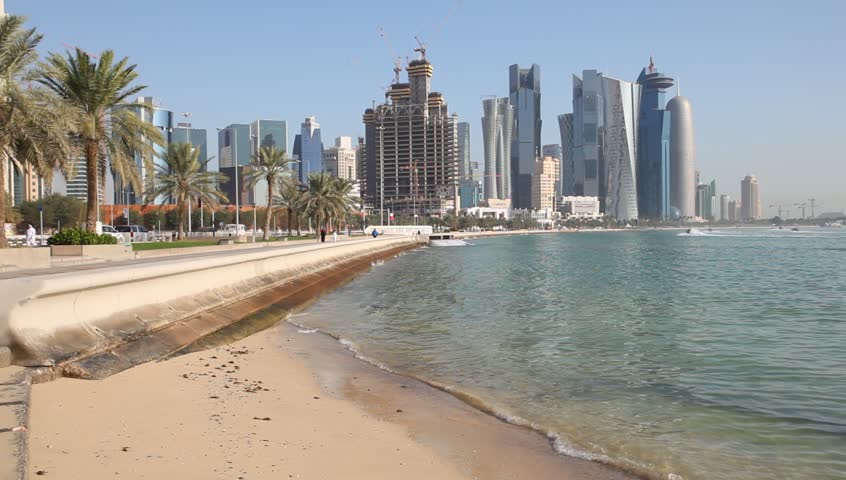
The capital of Qatar is Doha and is also one of its chief ports. It literally means “the big tree.” Although it was established in 1825, it wasn’t officially declared the capital until 1971 when they finally gave the boot to the British. The city played an important part along the trade routes and in the pearling industry. Today, Doha has hosted several pan-Arab and pan-Asian sporting events, international conferences, and will host the 2022 FIFA World Cup. Doha is the center of government, commerce, culture, and higher education. Al Jazeera Media Network, the second largest media company in the world (second to the BBC), is based on Doha. There are a number of art museums, theatres, and even a film festival based here. 


For a long time, fishing and pearling were the main economic drivers for Qatar until the Japanese came up with cultured pearls during the 1920s, which rained on the Qatari’s parade. However, oil was discovered in the gulf, and although it took a while to fully assess the area for extraction, it changed everything. Qatar is the leading exporter of liquefied natural gas. There’s no income tax and unemployment is super low (like 0.1%). Although they have a high-income economy, they rely quite a bit on foreign workers to get there.


Like much of the region, Islam is the majority religion of Qatar. The majority of the people practice Salafi Islam (part of Wahhabism). There are also sizable followers of both Christianity (mostly Catholic) and Hinduism and a smaller group of Buddhists. The minor religions in Qatar are pretty much only practiced by foreigners.


Arabic is the official language here, but locals speak a Qatari Arabic dialect. They even have their own Qatari sign language as well. English is the most studied/most spoken second language, and in many cases (commerce, for example), it’s used as a lingua franca. Because of its international make up of foreign workers, there are many other languages and cultures (mostly Asian) represented in Qatar.


This area is so hot in the summers that it’s nearly unbearable. As a half-Scottish and half-German woman, I would practically burst into flames if I were to go during summer. Architects have come up with some solutions for creating more shadow areas as well as advanced ventilation and cooling systems. They’re even looking into using more reflective materials on the buildings themselves. Scientists predict that if climate change stays its course, Doha and other areas of Qatar will become inhabitable by the 2070s. That’s roughly 50 years from now. I will be 88 years old. It’s entirely possible I will watch this country disappear. And that scares me.

Up next: art and literature

Sunday, May 18, 2014

ERITREA: THE LAND AND THE PEOPLE


When my father-in-law passed away, one of the things I told my husband to make sure he picked up for me was this old elementary school geography textbook, last copyrighted in 1987, which was on his bookshelf in the living room.  Where he got it, I don’t know. I was in first grade that year.  The country of Eritrea was not yet a country at that time.  However, Yugoslavia and Czechoslovakia were still countries, Germany was still divided, Yemen was also still divided, Hong Kong was still a British territory, and Russia hadn’t broke up yet.  Myanmar was still Burma, Cambodia was still Kampuchea, and the DRC was still called Zaire. Not to mention other countries that had yet to be: South Sudan, East Timor, Montenegro, and Kosovo. Things have changed a lot in my lifetime. And back in my day, maps were easier to fill in for tests. I feel for my kids. 


The name Eritrea is actually the Italian pronunciation of the Greek name for the area, Erythrá.  However, it’s pronounced Ertra in the local language of Tigrinya.  The country lies on the Horn of Africa, surrounded by Sudan, Ethiopia, Djibouti, and the Red Sea.  The western fertile lands are accompanied by the hot, arid eastern coastal plains, which spread to the slightly drier and cooler highlands in the South.  The Dahlak Archipelago, consisting of two large islands and 124 smaller ones in the Red Sea, are the sites of ample fishing, pearl diving, and eco-tourism. Pearl fisheries in the Red Sea have been famous since the Roman Empire was around.  (Only about four of these islands are inhabited.)  A few years ago, Eritrea announced that it was going to place all of the coastal regions and all 350 islands it controls under environmental protection, the first country to do so. 


The ancient Egyptians likely included Eritrea as part of the land called Punt. It was later called D’mt (sometimes written as Damot) and was known for their advances in agriculture and development of iron tools and weapons. Some scientists also believe this area is home to some of the oldest human bones ever found, the cradle of civilization. Throughout the centuries, the people living in what is now Eritrea have been invaded from all sides: southern Arabians (probably from Yemen), the Ottomans, the Portuguese from Goa (in India), the Italians, and the British. Toward the end of the 19th century, the Italians took control of the area (along with Ethiopia and part of Italian Somaliland) and renamed it Italian East Africa.  However, the British kicked the Italians out during the beginning of WWII and took over.  Eritrea was counted as one of Ethiopia’s provinces so that Ethiopia would have access to the Red Sea; however, tensions between the two countries grew until they entered into a 30-year war resulting in Eritrea gained its independence in 1991. Even today, tensions are still shaky between the two countries. 


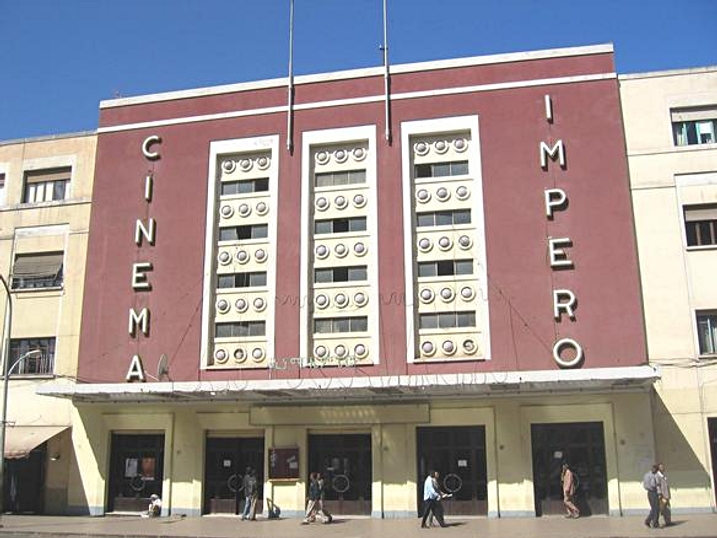
The capital of Asmara, also known as Asmera by the locals, lies in the middle of the country.  Originally a Tigrinya and Tigre settlement dating back to around 800BC, it’s become known for its Italian architecture left over and preserved from the colonial days, many utilizing the art deco style.  The city is modern in almost every sense: from contemporary public art and architecture to museums, sports arenas, shopping, higher education, and the arts. 


Recently, Eritrea’s economy has seen a significant jump, mostly based on its gold and silver mining industry as well as cement manufacturing. Years of war has taken its toll on the economy with a decline in able workers killed in action as well as inadequate and destroyed infrastructure from the resulting damages.  However, even during the war, they did their best at maintaining certain aspects of infrastructure: paving roads, bridge repair, etc.  They do have their own railway and airlines, but it’s not yet reliable; service is infrequent and sporadic. 


While technically there’s not actually an established official language, the local language most widely spoken and used as a de facto national language is Tigrinya.  Tigre and Dahlik are also used in certain areas of the country.  Arabic is also listed as a de facto national language because of its proximity and relationship to Arabian countries. English is used as a working language and taught in schools along with Italian, which many people can still speak and understand.

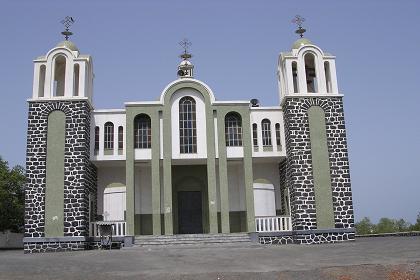
The vast majority of people in Eritrea follow Christianity, followed by Islam, but the percentage of followers vary.  Eritrea only allows people to adhere to specific sects of these religions.  For Christianity, you must be part of the follow: Eritrean Orthodox Tewahedo Church, Catholicism, and the Evangelical Lutheran Church; and for Islam, it must be Sunni.  You have to register for any other denomination. If your sect is deemed too radical (Jehovah’s Witnesses, Bahá’í, Seventh Day Adventist, and many others), then you cannot practice freely. If you are caught practicing an unregistered religion in private, you can be imprisoned for an indefinite amount of time. 


Along with this idea, media freedom places Eritrea at the bottom of the list in comparison with all other countries in the world. It’s the only African country to have no privately-owned news media – whether it be in print, radio, or television.  There are absolutely no foreign journalists living in the capital since the ban of independent news agencies in 2001. The only news comes from the single-party state-owned news agency, only telling you what they deem is important. 


One interesting (yet sad) thing I read was that during the Ptolemaic times of ancient Egypt, they used to keep hundreds upon hundreds of elephants in Eritrea in reserve for times of war.  However, during the latter half of the 20th century, no one saw a single elephant in the wild.  Many think they were either killed from the Ethiopian-Eritrean war or fled elsewhere because of the war.  (A herd of about thirty were spotted in 2001, and it’s believed that the elephant population may be around a hundred now.)  Another thing I read is that the port city of Massawa literally means “shout really loudly.” I’m always interested in interesting city names and their literal translations.  (I just found out recentlly that Brazil has a city named Não-Me-Toque, or Don’t Touch Me.)


I’ve found my recipes – the food sounds spicily amazing. I know I’m going to love it.  My family, on the other hand, will probably be plotting to bury me alive.  There’s a lot that I don’t know about Eritrea, but I’m really excited to find out more. I have a feeling that there are some really cool things here. 


Up next: holidays and celebrations

Tuesday, July 31, 2012

BAHRAIN: ART AND LITURATURE

Art in Bahrain is like a snapshot representation of the Middle East. The architecture is characterized by geometric designs which are seen in many Islam-inspired buildings. Many buildings contain arches that come to a point at the top, whether it be doorways or windows or just decorative designs. Depending on where these beautiful building designs are located within the building, their architectural designs may also be created for a more practical reason: naturally cooling the home in the intense heats of the summer. One building that utilizes this technology is the Bahrain World Trade Center building, a twin tower that I think is shaped like a sailboat with three huge wind turbines in between the two towers. The building and these turbines are strategically placed to best tap into the massive amounts of wind energy to provide power to the entire building. To me, it's a great sign of renewable energy.

Bahrainis have also carved their niche in painting, sculpture, pottery, handicrafts, photography, as well as other mediums. Like many East Asian countries like Japan and China, calligraphy is also an old art form. Some of the styles and techniques used reminds me of pinstriping (something I'm desperately trying to learn, if it wasn't so humid). Some artists incorporate different colors to add dimension to their work.

At one time, before oil became king in Bahrain, the natural pearl industry here produced some of the world's most coveted pearls. Some think it may be because of the fresh water that mixes with the salt water in the waters around the islands of Bahrain. The industry today has decreased a lot in size since its glory days, but pearl jewelry and other decorative textiles using pearls are still popular in Bahrain.

Traditional literature in Bahrain tends to follow a classical Arabic style. Poetry is immensely popular. A few contemporary poets include Qassim Haddad, Ibrahim al'Urayyid, and Ahmad Muhammed al Khalifah. Some of the younger writers tend to be more influenced by Western free verse and other styles.

One poet that I liked is Qassim Haddad. He is an influential poet on Bahraini literature and is the founder of the Bahraini Writers' Union. (His son Muhammad Haddad is a notable film composer.) His metaphoric style forces the reader to see other meanings in the words, or to look at it from a different angle, usually looking backwards. I found some excerpts of some poems, but I really like this line from Haddam: "Wine in half the cup, the other half was not empty; it was lost in ecstasy." Ok, here are a couple others: "Be prepared... the past is coming," "I write about love the way a child draws his impressions of adulthood," and finally I'll leave off with "To write is to breathe unused air." 

Up next: music and dance