Sunday, March 17, 2013

CAMBODIA: THE FOOD


It’s St. Patrick’s Day today, and as usual in Indiana we barely stepped across the above-freezing line. Last year, however, it was 79 degrees.  I miss last year.  Especially since my sinuses can’t keep up with the yo-yo temperatures of spring in the Midwest. So, this meal was the perfect comfort food for such a bleh day.
This is my St. Patrick's Day knife. So that way I won't get pinched while I'm cooking. Now, accidentally slicing my thumb is a completely different story. 
 I basically cooked two entrees. The first entrée is called loc lac.  It starts out with marinating beef (I used stew beef) in oil, black pepper, minced garlic, sugar and salt. I let it marinate for about 45 minutes. Then it’s cooked down in a skillet (or wok) with oil, sugar, garlic, and pepper and soy sauce. It actually called for mushroom soy sauce, but I couldn’t find it. I sautéed it until the meat was well-done. The recipe called for it to still be medium rare to medium, but I’m sorry, I have to have my meat cooked through. It’s served on a bed of lettuce leaves (I cheated – I used a bag salad mix). There’s a lime dipping sauce that goes with it: a peppery concoction of salt, sugar, lime juice, water, black pepper and minced garlic. This was so good; it was good without the dipping sauce, and better with it.

The beef was good by itself. I was tempted to add it to the soup as well. You know, combining all my favorites in one bowl. 
 The second part of the meal was kuyteav, a noodle soup that I thought reminded me of Vietnamese pho soup. I amended this recipe here and there and left some things out, like the chilies; for instance, I didn’t make my own broth. I used a store-bought chicken broth, and put in some sugar and salt, and although the recipe didn’t call for it, I boiled some lemongrass in with the broth. Lemongrass is really good for cough, colds, and sore throats (which I need!) as well as many other health benefits.  It’s native to Southeast Asia and is used in a lot of their cooking. It wasn’t overpowering and added a nice mild flavor to the broth.  The soup itself is made by putting noodles in the bowl (I found these ready-made Thai noodles which worked quite nicely), then I added about a tablespoon of kraut (my substitution for “preserved cabbage”), some bean sprouts, some pork (it called for both ground pork and pork loin; I just used boiled pork loin cut into thin strips), and sautéed shrimp and garlic. I then topped it with sprigs of fresh cilantro and chopped scallions. It was so good – it was like the perfect comfort food.

I'm hoping the doctor will order more of this for me. 
 I found a recipe for a type of fried breadstick called chaquay.  I think I read that this recipe actually was from the Chinese. For the first time, I had a bread that really didn’t turn out well. It called for wheat flour and included some baking soda, salt, a little yeast, some water and sugar and mix it up to form a dough. It was really sticky and elastic-y, and even after letting it sit for 30 minutes, I still had to add a ton of flour to it to make it anywhere close to being able to work with it. I tried rolling it out, but it still wouldn’t stop being so sticky. In my effort to have some sort of bread with my meal, I decided to just cut out strips and fry them anyway. Because it was so sticky, they were as far from a uniformed looking breadstick as it could get. My chaquay turned out looking more like severely arthritic fingers. But they tasted good dipped in the soup, which is what they were recommended to go with.

Arthritic fingers. Oh, wait, no sorry, that's my bread. 
 I actually made a dessert this time. But only because the recipe seemed simple. I took a can of coconut milk and add some sugar and let it boil until it starts to become thicker. Then I added four bananas that were broken up into bite-size pieces into the coconut milk. I let it cook down for about another five minutes or so until the coconut milk was creamy. (Of course, I added a little bit more sugar as well.) It’s best eaten when completely chilled, as we found out.

Exactly what I needed for the end of the day. 
 I think this meal was about healing and getting better. And I started thinking again about the healing power that food has. Not only on a medicinal level, using food for its restoring and regenerative properties instead of medicine. This idea is utilized as part of the basic principles behind Ayurvedic medicine. But it also means the idea of comfort food, something my husband and I have had many discussions about. Everyone has a certain list of foods they want to have when they want to feel better when they’re sick or feel better when they’re feeling down. Soups are always at the top of my list as comfort foods. And anything with rich, thick sauces. And cheese. And chocolate.  Just not necessarily altogether.  So, this meal, in essence, was perfect for today. My husband gave the meal two thumbs up, and told me we HAD to do this one again. If the weather continues as it does, I’m sure I will.

The final product... It's a winner! 

Up next: Cameroon

Saturday, March 16, 2013

CAMBODIA: MUSIC AND DANCE


Like the beginnings of traditional literature in Cambodia, music also took inspiration from India as well, heavily relying on various Hindu forms. Their music is highly integrated with dancing, most of the time, it’s difficult to make a distinction between the musical form and the dance that accompanies it.

The main instruments that are used in traditional music are the ching (a type of cymbal), gong, roneat (a xylophone made from bamboo), pai au (flute), sralai (oboe, because everyone needs someone to blame – sorry, that was the horn player in me speaking), tro (fiddle), and the chapey (a bass banjo – I had no idea there was such a thing). There are also several types of drums utilized as well.


Pop music comes in two forms: a moderately slow circle dance called romvong and danced by both men and women. The other form is called romkbach, which has been described as being closer to Thai music, music with a slower, more emotional melody line. Kantrum is a type of quick dance music played by the Khmer who live on the border with Thailand. Linguistically, it stands apart because it’s sung in both Khmer and Thai and switches between the two, even in the middle of a song. 


Dance in Cambodia mainly falls under three different types: classical dance, folk dance, and social dance. Classical dance pretty much stemmed from the court dances where the dancers are dressed in intricate costumes. They’re performed many times for holidays and for tourists. Folk dancing is centered more about the people, where the dancers are dressed like farmers and peasants. Many of the themes of these dances are centered around love and folktales using animals and different scenes. Social dances are obviously danced in social situations, namely banquet parties. These different dances are accompanied by different kinds of orchestras consisting of various instrumentations.


Some of the most popular singers who came out of the traditional music genres are Sinn Sisamouth (probably THE most famous one), along with Ros Sereysothea and Pan Ron both of whom performed with Sisamouth. I found some of their music on Spotify, and it’s kind of a cross between the old crooners from the 1950s (a la Frank Sinatra) and 1960s psychedelic and garage band sound.  I actually really liked it. Now as far as music of today goes, I discovered one of my new favorite bands: Dengue Fever.  They’re actually from Los Angeles, California but combine Khmer music with psychedelic rock sounds. I absolutely love it! I had first picked up the album Escape from Dragon House and was completely enthralled with it. So much so that I went back to the library and picked up the album Cannibal Courtship. I also discovered a group called the Cambodian Space Project. It’s kind of the same genre of music; I wish my library had a copy though. It’s pretty cool stuff. I did find the album Not Easy Rock and Roll (which I’ve been listening to on Spotify) on iTunes for $9.99.


Up next: the food!

Thursday, March 14, 2013

CAMBODIA: ART AND LITERATURE


Art in Cambodia goes back centuries to the Angkor days. Several styles of traditional art were once the very heart of day-to-day living and functionality, whether you made it, used it, wore it, or merely admired it. The Khmer Rouge took away all of the arts practices – artists, musicians, and writers were killed for their craft.  However, after they left power, the arts slowly started to make a comeback. Different schools for learning the traditional arts were established, as well as learning contemporary art.

Textiles are an important part of Cambodian life. Silk weaving has been practiced for centuries, given Cambodia’s proximity to the famous Silk Road. When it comes to weaving, there are two main techniques. The first is called ikat (no, not another Apple product), which is basically dying the weft yarn (the horizontal strands in fabric) in order to make designs. The designs vary from region to region. It’s somewhat of a long, complex process.  The other is called uneven twill, a process of taking two or three colors of yarn and weaving them in such a way that one color will be dominant on one side of the fabric and the other one (or two) will show on the other side.  The dye they used came from natural elements.


Besides silk, cotton is also highly popular. Some of the more popular woven items are a sampot (wrap skirts, similar to a sarong), pidan (tapestries with pictures woven into them), and krama (traditional headscarves worn by both men and women). Basket weaving, wicker and rattan arts are also prevalent.


Stone carving goes back to the Angkor days and was used to decorate the temple walls and surrounding areas. Some can be quite elaborate and intricate in design. It’s become somewhat of a lost art, but efforts are being made to try to bring it back. Likewise, lacquerware and silversmith work are two other arts that are starting to make a comeback into the arts world as well.


Kite-making and the kite-flying tradition is one that spans across Asia on a whole. In Cambodia, they sometimes attach small pipes onto the kite so that when the wind blows, it makes a whistling sound. They call these singing kites. The tradition goes back centuries, but in the past 20 years or so, kite-flying competitions take place with several competitors and many spectators alike, ranging from the young to the young-at-heart.


Of course, drawing, painting, and sculpting of a more modern, European style are also highly regarded as well. Especially in the years after the Khmer Rouge, art production and art education took off, and several art museums were rebuilt in Phnom Penh and other major cities. Some of the artists that have made a name for themselves are Chhim Sothy, Chath Piersath, Chhan Dina.


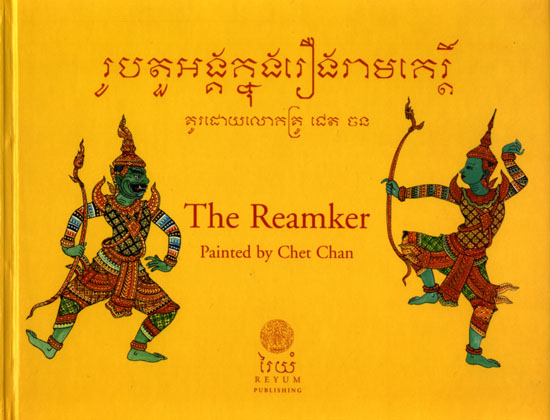
The first texts in Khmer were mainly religious texts (such as translations/ transliterations of the Tripitaka), written by Buddhist monks as well as court documents and stone-carved scripts at temples. There was also a strong tradition of folklore and storytelling in Cambodia.  Most of these stories were passed down verbally from generation to generation.  Many of the topics were deeply laden in Buddhist themes and proverbs.  The ancient Hindu epic poems were also a source for inspiration as well.  “Reamker” is a Cambodian version of one of these poems that has been adapted to both theatre and dance.


One of the first famous writers – perhaps because he was the king as well – was King Ang Duong.  Two of his well-renowned works, both inspired from the Jataka tales (stories told about the previous births of the Buddha), are “Kakey” and “Puthisen Neang Kong Rei.”

After the French took over Cambodia, written language took on another level.  The French were controlling, but they did help establish and produce printed Khmer literature by creating the movable blocks for the Khmer script to be used on a printing press, the first Khmer language book being published in 1908. They also transformed their educational system as well, giving more students a chance to learn to read and write. 


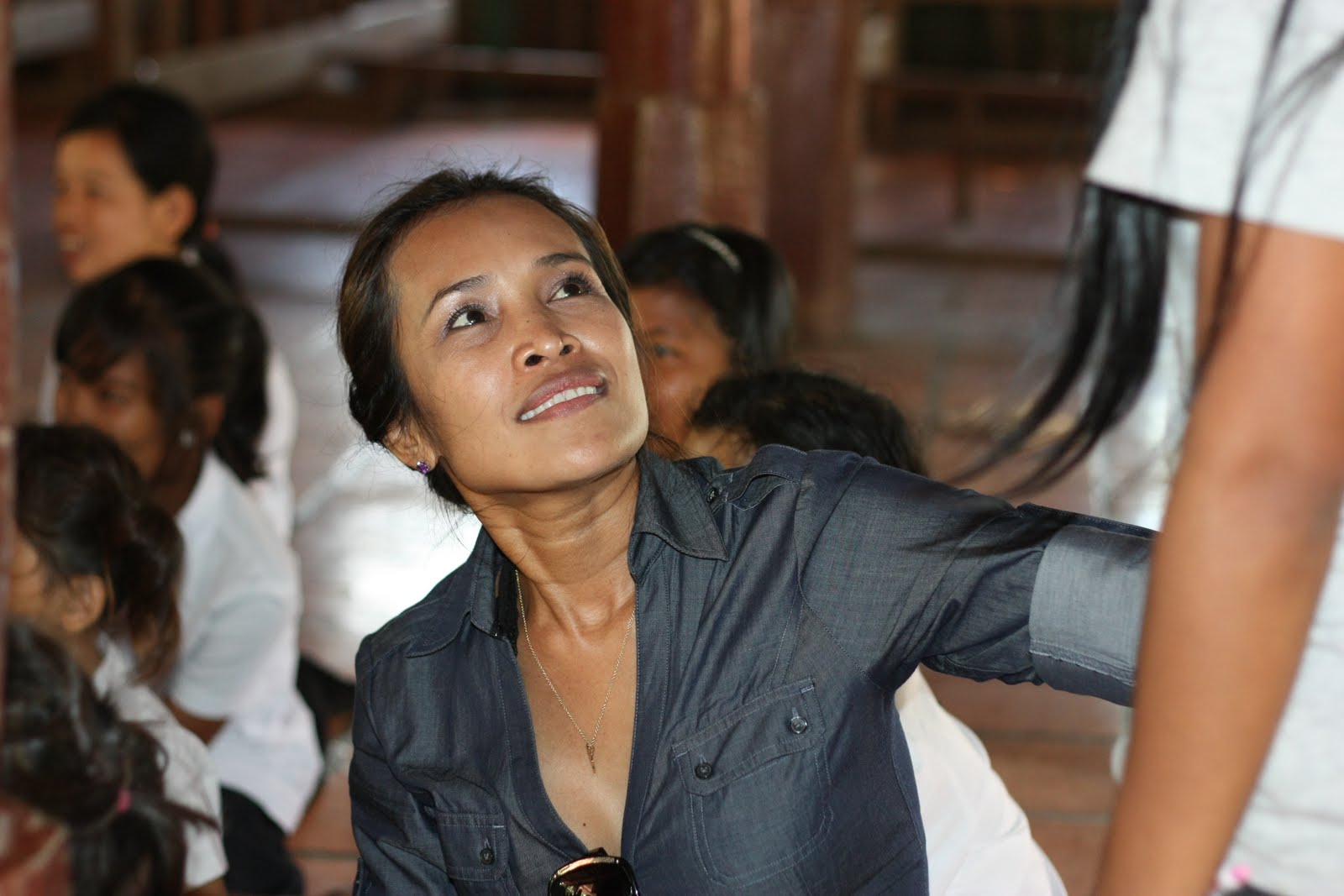
Writers and Cambodian literature on a whole also suffered the same fate from the Khmer Rouge days. One of the more well-known Cambodian authors today is Somaly Mam. Her beginnings were bleak, being essentially orphaned, not even sure which year she was born. She was taken in by a man she had to call “grandfather” (a sign of respect) who abused her and enslaved her before selling her to a brothel at the age of 14. She was then forced to marry a soldier in the Khmer Rouge, a man she had never met, who beat her and raped her repeatedly. She had to prostitute herself, sometimes five or six times a day just to make ends meet, and if she refused, she faced a barrage of torturous beatings. In fact, her best friend at that time was brutally murdered in front of her. She managed to escape, and a French aid worker helped her relocate to France where she later married a French national. Although she went through all of this, it did not deter her from helping other women caught in the sex trafficking trade throughout Cambodia and Southeast Asia. Her memoirs are written in The Road of Lost Innocence. She also founded The Somaly Mam Foundation in 2007 as a non-profit based in the US who helps organize anti-trafficking groups and assists in helping women and girls escape from sexual slavery. Please visit their website; there is a lot of information on the sex slave trade, what the foundation is doing, and how you can help: www.somaly.org.

Up next: music and dance

Tuesday, March 12, 2013

CAMBODIA: HOLIDAYS AND CELEBRATIONS


New Year’s Day.  January 1.  The traditional New Year’s Day on January 1 is relatively passed over. Businesses and schools are closed on this day, but that’s pretty much it. The big celebration happens at the Khmer New Year in April.

Victory Day.  January 7. This day celebrates the end of the Khmer Rouge regime in 1979 (the year I was born). On this day, Vietnamese troops entered Cambodia and started a bloody clash that ended the reign.  Most estimates report around two million Cambodians were killed in the genocide. Even after all these years, it’s still an emotional holiday and viewed with mixed feelings since it led to a dependency upon Vietnam afterwards.  Speeches from government officials and memorial services are often held on this day, as well as other displays of Cambodian cultural arts.


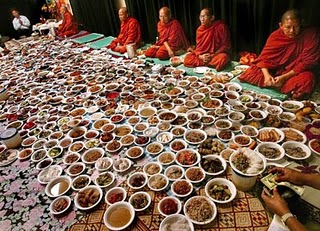
Meak Bochea.  Varies.  It’s a movable Buddhist holiday, mostly taking place during February. The holiday was established for the spontaneous gathering of monks to listen to the Buddha’s preaching. However, on this particular day, the Buddha accurately predicted his own death three months later.  The main ceremony is held in the Kandal province. Three hundred Buddhist monks are invited to the ceremony and offered money, food and drink. Other Buddhist countries celebrate this holiday annually as well.


International Women’s Day.  March 8. We just celebrated this holiday a few days ago (which I celebrated by doing things that I “wanted”: going to work, picking up Chinese take-out, and buying a cherry pie. And some Stella Artois.). It’s a holiday celebrating women, out struggles, and how far we’ve come in the world towards equality. One extraordinary Cambodian woman I discovered is Somaly Mam, who continues to fight for getting girls out of the sex trade. I’ll write more on her when I get to literature.

Khmer New Year.  April 14-16.  This is the largest and most important holiday in Cambodia.  It’s set around the time of year to celebrate the end of the harvest.  Many people head to the temples to receive blessings from the monks. While on the temple grounds, people will build five sand hills representing nirvana and decorate them with religious flags. The holiday lasts three days. On the first day, people clean and lighten their homes, decorating them with candles, flowers, statues of Buddha, as well as making a lot of food (much of which will be donated to the monks at the local temple). On the second day, people will often give to charity and help the poor. The third day is about washing: people will douse their own statues of Buddha with scented water, the children will wash their elder’s feet in return for blessings, and monks will perform a ceremony washing of the Buddha statues at the temple. Games are also popular at this time and each day a type of game is played.


Visaka Bochea.  Varies.  This day is in honor of the passing away of the Buddha 2557 years ago, as predicted on Meak Bochea. On this day, people often listen to talks about the Buddha’s teachings, and especially regarding The Noble Eightfold Path, the eight ways for getting rid of suffering.


Labor Day.  May 1. This day is for discussing labor issues and celebrating the worker. Usually there are a lot of speeches and parades. It’s also a common time to discuss labor disputes, minimum wage, and the state of jobs in the country. 

Royal Ploughing Ceremony.  Varies. This holiday marks the beginning of the rice cultivation season. Its roots stem from Hinduism, and the ceremonies are headed by the royal family.  These ceremonies are also a way to predict how well the crops will turn out that year, sort of like Groundhog Day in the US predicts how close to spring we are. 


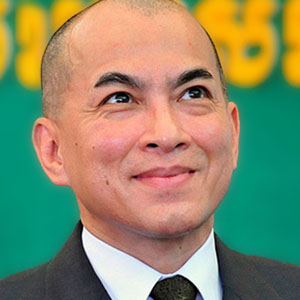
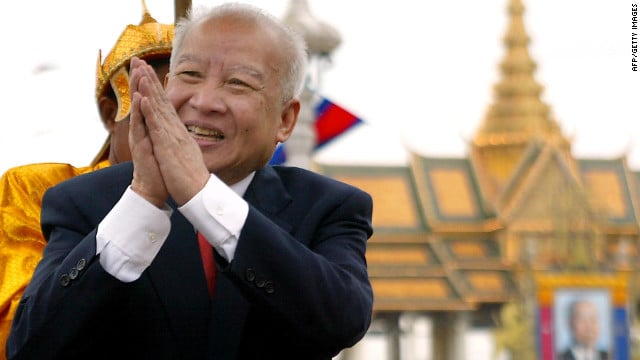
King Sihamoni’s Birthday.  May 13-15. This day is in honor of HM Norodom Sihamoni’s birthday. His birthday is actually on May 14, but the holiday starts the day before and the day after.  Before he was king, he was a ballet instructor and cultural ambassador in Europe.  People decorate their homes with colorful lights, portraits of the king and national flags.


Queen Mother’s Birthday.  June 18. This day is in honor of the mother of the current King Sihamoni and the wife of Norodom Sihanouk, Norodom Monineath. Born in Saigon, Vietnam, she married into the royal family of Cambodia and became the president of the Cambodian Red Cross. In honor of her birthday, the a large portrait of her is placed in front of the palace, and certain radio and television programs will often have a short program about her life and accomplishments. 


Constitution Day.  September 24. This marks the day in 1993 when Cambodia became a constitutional monarchy. It also marks the day when King Sihanouk retook over the throne since after he was ousted in a coup by the Khmer Rouge.

Pchum Ben Festival.  Varies.  Usually in October, this 15-day festival is fairly unique to Cambodia. Also known as Ancestor’s Day, people pay their respects to their deceased family members up to seven generations (sorry eighth on back). At this time, people visit the temples and give gifts of food to the monks. There’s also a tradition to throw rice into the fields in order to feed the spirits. No word on whether they actually eat it or not. Unless they were reincarnated as birds, perhaps.


King Father’s Birthday.  October 31. This is in honor of the King Father’s birthday, Norodom Sihanouk. He was the king from 1941 to 1955 and again from 1993 until he abdicated the throne to his son in 2004. Last year, he celebrated his 90th birthday (along with my grandmother). A large portrait of the king is placed in front of the palace and many people will gather and have their pictures taken in front of it. His birthday is only three days after mine.


Independence Day.  November 9. This year will mark the 60th year since declaring independence from France. The king greets various government officials and gives a speech to the people; there are parades and celebrations held throughout Phnom Penh and across the country. People line the streets with portraits of their king. Cities decorate itself with the national flags and the national colors.


Water Festival/Boat Racing Festival.  Varies. The largest of the boat races are held in Phnom Penh, but other races are held in other cities, such as Siem Reap. Traditionally, this was the method the king used to determine who were the strongest warriors by choosing from the highest-placed finishers. The festival itself lasts three days, making it one of the more popular festivals in Cambodia.


Human Right’s Day.  December 10. This is a holiday in commemoration of the UN’s adoption of the declaration of universal human rights in 1948. Celebrations are held all over the world, and a very large celebration took place in 2008 in Phnom Penh and around Cambodia with a massive parade of 5000 people, and 1000 people let off balloons. I bet that was something to see.

Up next: art and literature

Saturday, March 9, 2013

CAMBODIA: THE LAND AND THE PEOPLE


Images of Angkor Wat come to mind – the ancient Hindu temple (in a Buddhist country) dedicated to Vishnu surrounded by a square moat, miraculously remained unscathed through the oppressive Khmer Rouge years, and so important to Cambodia culture it’s on the center of the flag.


Nestled right between Vietnam and Thailand and south of Laos, it’s divided unevenly by the Mekong River (unfortunately it lost the delta area to Vietnam). The coastal areas along the Gulf of Thailand allow for shipping, fishing, and relaxing. Low flat plains stretch out between mountains in the southwest and north. Cambodia and its neighbors have two seasons: rainy and dry. The tropical temperatures don’t vary that much in contrast.

The name Cambodia used to be called Kampuchea, which is the Khmer word derived from Sanskrit for the name of this area, or the land of the Khmers. The name we know it in English, Cambodia, is derived from the word “Kamboj” which is the Sanskrit transliteration of the word “Kampuchea.”

The most widely spoken language is Khmer, spoken by the largest ethnic group in Cambodia, the Khmers. The language is part of the Mon-Khmer language group and is related to Vietnamese.  Khmer also has it’s own script too, which looks similar to Thai. Because the French occupied the area for so long, many of the older Cambodians still can speak and write in French. Most of the younger people have at least a reading knowledge of English since most of the Internet is written in English.

During the mid-1800s, Cambodia found itself in the midst of conflict between Thailand and Vietnam and sought protection from the French, which lasted from 1863-1953. When the king died in 1941, France hand-picked the next king of the area, thinking their choice would be easy to control; however, they were wrong about that: Cambodia gained its independence under the leadership of Norodom Sihanouk in 1953.

This is the best expression. It should be captioned. In fact, it should become the next Facebook meme. 
 The 1970s brought the height of the Khmer Rouge. Led by the infamous Pol Pot, it was an oppressive way to force the people to become an agrarian socialist society, to say the least. He forced the urbanites to march to the rural areas and force them to farm, and when they failed because they weren’t used to farming and had no idea what to do, they were shot. They were against any professionals and executed them: doctors, lawyers, teachers; and anyone who was involved in the cultural arts: musicians, artists, writers, etc. They also killed anyone who tried to practice religion, and it didn’t matter which religion it was. They even went so far as to kill people who wore glasses, since they saw this as a sign of intellectualism. This regime separated parents from children and spread them across the country, eliminating money, telephones, postal services – anything that would be a means of communicating. Married couples were allowed to see each other for very short periods of time, and sexual relations were strictly forbidden, punishable by death. People were no longer allowed to have their own eating utensils and were forced to eat when and where they were told. If they were found foraging for fruit or berries in the forest to survive, the government saw this as “private enterprise” and immediately fed them a bullet. These images are so horrifying, it was like Pol Pot studied the Holocaust, the Cultural Revolution, the Armenian Genocide, and thought, “How can I one-up them?” I can remember when he died in 1998 (I was a senior in high school), and my mother sighed, “Well, we can now breathe a little easier.” Pol Pot was never tried for these crimes against humanity. At the time of his death, he was on house arrest for ordering the execution of his second in command (and eleven members of his family) for attempting to make a deal with the existing government (the sentence didn’t mean much considering he hadn’t been seen in public since 1980.) (And no, I haven't seen the movie The Killing Fields yet, but it is in my Netflix queue.) 


On a lighter note, the capital city is Phnom Penh (pronounced “puh-NAHM pen”). It was once known as the Pearl of Asia for it’s beautiful architecture, both French colonial-influenced and traditional. The metro area has about 2.2 million people, about the size of the city of Houston, Texas. Situated at the crossroads of three rivers (Mekong, Tonlé Sap, and Bassac Rivers), it’s certainly the largest city in Cambodia and the main center of government. The name Phnom Penh literally means “Pehn’s hill.” It’s actually sister-citied with four US cities: Long Beach, CA; Lowell, MA; Providence, RI; and Cleveland, TN.


The country struggles with a 77% literacy rate and almost 29% of kids under age five are underweight.  Access to clean water and sanitation is far under standards (67% in urban areas, 18% in rural areas), leading to much higher rates of diseases such as typhoid fever, hepatitis A, malaria, and dengue fever. AIDS is also a problem in Cambodia as well as problems leading to and stemming from sex trafficking. On an up note, the past ten years have brought gains in the textile industry as well as agriculture, tourism, and construction as the main sources of economic boosts. However, in 2005, oil deposits were discovered underneath Cambodia’s territorial waters. Research and negotiations have been taking place to see whether there is a viable method to extract it. If the project gets off the ground, this could mean a lot for the Cambodian economy and its role in the global economy. Until then, it remains to be one of the poorest nations in the world. For me, this country lies between two of my favorites cuisines that I don’t eat often: Thai and Vietnamese. Since I’ve already figured out my recipes and am currently listening to the band Dengue Fever, I’m so geeked for all of this.

Up next: holidays and celebrations. 

Sunday, March 3, 2013

BURUNDI: THE FOOD!

Making this meal came at the will of sheer determination. Last week, I’ve become highly allergic to something in my house that’s not affecting anyone else but me. (It might be dust mites or this cat, but who really knows? I do know it’s driving me crazy.) But because my desire for an awesome meal far surpasses my desire for personal comfort, it was not a difficult decision to make at all.

Now, the bread recipe I chose was anise bread, something I’ve been waiting for for almost two weeks. Anise tastes/smells a little like licorice and is the flavoring in some kinds of root beer, as well as one of my husband’s favorites: Jägermeister. It’s also found in absinthe as well as other alcoholic drinks. Anise has some other health benefits as well, such as helping with menstrual cramps and combatting flatulence. The essential oil has been used as an insecticide against head-lice and mites (which I may try to come up with some kind of concoction out of utter desperation.) And I just really had to laugh at the Latin scientific name of anise: pimpinella anisum (ok, I’ll stop acting like I’m 16.)  The anise bread starts out with a sponge: a mix of yeast, sugar, and water, and a cup of flour, then let it rest to rise. You add this to the dough and then let it rest some more. After dividing it into six pieces, it’s brushed with an egg yolk and rests a little more before baking it in the oven. When it came out, it was so delicious, with only a hint of anise taste. Definitely pairs well with a meal.  

I know what my breakfast is tomorrow. 
The main dish I chose was called “Grilled Tuna with Herbed Aioli” which I neither used tuna, nor did I grill it. I chose salmon steaks, and I baked them. But I did make the herbed aioli, which is a mix of mayonnaise (I always choose Miracle Whip – real mayonnaise is disgusting, a debate my sister and I have had since we were in high school) and red wine vinegar (which I used white wine vinegar), fresh basil, fresh thyme, dried tarragon (a first for me!), olive oil, and minced garlic. All of the ingredients sans the mayo are drizzled on it prior to baking/grilling, and the aioli tops the fish before serving.

Not the most attractive picture, but my stomach had  a different opinion. This is minus the aioli.
To go with it, I made ibiharage. It’s a rather simple side dish full of flavor. I started with sautéing minced garlic and onions and then adding a can of navy beans. I seasoned it with a little bit of salt, pepper, and some chili powder. And just to add a little bit of heat, I threw in a small bit of Jamaican jerk spice. It was so good; if my mom had made this when I was a kid, perhaps I would’ve liked navy beans more.

Navy beans. Maybe I can give this recipe to my mom. 
The meal was really good, in my opinion. The herbed aioli was something of a bother to my 4-year old son. I think the point is to introduce new flavors and flavor combinations to them. You never know what might become your next favorite. (I know the anise bread is mine.) And, with this, I’ve finally come to the last of the B countries. A little bittersweet – there were a lot of good meals from countries that start with B, and a lot of new favorite meals, and some I just archived.  And you know what? I bet there’s a sequel for the countries that start with C.

The final product. It didn't make my allergy to whatever-it-is go away, but at least I'm full. 

Up next: Cambodia

Saturday, March 2, 2013

BURUNDI: MUSIC AND DANCE

Music in Burundi is closely tied to its rich history of storytelling and folklore.  Various musical traditions are also closely linked with that of Rwanda.  For Burundians, music is an expression of the soul.

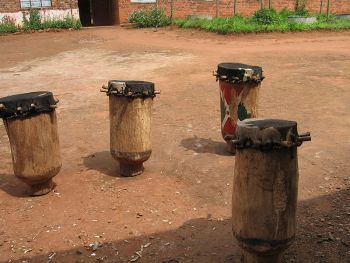
Probably the most important instrument is the drum.  It is the central aspect to Burundian music.  One type of drum that is popular is the karyenda, made from hollow tree trunks.  Actually, popular isn’t even the word: it’s much deeper than that. It’s a national symbol and is even – for some – elevated to a quasi-divine level.  In the very early years of independence, the karyenda was shown on the flag and the coat of arms.  The karyenda along with another drum called a rukinzo follow the kings wherever they go.


One of the more famous groups who reached international fame is the Royal Drummers of Burundi.  Their techniques have been passed from father to son for generation upon generation. Singing, chanting, and dancing also accompany the drumming as well, with some of the drummers also dressed with spears and shields. They have three albums out and have appeared with several other big names in the music industry throughout the years, including Joni Mitchell and Def Leppard. Keep watching to the end -- the way they end their concerts is to pick up the drums and balance them on their heads all while still playing. 


Only a few musicians from Burundi made it to fame outside of the country. Éric Baranyanka is one musician who comes from Burundian royalty. Ciza Muhirwa is another. But probably the most well-known is Khadja Nin. I found a copy of her CD at the library and I really, really like it. There are times when her music reminds me a bit of Sade, taking on characteristics of pop mixed with African rhythms and flavor.


Different kinds of dance accompanies singing, especially mass singing.  Dances are used to mark different life events and other important events, such as wedding celebrations, the birth of a child, when the crops are ready, war dances, meetings where young guys meet young girls, and then there’s just dancing for entertainment. Different regions have different kinds of dances and variations of dances. And the Hutus and Tutsis often share many types of dances. If you notice, the dancers are wearing those rattles on their ankles that I mentioned dancers from Burkina Faso also wear. 


Up next: the food!