Showing posts with label Arabian Peninsula. Show all posts

Sunday, June 3, 2018

SAUDI ARABIA: THE LAND AND THE PEOPLE


As a kid, I was really into these two atlases my mother had. One covered US states and territories and the other was for the world. I remember a photo of Saudi Arabia in the Middle East section that was of the Rub’ al Khali desert, a vast desert that covers roughly the southern third of the Arabian Peninsula. It literally means “Empty Quarter.” The starkness and the emptiness really got me, yet there are animals and certain plants that have learned to live there somehow. Remind me of a few jobs I’ve had. 

Looks like one of those generic computer backgrounds that come pre-installed.
The country is named after the Al Saud, the royal family. The term Arab or Arabian is thought to have been derived from words meaning “nomadic” or “desert,” but there are other theories of its origin as well. 


Saudi Arabia takes up most of the Arabian Peninsula. It’s surrounded by Jordan, Iraq, and Kuwait to the north; Bahrain, Qatar, and the United Arab Emirates to the east; and Oman and Yemen to the south. The Persian Gulf is off to the east (by Bahrain and Qatar) while the Red Sea and the Gulf of Aqaba separate the Arabian Peninsula from Africa to the west. A number of small islands dot the coastlines on both sides. And amazingly, it’s the largest country that doesn’t have any rivers. No surprise here, but Saudi Arabia has a desert climate. They’re known for their high daytime temperatures in the summer, which are typically between 113-129ºF! Um, no thanks.


It’s thought by many historians that the first people here arrived from eastern Africa at the Horn of Africa roughly 75,000 years ago. There were several civilizations and kingdoms that thrived in this area before the advent of Islam, including Al-Magar, Dilmun, Thamud, Nabatean, Lihyan, and Kindah. When the prophet Muhammad was born, much of this area was nomadic societies with a few cities on the coasts and edges of the deserts. But Muhammad had unified some of these nomadic tribes and converted them to Islam. After his death, they spread his religion beyond the boundaries of the Arabian Peninsula. At one point, the Umayyad Caliphate spread from modern-day Portugal to Pakistan, making it one of the largest empires in history. Mecca and Medina became important cities in Islam. However, much of what is now Saudi Arabia was still pretty much tribally run at this point and opened itself up for larger civilizations to move in to take over. The Ottomans entered the picture in the early 16th century. What started as a means of keeping the Portuguese out, opened itself up to staying around for the next four centuries (gotta make sure the job’s done, I guess). The Saud family established their place in 1744 when Muhammad bin Saud joined together with the religious leader Muhammad Ibn Abd al-Wahhab to create a super conservative form of Sunni Islam. Set up near Riyadh, they quickly expanded and took control over most of their present-day boundaries. Previous tribal leaders didn’t take too kindly to the Saud family’s rule and there were conflicts and revolts over it. Finally in 1932, the kingdoms of Nejd and Hejaz united and became known as the Kingdom of Saudi Arabia. Not long afterwards, oil was discovered, and of course the US smelled it and started salivating and got involved (not to mention, just trying to control all of Aramco, their main oil company, themselves). Foreign workers flooded the country to work, setting off the local’s xenophobia. During the 1970s, oil wars over who controlled the pricing and profits (along with Saudi Arabia’s dislike of Israel and the West) caused prices to quadruple. A growth of more (conservative) religious radicalization is a cause for concern. Human rights groups are concerned about the lack of rights and treatment of women. It was only last year when women were allowed to get a driver’s license.


Riyadh is the most populous city and national capital. Roughly located in the center of the county, it was originally called Hajr during the pre-Islamic days. It really expanded and adopted the grid-like city planning during the 1940s and 1950s. The old parts of the city aren’t that large, but one of the most historic buildings includes the Masmak Fort. Today, it’s a modern city and serves as the center of government, finance, media, transportation, and sports and culture.


Saudi Arabia’s economy is –no surprise here– mainly supported by petroleum. However, it’s also highly dependent on foreign workers in this industry as well. It’s estimated that Saudi Arabia has roughly one-fifth of the world’s petroleum reserves. There is also a small mining industry, mostly in gold and some other minerals. A few areas in the country are able to support its small agricultural endeavors. Saudi Arabia does struggle with creating enough drinkable water and food variety as well as inequality and hiring its own people over foreign workers.


Officially, all Saudi citizens are Muslim. There are several estimates, but most would put the Sunni Muslim population between 75-90% and the Shia as the remaining 10-25%. The version of Sunni mainly practiced here is actually Wahhabism (also called Salafism), which is an ultra-conservative form of Islam. There is a significant number of Christians in the country, but they are mostly foreign workers. Atheists and agnostics are considered terrorists (I should probably stay away then). To leave Islam (called apostasy), either by converting to another religion or becoming an atheist, is punishable by death in Saudi Arabia.

Yeah, this seems a little crazy to me. Not exactly sure what's so secret down this road.
The official language is Arabic, although there are several dialects spoken throughout the country: Najdi Arabic, Hejazi Arabic, and Gulf Arabic. There’s also a Saudi Sign Language for their deaf community. Because of the large number of foreign workers in the country, there are large pockets of Tagalog, Urdu, Rohingya, and Egyptian Arabic speakers as well.


I came across this sport that’s popular in Saudi Arabia called Sidewalk Skiing. Its name doesn’t really describe what they’re actually doing, however. What it is, is taking a car and getting it to ride on the two tires on one side of the car while it’s in motion. And while they’re in motion, the passengers will sit on the outside or do tricks on the car. I actually saw this in the M.I.A. video for “Bad Girls” a few years ago. I thought it was crazy then, and still think it’s crazy.

Up next: art and literature

Monday, May 15, 2017

OMAN: THE LAND AND THE PEOPLE


When I was a kid, I pronounced this country as “Oh, man!” I also used to get Muscat and Muskrat mixed up (I’m not sure why; they are vastly different.) However, in real life, Oman planted its stakes at a very strategic location in the Middle East and has taken full advantage of that location for many centuries. Once quite a powerful empire, its leader now tries as best as he can to maintain control, even if it goes too far. 

 
Where exactly the name Oman comes from is kind of up in the air. Historical linguists have argued various possible etymologies. Some believe it may have stemmed from either Greek or Roman references to the country (Pliny the Elder referred to the ancient city of Sohar/Suhar as Omana), but others believe it may have been named after other important people or even places in Yemen where some of the original settlers hailed from. It’s hard to say. Pick your favorite story, I guess. 


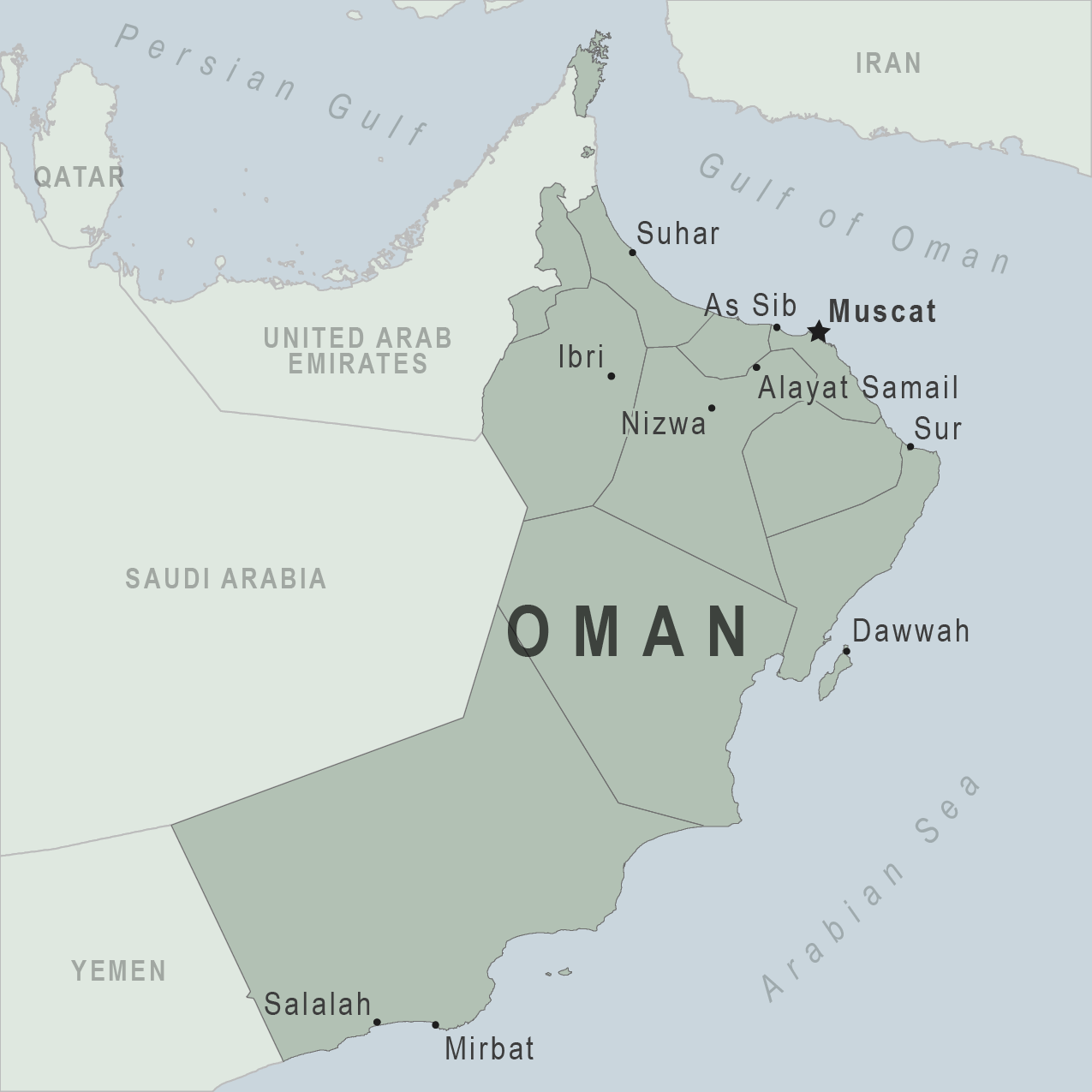
Oman is located on southeastern corner of the Arabian Peninsula. It shares borders with Yemen, Saudi Arabia, and the United Arab Emirates (UAE). Oman also has several enclaves and exclaves that border with the UAE. Its southern coast touches the Arabian Sea, across from India and Pakistan while the northeastern side (and its capital Muscat) borders the Gulf of Oman. The exclave of Musandam Governorate juts out into the Strait of Hormuz, which is at the tip of the Persian Gulf. At that point, it’s really not that far from Iran. Overall, Oman is hot and dry. There are areas in the mountainous regions of the south where it has more of a tropical climate, though. 

Sultan Qaboos bin Said
The earliest peoples were African Nubians. The oldest settlement we know of is Dereaze, which is located in the city of Ibri. Starting during the 6th century, this area was ruled by various Persian dynasties. As the Portuguese were traveling around Africa and India, they stopped in Oman during the early 1500s. However, Ottoman Turks captured the city of Muscat and fought back the Portuguese for it. The Imam of Oman, Saif bin Sultan, started pushing to expand their holdings along the Swahili Coast of Africa (along the central part of its eastern coast: Kenya, Tanzania, Mozambique). The Omanis also pushed the Portuguese out of many of these areas, including Zanzibar (current-day Tanzania), which was an important piece of property and served as Oman’s capital for a brief time. After several instances of battles and divisions, the country was finally divided between in the interior (called Oman) and the coastal area (named after the capital, Muscat). The British stepped in and helped draft the Treaty of Seeb, which declared that the sultan recognized the interior region’s autonomy, and the external affairs of Oman would be handled by the Sultan of Muscat. Oman gained its independence in 1744 and has been ruled by the Al-Said family since. (This makes it the oldest independent state in the Arab World.) When Sultan Said bin Taimur took over during the mid-1950s, Oman became more of an isolated and feudal country, and disagreements between him and the Imam over oil caused a feud that led to military action. After a coup, Taimur was disposed and Qaboos bin Said al Said became the Sultan. He started out with the goal of modernization across all fronts and was a founding member of the Gulf Cooperation Council. He even extended voting right and other rights to women. However, it wasn’t enough to combat some of his extreme decrees, such as the censorship of the press, criticism of the government, among other violations of human rights. 

Muscat, Oman
Muscat is the largest city in Oman and serves as its capital. The city is located along the northeastern coast. It’s long had the distinction of being an important trade port and at different points in time was ruled by Persians, Portuguese, and the Ottomans. When the current sultan took over in 1970, the city saw a rapid increase in its infrastructure, which led to an increase in economic development. With a city population of about 630,000, there are many things to see like museums, mosques, and markets and malls.


Overall, Oman has a pretty diversified economy. Petroleum and oil remain to be high on Oman’s economic drivers, but tourism is also pretty high up there as well and is growing. Their economy also depends on industry and agriculture (a lot of dates and fish!). They do have a free-trade agreement with the US (and probably other countries), and that helps to build up foreign economic ties. Oman also receives many foreign workers from Asia (especially India) and various places in Africa. They don’t make as much money as native Omanis, but it’s definitely more than what they’d make back home. 

Muhammad Al Ameen Mosque
By far, Islam is the largest religion in Oman with nearly 85% of the people practicing some form or another. In Oman, the largest denomination is Ibadhi, followed by Sunni and Shia. There are also significantly smaller groups of Christians and Hindus with a few other religions represented in the mix. 


The official language of Oman is Arabic, although Baluchi is also spoken many areas of the country. However, there are several indigenous languages that are endangered now. As far as second languages and foreign languages go, most street signs in Oman are written in both English and Arabic, and they were the first country in the Persian Gulf countries to offer German as a foreign language. Because of the number of foreign workers from India, there are a variety of Indian languages spoken in Oman as well. Swahili is often still used because of Oman’s historical ties with the language.


There are many peculiar things about Oman that I’ve read about. Oman is also famous for breeding Arab horses (probably like what was used in the movie Hidalgo?). Because their holy day is Friday, their weekend is Thursday and Friday. (That might be changing to Friday-Saturday to reflect more of a global business schedule.) They apparently don’t have Coke products for some reason (or they’re really hard to find). However, you can find Pepsi products easily. One thing they do have instead are really great coffee shops. They serve coffee in small cups (kind of like a cafezinho in Brazil) along with eating dried dates with it. I already know I’m using dates in one of my recipes. Even with some of its issues, I’m sure there are more quirky things here.

Up next: art and literature