Monday, May 21, 2012

ARMENIA: HOLIDAYS AND CELEBRATIONS


There are a handful of public holidays celebrated in Armenia, but there are other celebrations that are spread throughout the year.

January 1. New Years Day. In Armenia, the new year is brought in with cookies, sweets, and a lot of other foods prepared just for the celebration. People will often exchange gifts for New Years as well. One tradition in Armenia is to make darin. Darin is a type of large flat bread that has a coin baked into it. The person who finds the coin is thought to have good luck for the coming year. (I hope the good luck means they avoided the dentist. And I talked about this kind of bread concept when I did Andorra.) Dolma is also really common around this time of year, especially made with rice and grape leaves.


January 6.  Christmas Day.  I’m sure you noticed that Christmas isn’t celebrated on December 25, like much of the world. Why is that? Well, a long time ago, the leaders of various Christian churches gathered to decide upon a date that Christmas should be celebrated on, since there really wasn’t an established confirmed date of Jesus’ birth. While there were many countries in the East that chose January 6 or 7 or January 19, they eventually changed to conform to the December 25 date. Armenia remained one of the few who stuck with their first decision.  No flip-flopping. That’s the date, and I’m sticking to it.

On Christmas Eve, many people will attend church for an evening service and will bring “consecrated fire” (in what form, I have no idea) home with them to shed light on and get rid of any evil spirits in their home. On Christmas Day, they will eat a special dish of rice with raisins and fruits. There isn’t any fish consumed on Christmas Day. (My husband would absolutely flip out over the universal vegetarianism.) People will also take this time to visit the graves of loved ones.

January 28. Army Day. This is a holiday designed to pay homage to the army that was created when the country became the Republic of Armenia in 1992.

March 8. Women’s Day. Men will traditionally give women flowers, and people generally spend the day with their friends and families.

April 8. Easter. One of the most popular religious holidays in Armenia. One tradition is that at the start of Lent, many people will take lentils or other sprout-bearing plants and plant them on a flat tray and by the time Easter comes, it’s used to place the Easter eggs in the sprouts as a display. Another tradition is to paint the eggs red (to signify the blood of Jesus when he was on the cross), and the women wear shawls and make a bread called Choreg (sometimes spelled choereg or choerek or maybe some other alternatives). Choreg is like a braided yeast roll, and if you wait, I’m going to make some when I get to that part of the blog.

April 24. Genocide Remembrance Day. This is in remembrance of the 1915 genocide of over a million Armenians. It was an attempt by the Ottoman Empire to completely eradicate the Armenian people and to remove them from the lands where they have resided since antiquity. The ones they didn’t kill, they sent on a death march to Syria. Many of the tortures foreshadowed those of the more infamous holocaust by Nazi Germany in the 1930s-1940s. Every year, thousands of people will join in a march to the Tsitsernakaberd, a memorial in Yerevan designated to the victims of the Armenian genocide.

May 9. Victory and Peace Day. This is a day that celebrates the fall of the Nazi forces. During WWII, Armenians fought alongside Russia and nearly a quarter of a million Armenian soldiers died in battle. Armenia also has a Tomb of the Unknown Soldier in Yerevan and many people visit it on this day.

May 28. Republic Day. This is the day that Armenia celebrates (along with its neighbor Azerbaijan) its independence from the Transcaucasian Democratic Federative Republic (try saying that three times fast after three shots of vodka). It basically consisted of the countries of Armenia, Azerbaijan, and Georgia. This holiday wasn’t really celebrated until after the collapse of the Soviet Union.

July 5. Constitution Day. This is an official holiday. It marks the day its own constitution was adopted. Victory Park in Yerevan is a popular place for many national festivities, including speeches, concerts, and dances. 

August 25. Vartavar. Celebrated 98 days after Easter (so this is a movable holiday), it’s a holiday where people of all ages are encouraged to throw water on strangers. And it can be by any means – either by water guns, buckets, hoses, however you get it there. It’s a welcomed holiday in the August heat. This has got to be one of the best holidays ever, especially if you’re a kid.


September 21. Independence Day. This celebrates the independence of Armenia from Soviet Russia. Many people will fly Armenian flags, and there are parades in the streets of Yerevan. Gathering together with family and concerts prevail during the day, ending with fireworks displays at night. My daughter thought it was awesome that there’s a holiday somewhere on her birthday.

December 7. Spitak Remembrance Day. In 1988, a 7.1 magnitude earthquake shook the northern regions of Armenia, killing at least 25,000 people. Many of the deaths were contributed to shoddy construction of homes and businesses created from Soviet-era building. 111 countries sent humanitarian help to this area. This picture shows the Motherland memorial in Washington, D.C.


 Up next: art and literature

Resources:
Wikipedia: “Public Holidays in Armenia” “Vartavar” “Armed Forces Day” “Republic Day” “1988 Spitak Earthquake”

Saturday, May 19, 2012

ARMENIA: THE LAND AND THE PEOPLE


Every time I get ready to do a new country, I usually take a look at my pre-knowledge. What do I already know about this country? Well, for one, I had the location wrong (yes, it’s rare, and I’m embarrassed to admit that.). The only other thing I had going for me was that their language was also called Armenian. So, I had a LOT of learning to do.

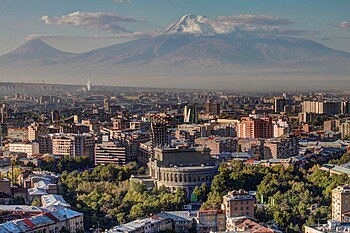
First of all, Armenia is located in the northern part of the Middle East, by Turkey and north of Iran – not in southern Europe like I had previously thought. It’s also bordered by the countries of Georgia and Azerbaijan.  Armenia is also the home of the famous Mt. Ararat – you know, like where Noah’s ark landed after the flood.  In fact, the word for “Armenia” in the Armenian language is Hayk (sometimes called Hayastan), which is named after the great-great-grandson of Noah. The name “Armenia” itself is thought to have ultimately come from the Greek.


Armenia prides itself for being the first country to declare Christianity as its official religion, since about the 4th century. (This is even before the Roman Empire did! Take that, Romans.)  In fact, one monk and linguist by the name of St. Mesrob Mashtots (awesome name) was the one who created the Armenian alphabet, which was one of the key things that helped to develop the Armenia kingdom and its standing as its own independent government. The Armenian language itself, while similar to other languages spoken in nearby cultures, is linguistically in a category on its own and belongs to no specific language branch. (Sort of like the Albanian language.) St. Mesrob is considered one of the Holy Translators of Armenia. (I didn’t even know that was a valid position. Wonder if I could apply… I thinking I may not get it simply because I’m 1) not holy, 2) not a translator, and 3) not Armenian. But stranger things have happened.)

The country itself has a fairly high rate of sanitation and clean water, as well as literary rates. However, the country has taken an economic downturn in the past decade: Armenia is #1 in the world in unemployment of 15-24 year olds at 57.6%. In comparison with the United States, the unemployment rate for 15-24 year olds is only 17.6%. Overall though, the unemployment rate is around 5.9%, compared with the United States, which is around 9.1%. Initially what this says to me is that they have more adults working rather than high-schoolers and young adults, who are more than likely attending school during these years. Whereas you’ll find in the United States, there is more of a push to have younger workers while in school. But there may be other factors I’m not aware of as well.

For much of the 20th century, Armenia was part of the communist Soviet Union. Even though Yerevan has been the capital of the Republic of Armenia since 1991 (starting with the fall of the Soviet Union), there are still many remnants of the Russian influence on the city, country, and its people. In fact many people still insist their kids learn Russian as a second language.


The capital city is Yerevan and Armenia’s largest city. It’s considered one of the oldest continuously inhabited cities in the world (Damascus, Syria is the oldest), showing evidence that people have lived there since around 800 BC. Today, Yerevan has about 1.1 million people living there, almost as many as Indianapolis, Indiana. In fact, the city just earned cool points in my book since they were named 2012 World Book Capital, an honor designated by UNESCO to certain capital cities that stress an importance in books, reading, and literacy programs aimed at not only local levels but also international levels as well. (The cynic in me was saddened but not surprised that Washington, D.C. hasn’t made the list yet; but when you have lawmakers promising to cut the entire Dept of Education, I don’t see World Book Capital happening anytime soon, unfortunately.)


While the area may have been controlled by a plethora of ruling parties and have changed hands many times in its history, Armenians strive to maintain their own identity throughout all of this and are proud of what is Armenian. Even if it means parts have been borrowed here and there.  Like its language, their culture may be similar to nearby cultures, but it is indubitably and irrevocably Armenian.

Next up: Holidays and Celebrations

Resources:
CIA World Factbook: Armenia
Wikipedia: “Armenia” “List of country-name etymologies” “Saint Mesrob” “Yerevan”
National Geographic.com

Sunday, May 13, 2012

ARGENTINA: THE FOOD

Today is Mother’s Day, and I am cooking food from Argentina. My husband told me, “Why go out when you cook better than a restaurant?”  Well, I suppose he may be right on that one (even though I had been craving jerk chicken for almost a month now). And you certainly couldn’t buy this meal in a restaurant for as cheap as it was for me to make it myself.

The ingredients for this were pretty easy to find for the most part. It was finding the recipes that gave me some trouble. I was immediately drawn to this bread called chimichurri bread. It was full of spices and other good things, and I just HAD to make it. However, almost every recipe had these directions: “Put it in a bread machine and press ‘Start.’”  That’s lazy. The whole point of this was to make bread by hand, and besides, I don’t even own a bread machine. But I did end up finding a quasi-by-hand recipe that I had to improvise off of. The first part of the recipe still called for the dough to be processed in a bread machine on dough cycle, which I still had no idea what that meant. So what I did was mix everything together, let it rest for an hour, then lightly kneaded it before put it in a loaf pan to bake.

This dough rested like a baby, you know, for only an hour and woke up without much change as before. 
It seemed kind of thick and didn’t really rise at all, and I did have to keep it in the oven longer than indicated (which it probably could’ve stayed in a tad bit longer). But it was good though, especially with the melted smoked provolone on it (based on a provoleta recipe I found) that melted way more than it was supposed to.  It’s probably because I cut the pieces too thin, but I never claimed to be the world’s best cheese slicer. In fact, I didn’t even make the Sweet 16. I’ve learned to get over it, though.

The finished product. See how I learned to score. (The bread. Where was YOUR mind?) 
The main dish I made was beef empanadas. I did a couple things new in this recipe that I’ve not done before. It had me pour boiling water on the ground beef to partially cook it (but it didn’t say how much boiling water I had to use. I ended up using about 6 cups). I also wasn’t really sure about the pastry sheets – the only thing I could find was fillo sheets. I used one of my soup bowls as a stencil and a paring knife to cut out the circle shape. Because the fillo sheets were so thin, I doubled them up. But they turned out really good. I know they were good because my kids each ate two.

Just looking at this picture makes me want to go get another one. Hold on just a second...
And the plus in all of this for me was that I found Quilmes beer from Argentina to accompany our meal (well, mine anyway). Two weeks ago when I was looking for conch at this fish market, I took a look around. And surprisingly they carried several different kinds of beer from various Central and South America. It’s actually not a bad beer; I kind of like it. The bottle claims it’s Argentina’s favorite beer. I can see that, even though I’m pretty sure I should probably go to Argentina and try them all and see for myself. You know, truth in advertising.

Quilmes is Spanish for "Just let me enjoy this without anyone bothering me, please." 
The whole meal was simple, yet filling, even though I was a little hesitant about putting raisins and green olives in with my beef.  But like I keep insisting to my husband, flavors mix when together and create new flavors. Actually, I tasted the Spanish smoked paprika more than anything. I’m glad that I did this meal. It brought my family together, and that’s really all I wanted for Mother’s Day. (Ok, that, and to have my new stereo installed into my vehicle by my incredibly gifted husband. That’s all really.)

Up next: Armenia

Resources:

Saturday, May 12, 2012

ARGENTINA: MUSIC AND DANCE


One of the most popular and well-known styles that came out of Argentina is the tango. German and Italian immigrants brought this style of music to this area when they immigrated there. A traditional tango orchestra consists of a sextet: two violins, a piano, a double bass, and two bandoneóns (an instrument that sounds somewhat like an accordion).  The driving feature of the tango is the “dotted quarter – dotted quarter – quarter” [in 4/4 time] feel to it.

The dance of the same name that accompanies tango music has its roots from Europe and Africa. It was immensely popular around the turn of the 20th century up until about the middle of the century. Tango was a social dance, and was especially popular among working-class and immigrant communities. There are several styles and type of tango dance, but more or less the two partners stand very close – almost chest-to-chest – where one person leads and the other follows closely. Tango is included among the canon of ballroom dance. In 2009, UNESCO approved the dance to be part of the Intangible Cultural Heritage List. This is an example of both tango music and tango dance. 


In popular music, rock music is all the rage. And that, my friends, makes me happy. One band that I came across on Spotify is Intoxicados. I really like them, although I found I liked the album “Otro dia en el planeta tierra” [roughly translated as “the other day on planet Earth”] better than the album “El Exilio de Espicies” [roughly translated as “the exile of spicies”].  Both albums are available on iTunes for $9.99.


I’ve also come across the band Catupecu Machu. They’re a little harder rock than Intoxicados. There are some songs that I like, but others are just ok though.  There are several albums on iTunes ranging from $7.99 to $15.99.


I also really like the band Babasónicos. They have a sort of 70s/retro sound to some of their songs. They actually sometimes remind me of the Brazilian band Skank (before you get any ideas, it’s pronounced /skunk/).  I was listening to the album “A Propósito” on Spotify and was quite impressed. I might end up buying this one. I’m not sure yet, but I did like it a lot. It’s a toss-up between Intoxicados.


There’s also a movement to bring back Argentine folk music. Several folk artists have become popular in their efforts to bring folk music to younger crowds. One artist who has mixed folk with rock is Leon Gieco. (Every time I see his name I think it says Geico, like the insurance company.) His album called “Grandes Exitos” is really good. ($9.90 on iTunes). [While Spotify dates the album as 2005, iTunes says it was released in 1995. Regardless, good music is timeless, so I’m not sure why I bother with mentioning this discrepancy.] I’ve also listened to his album called “4° LP” which is very good, but not available on iTunes (I’m lazy and am in love with instant gratification; if I can’t buy it and download it right away, I’m going to let out a huge sigh and curse.) Enjoy! 


Up next: the food!

Resourcs:
Wikipedia: “Culture of Argentina” “Tango music” “Tango dance” “Bandoneóns”

Wednesday, May 9, 2012

ARGENTINA: ART AND LITERATURE


Before the 20th century, art in Argentina stayed mainly with the major trends of European styles. However, during the 20th century, Argentine artists started to develop their own styles that were uniquely their own. During the 1970s, there was a movement of artists called the “New Image Painters,” who created works using ordinary objects but placed in unordinary positions, backgrounds, and situations. The point was to have the viewer create the context as to which it was there. Argentines also followed through some of the major art movements in Europe and America, such as the impressionism, cubism, and the pop art movement. One of my favorite artists I came across is Xul Solar. His work seems like a cross between Pablo Picasso and M.C. Escher. 


 One popular style that was influenced by Mexico (among other countries) is muralism. Many artists looked around and realized that they were surrounded by blank canvases in the forms of the drab sides of buildings and walls. Starting in the 1920s and 1930s, artists started painting cultural and national scenes in neighborhoods to try to bring the areas up and also as an expression of their social and political ideas.


Architecture and sculpture remains highly influenced by classical European styles.  The styles of Spanish, Italian, and French architecture and sculpture of different periods can be seen in cities such as Buenos Aires, Cordova, and Mendoza. 

Argentina has produced a plethora of writers, poets, and playwrights.  One of its most famous writers is Jorge Luis Borges who’s most famous for his short stories, especially the collections Ficciones and The Aleph.  Another writer that I had forgotten who was from Argentina is Manuel Puig. I knew him from reading the play Kiss of the Spider Woman, which was made into a musical in 1993. (Yes, and I will admit that I do own the soundtrack.) 


Argentina is also a major producer of films and cinema, producing around 80 full-length films a year. Many of these are considered part of the canon of Spanish-language films. Argentina also boasts that the world’s first animated feature film was not only made but produced there in 1917. It was created by cartoonist Quirino Cristiani and was called El Apóstol. The only copy of the film itself was destroyed in a fire and now considered a lost film. (In contrast, the first animated feature-length film produced in the United States was Disney’s Snow White and the Seven Dwarfs in 1937.)

Up next: Music and Dance

Resources:
Wikipedia: “Culture of Argentina” “List of Animated Feature Films: Pre 1940”

Monday, May 7, 2012

ARGENTINA: HOLIDAYS AND CELEBRATIONS


There are a lot of holidays that celebrate the country or a national event in Argentine history. There are of course holidays and celebrations that reflect the large Roman Catholic population as well.

January 1.  New Years Day.  There are several traditions (some ordinary, some not) that take place. Most people will gather together for a late meal with friends and family. Traditional foods include pan dulce (a sweet bread) and turron (a type of cake of sorts).  Around midnight, everyone will go outside to bring in the New Year. Fireworks displays light up the night, and people will stay out and dance with live music, eat, and celebrate practically up until dawn. Many people will attend church services on New Years Day itself. (I have no idea how; I’d probably fall asleep if I attended after staying up all night.)  Some people will run around the house with a suitcase to hope for more travels during the coming year, whereas others will eat beans to ensure they stay on at their job or with hopes of a better one. Many others will go swimming, either in a pool, river, or lake.  (This isn’t a Polar Bear Club sort of thing; remember, in Argentina it’s summertime in January.)

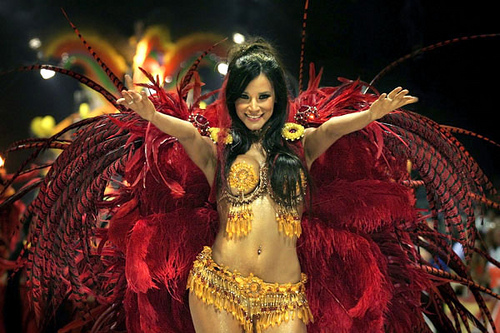
February 20-21.  Carnival.  (This is a floating holiday.) The traditions of Carnival in Argentina are similar to those that we see in Rio de Janeiro. Many cities throughout Argentina hold their own Carnival traditions, but two of the largest are in Buenos Aires and in the city of Gualeguaychu.  There are presentations of many different samba schools with up to 700 dancers all dressed in brightly decorated costumes.

March 24.  Day of Remembrance for Truth and Justice.  This is a day of remembrance for the victims of what’s called The Dirty War, where thousands of students, left-wing activists, journalists, trade unionists and sympathizers were killed.  It’s more specifically in remembrance of the coup d’état in 1976 when the National Reorganization Process took power.

April 2.  Day of the veterans and the fallen in the Malvinas War.  This day is to commemorate the day in 1982 when Argentina fought against the British to gain control of the Falkland Islands.  There are still disputes with them over ownership. 

April 8.  Easter.  (This is a floating holiday.)  Many towns and cities will have reenactments of the Passion during this time.  The whole week following Easter Sunday is a week of celebrations.  Many people take this two-week period off of work.  I would just be happy with taking the Monday afterwards off.

May 1. Labor Day.  There have been a lot of labor issues in Argentina’s history, and with a fairly high unemployment rate, it’s still a pressing issue today.  There are initiatives to try to make the work day only 6 hours, but most people probably work closer to 10 hours a day on average.

May 25.  Day of the First National Government.  It’s a day commemorating the May Revolution (which began the Argentine War for Independence) and the Primera Junta (the First Assembly).

June 20.  National Flag Day.  A day to celebrate the Argentine flag.  There are three horizontal bands: light blue on top, white in the middle, light blue on the bottom. The light blue represents the skies, and the white represents the snow-topped Andes. In the middle of the white band is a yellow sun with a face, known as the Sun of May.  Its facial features are those that are from Inti, the Incan god of the sun.


July 9.  Independence Day.  A day celebrating Argentina’s independence from Spain. Many people display flags and have cookouts with their families and friends.

August 17.  Anniversary of the death of General José de San Martín. He was one of the main tacticians in leading Argentina to independence. He’s considered a national hero.


October 12.  Day of Respect for Cultural Diversity.  Almost the same as Columbus Day in the United States. It’s a day to celebrate Christopher Columbus’ accomplishments and bringing “civilization” to the Americas.

November 20.  Day of National Sovereignty.  It’s a day to commemorate the Battle of Vuelta de Obligado, a battle where a small group of Argentine soldiers fought against the Anglo-French navy that entered the Paraná River. Even though it ended with the Argentines loosing the battle, it’s still considered a major national historical event.

December 8.  Immaculate Conception Day. This is a day for Christians (mostly Catholics) that celebrates their belief in the concept that Mary had conceived as a virgin. Many people will attend church services on this day.

December 25. Christmas Day.  Many Argentines celebrate Christmas in the stereotypical ways celebrated around the world. They decorate their homes with lights, as well as having a Christmas tree (although it doesn’t necessarily have to be an evergreen tree). Gifts are exchanged with family and friends. Even though Christmas falls in the summer in Argentina, they do have many of the traditional foods found in Europe or America, such as roast pork or turkey, but they also include a lot of fresh fruits and cold desserts as well. A popular tradition is to visit the beaches during this time. 

Up next: art and literature

Resources:
Wikipedia: “Public holidays in Argentina” “Day of Remembrance for Truth and Justice” “Dirty War” “First National Government” “General José de San Martín”  “Day of National Sovereignty”
CIA World Factbook: Argentina

Sunday, May 6, 2012

ARGENTINA: THE LAND AND THE PEOPLE


When I realized I was doing Argentina this week, the first thing that ran through my mind was “Don’t Cry For Me Argentina.” Of course I know there’s got to be more to Argentina than one piece of history brought to us by Andrew Lloyd Webber. Located in the southern part of South America, it’s the second largest country on the continent (after Brazil). In fact, it’s the eighth largest country in the world, when it comes to area.  The land itself is as diverse as its people. The Andes mountains (not to be confused with Andes Mints. Mmm…) border the western side of the country, while there are rich fertile plains in the northern part of the country, called The Pampas. They are subject to some volcanic activity along the mountainside border with Chile as well as earthquakes. 

The Pampas
 While the official language is Spanish, as with most of South America, there are several other languages that have large numbers of speakers who live in Argentina. You’ll also find pockets of Arabic, German, Guaraní, English, French, and Brazilian-Portuguese spoken here as well.  

Rio de la Plata
Located on the Atlantic Ocean side in the Rio de la Plata, the capital Buenos Aires has almost 13 million people in it. It’s one of the largest metropolitan areas in South America, bringing a lot of diversity to the area. Roughly 92% of Argentines identify themselves as Roman Catholic, but less than 20% are actually practicing. Having access to clean water, sanitation, and medical supplies are contributing factors to why most Argentines have a fairly long life expectancy.  (Although there are some risks for communicable diseases in the poorer and/or less urbanized areas, of course.)

The name Argentina itself comes from the fact that Spanish explorers were following a rumor there were large silver deposits in the mountains, for which there were none found in the area where they landed. The Latin word for silver was argentum.  (In fact in French, also based from Latin, the word for both silver and money is the word argent.) I think this is hilarious in a sort of anti-climactic way. The capital Buenos Aires roughly means “fair winds” after the long form of the city name that was named after the patron saint of Sardinia: Ciudad de la Santísima Trinidad y Puerto de Santa María del Buen Aire. I can understand why they’d just call it Buenos Aires. Mostly because it saves in ink on government forms, I imagine. 
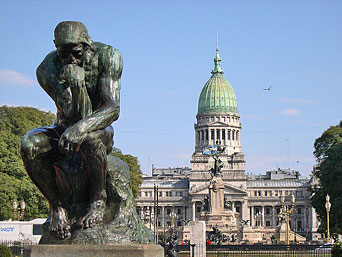
Buenos Aires, Argentina
 A lot of Argentine culture has been heavily influenced by other European and American cultures, but it has also mixed with the local peoples and its own history to create its own unique culture. As we take a look at Argentine cultural arts, you can definitely see how it may be similar to others but yet it is definitely, indubitably all Argentina.

Next up: Holidays and Celebrations

Resources:
Wikipedia: “Argentina” “Buenos Aires” “Etymology of Country Names” “Etymology of Argentina”
CIA World Factbook: Argentina