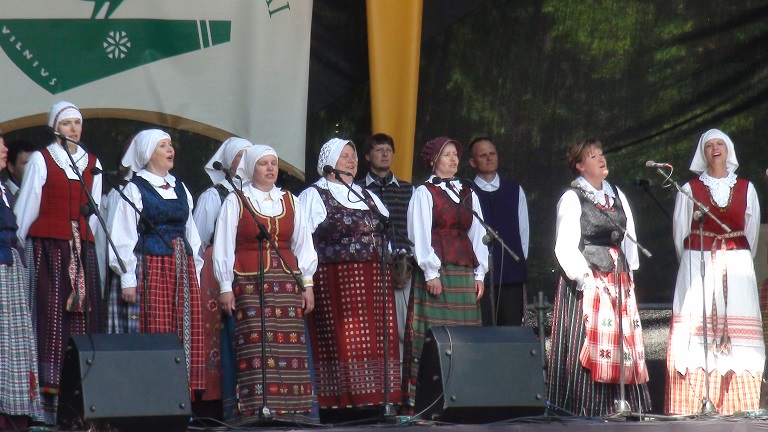
Vocal music uses several
different kinds of harmonization: monophony, homophony, and polyphony. Each
style certainly depended on which region was creating it and at what time it
was popular.

As far as
instrumental music goes, they used several instruments that were in common with
Russian and Baltic music: harmonica, accordion, concertina, balalaika,
mandolin, guitar, cornet, and the kankles (a type of zither).
Folk music was
divided between several different styles, and each style was designated for
different types of folk songs: sutartines are a main one (multi-voiced songs
that are often syncopated and are usually divided between 2-4 performers) and there
are also a different number of tasks songs were written for (wedding, hay and
rye harvesting, spinning and weaving, berry picking, fishing, etc.).
Classical music was
mainly dominated by Lithuania’s own Mikalojus Konstantinas Ciulionis who was
also a renowned painter. In his 35 years, he composed nearly 200 pieces. I
listened to several of his orchestral works as well as his piano works, and I
really like his style. Most of it sounds similar to typical late 19th
century music. But that’s one of my favorite time periods for music. He’s most
widely known for his works In the Forest
and The Sea. Osvaldas Balakauskas and
Vytautas Miskinis were two more Lithuanian composers of note.
Dance traditions
have always been an important part of Lithuanian culture. And every movement
serves a purpose and has a meaning, often tied with a specific emotion.
Typically, their dance is deeply rooted in their agricultural life. Many of the
other types of dances (war dances, hunting dances) have not survived. Some of
the polyphonic sutartines actually have dances that go with them. These simple
dances are generally danced in a circular or quadrille style dance. There are a
number of other circular dances, not to mention paired dances, group dances, borrowed
dances from other European dances, and even dance games where the dances follow
certain “tasks” in the dance. However, you won’t find much jumping or kicking
in Lithuanian dance; it’s more subdued than that.
There are a number
of musicians and bands I came across on Spotify. The first band I listened to
is Foje, a band that was popular in the 1980s. It is every bit of 1980s that
you can think of. I’m sure it probably comes with a side ponytail, neon colors,
and leaded gas. The lead singer of the band was Andrius Mamontovas, who also
had his own music as well, which sounds more like acoustic 1990s music.
Antis was another
band that has a quasi-1990s-electro sound. I sampled several songs, but I had a
hard time finding one that I truly liked. There were a few, but overall, I
think I just had to be there. However, I found this video (above), so maybe I just needed to listen to other albums. With the help of Google translate, "debesys musu minys" means "clouds, our thoughts."
The band Skamp is a
quasi-ska/rock band. I like some of the songs I listened to. Most of the songs
are sung in English with a few songs in other languages (French, maybe? And
maybe Lithuanian?)
I liked some of
what I heard from Happyendless. It still has a 1980s rock feel to it, but it’s
done in a way that I like. Dramatic, to say the least. It’s completely sung in
English.
Ten Walls is a
group (or maybe it’s just a DJ) who makes electronica music. I love what I was
able to listen to. It’s the perfect music to listen to. And as a trance music
lover, I recommend it, even if it’s not fully trance.
I highly enjoyed
listening to Jurga as well. Her music was a cross between being ethereal and
electronica and indie rock. It is also something good to listen to while I
work.
I'm confused when it comes to Jazzu. What I listened to seemed a little
farther out there for me -- kind of a hardcore electronica/drum-n-bass type
of music (sort of). There were a few songs I liked, but some others were just
too industrial for me. However, what I found on YouTube was acoustic piano with a female vocalist, which I liked much better.
And finally, my
favorite of what I listened to: Freaks on Floor. I think people should know
this group. Definitely an indie rock band and definitely talented. I listened
to most of the album Life and most of
Hello Girls! I really like their
style. Like, really. Like when my tax check comes in the next couple of weeks,
I’m thinking of getting these albums.
Up next: the food

_-_1909.jpg)