Showing posts with label Mosquito Coast. Show all posts

Sunday, February 19, 2017

NICARAGUA: THE LAND AND THE PEOPLE


For years, I’ve always bought into the sentiment that Nicaragua was a dangerous place. But as I was reading through information about the country, I found out that is actually not really the case today. In fact, it’s one of the safest countries in Central America, and it has the lowest crime rate as well. So, where does this come from? Perhaps, it’s left over from American propaganda from the early 1980s. I don’t know for sure, but if I was wrong about that, it leads me to ask what else am I wrong about Nicaragua?


The name Nicaragua is derived from the word the Spanish gave to it. They named the country after Nicarao, one of the chiefs of one of the largest tribes. However, Nicarao wasn’t really the leader of the largest tribe according to some historians, but a guy named Macuilmiquiztli. Regardless, the name stuck and here we are.


Nicaragua sits in the middle of Central America and is the largest country in he region. It’s bordered by Honduras to the north, Costa Rica to the south, the Caribbean Sea to the east, and the Pacific Ocean to the west. The country is generally divided into three sections: Pacific Lowlands (hot, fertile plains), North Central Highlands (forested with rivers), Caribbean Lowlands (rainforests). Lake Nicaragua is the largest lake and actually has 430 volcanic islands. It’s also home to the bull shark, the only freshwater shark in the world. The rainiest area is the Mosquito Coast along the Caribbean. Because of the tropical climate (although it varies depending on altitude and location), there is quite a biodiversity here. 
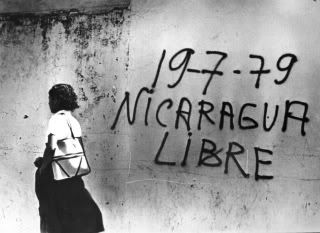

The earliest people arrived in Nicaragua from Mexico around 500BC. Eventually the Aztecs and Mayans spread into this area. In the early 1500s, Christopher Columbus made his way to Central America and explored his way along the Miskito Coast. Like in true Columbus fashion, he tried to force the different tribes to convert to Christianity. Two of the three followed suit, but one tribe wasn’t having it. They fought against them but in the end, they fell to the Spanish. The Spanish started building permanent cities: the first was Grenada, and the second one was León. They also began intermarrying with the indigenous people, creating a mixed race called the mestizos. However, they were also killing them off with their nasty European diseases that the natives had no immunity for. During the early 1800s, Nicaragua was part of the First Mexican Empire, but later joined the Federal Republic of Central America. During the mid-1800s, the two cities of León and Granada became politically polarized; the Liberal Elite were in León and the Conservative Elite were in Granada. The Liberals invited American William Walker into their fight, but Walker set himself up as president instead, to which most of Central America came for him to boot him out. Great Britain, who had been controlling the Mosquito Coast since the mid-1600s, finally gave it back to Nicaragua (even though it remained autonomous for several decades afterwards). The 20th century was quite a turbulent one for Nicaragua. In response to helping the Conservatives and generally keeping peace, the US stepped in. The Marines moved into Nicaragua and stayed from 1912 to 1933. (They did try to leave once, but everyone started killing each other, so they came back.) The Somoza family would rule the country for several decades, leading in a ruthless fashion. The country would undergo another revolution. The Sandinistas took over in 1979, and the Carter Administration initially gave them money in support but got pissed when they found out they were using the money to support rebel forces in other Central American countries the US didn’t like. Reagan one-upped Carter by getting the CIA to fund and train the contras. Later on, people got pissed about that, and Reagan started selling weapons to Iran and taking the money to fund the contras that way (known as the Iran-Contra Affair). The Sandinistas were eventually voted out, and although elections have generally been fairly peaceful (more or less), there have been quite a bit of shady and illegal deals (fraud, embezzlement, corruption, mayhem) by top officials. However, Nicaragua was the first country to democratically vote in a woman in the Americas. It’s more than what we can do, apparently. 
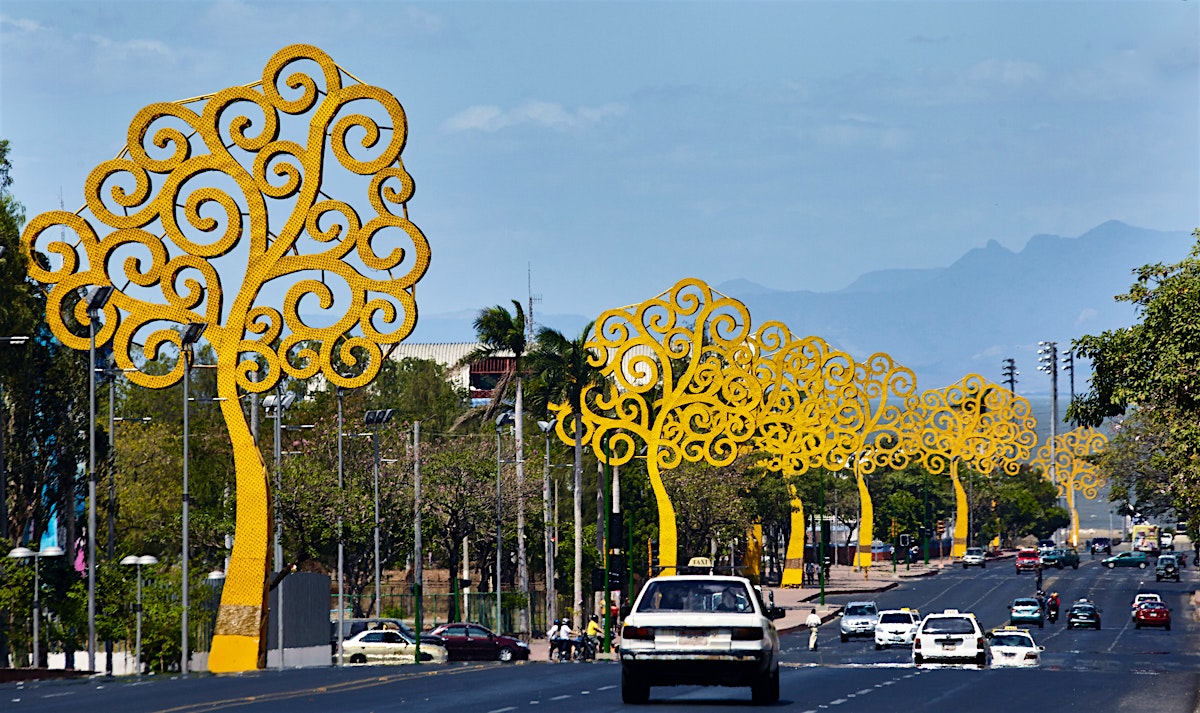

Today, the capital city is Managua, a city of about 1.3 million people (metro area) located along the shores of Lake Managua (also called Lake Xolotlán). The capital city was moved here in 1858 because no one could agree whether León or Granada should be the official capital city. However, Lake Xolotlán has been polluted since the late 1920s. (Thanks, Industrial Age.) Managua was the first capital city to declare itself rid of literacy. It’s become an educational hub for the country with 48 universities and 113 colleges. It’s also the economic center and home to many multinational and national headquarters. Not to mention that it’s the head of the government, media, and culture. The city is filled with museums, shopping centers, sports venues, world-class restaurants, theatres and entertainment, and historical sites.


However, Nicaragua remains to be one of the poorest countries in the Americas. Workers here have some of the lowest minimum wages in this part of the world. They depend quite a bit on agriculture (mainly bananas, other fruits, coffee, cassava, sugar, cotton, and beef) and remittances from abroad. Nearly 80% of the population lives on less than $2 per day. Infrastructure is still weak in many of the rural areas, and sanitation hasn’t made it out to many of the rural areas either, but changes are being made and improved. However, tourism is quickly growing, and many people visit each year for its ecotourism opportunities: Nicaragua has been dubbed the “land of lakes and volcanoes.” 
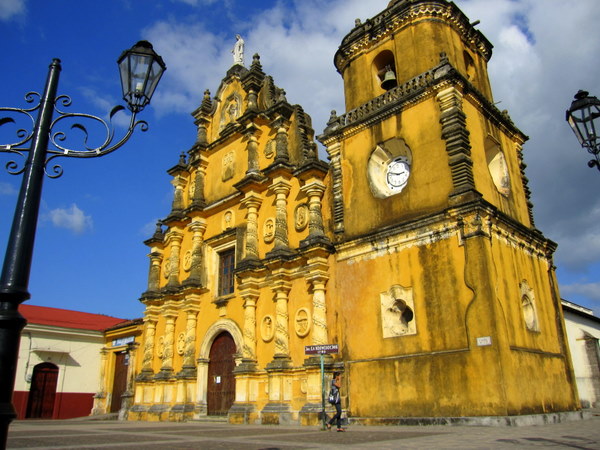

Officially, Nicaragua doesn't have an “official” religion, but Nicaraguans tend to take religion seriously. For the most part, anyhow. And when it comes to religion, Roman Catholicism is the most dominant religion in the country. There are also pockets of Protestants, Anglicans, Mormons, and Moravians throughout the country as well. Because of its historical ties with Roman Catholicism, there are very strong ties between cultural fests and holidays with the religion and its patron saints. 


Although Spanish is the official language and most widely spoken language in Nicaragua, there are a number of other languages spoken throughout the country as well. Along the Miskito Coast, the Miskitu language is still spoken there by the Miskitu people. Very few of the Rama people still speak their Chibchan language fluently, although most speak a Rama Cay Creole. There are also English-based and Spanish-based Creoles spoken throughout the country. In recent years, the Garifuna people have tried to bring back the Arawakan language (who mostly speak Miskito Coast Creole today).  


Managua, like many cities across the world, doesn't name their streets. And I thought I had read somewhere years ago that U2’s song “Where the Streets Have No Name” was about Managua. But when I researched this further, Managua wasn’t the inspiration for this song. It was actually about Ireland (and Northern Ireland). Makes sense now that I think about it. Again, there are so many things that I thought I knew about this country that is apparently not quite true. So, I’m looking forward to setting the record straight with myself and maybe you, too.

Up next: art and literature

Sunday, February 15, 2015

HONDURAS: THE LAND AND THE PEOPLE

When I was in college, I used to meet a lot of people from a lot of different countries. It helped that I was part of the Languages, Literatures and Linguistics department at Indiana State University. I met a few people from Honduras there as well as when I used to tutor in ESL in various places. And oh, what I wouldn’t give to be there right now, where it’s warm and fresh fruit is always in season, instead of here in Indiana, where we’re bracing for wind chills below zero and fruit is expensive now because it’s out of season. Those things make me sad.

The name Honduras means “depths,” which may be stemmed from many sources. Some historians believe it may have been based on a statement from Christopher Columbus, or it may have referred to the Bay of Trujillo. Before 1580, Honduras only referred to the eastern part of this area whereas Higueras (“fig trees”) referred to the western portions.


The country of Honduras is located in the middle of Central America, surrounded by Guatemala to the west, El Salvador to the southwest, and Nicaragua to the east. It has a very long coast on the Caribbean side (700 km/435 mi) and a very short coast on the Gulf of Fonseca (153 km/95 mi), which opens to the Pacific Ocean. Because of its tropical climate, Honduras has a wide variety of flora and fauna. They’re quite known for the number of native plants, including 630 varieties of orchid along with over 700 types of birds, and over 50 types of bats. Honduras’ rain forests and cloud forests keep ecotourists arriving year after year. The Mosquito Coast, named after the Miskito Indians who first lived there, spreads along the Caribbean coast and extends through most of the Nicaraguan coast. There are still many areas of the Mosquito Coast that are scarcely populated and contain untouched rainforests.


Before Columbus arrived in this region of the world, the Mayan civilization extended through what is now known as Honduras. On his fourth and final trip to this area, Columbus landed in the Bay Islands and near where the city of Trujillo currently lies. Hernán Cortés later came in from Mexico to conquer these lands as well; however, much of the Miskito Kingdom did not fall to the Spaniards at that time. The Spanish counted Honduras as a province of Guatemala, and eventually moved the capital from Trujillo to Comayagua to its current-day capital of Tegucigalpa. They set up silver mines, basically using the native peoples to work the mines in exchange for protection from other warring tribes along with other promises (this legal system was called encomienda). But as disease spread, the Spanish brought in slaves from Africa to pick up the “slack” from the dying native population they were more or less responsible for. Honduras did eventually gain its independence from Spain in 1821, but it was difficult for them to find their place. It was part of the First Mexican Empire, then it was part of the United Provinces of Central America before settling on becoming the Republic of Honduras.  There have been many skirmishes and rebellions throughout the early years in Honduras’ history. The fruit companies, and more specifically the sale of bananas, carved out a significant corner of Honduras’ economy, thus leading to the term Banana Republic (given by no less than the US author O. Henry). The downside was that although these were very large companies and had a lot of influence on several governments, they were tax exempt, and therefore didn’t contribute very much to the economies at all. In 1969, Honduras and El Salvador became engaged in border tensions that escalated during elimination matches ahead of the World Cup.  This became known as the Soccer War. The US has had a military presence in Honduras many times in the early part of the 20th Century as well as on and off again during the 1970s and 1980s in an effort to keep peace in Central America among other reasons. Honduras has also been ravaged by hurricanes and flooding many times, causing millions of dollars in damage and taking years to rebuild its infrastructure.


The capital city is Tegucigalpa, or commonly referred to as Tegus by the locals. Lying in the interior of the country, yet not far from the Pacific side, this capital city has about 1.3 million people in its metro area. The origin of the name Tegucigalpa is disputed, although many historians and anthropologists believe it is derived from a Nahuatl word. The government of the newly founded country decided to alternate the capital city between Tegucigalpa and nearby Comayagüela, although eventually the capital included both cities, each city holding different functions of the government.


Honduras is one of the poorest countries in Central and South America with a high unemployment and underemployment rate and a high poverty rate. Although they do have a substantial mining industry, mostly in silver, gold, zinc, and lead, the country is still highly indebted to foreign aid. There seems to be a lot of debate over whether government-owned or private-owned utilities and subsidies are better and how much actually goes back into the economy. Honduras’ infrastructure is one area that varies widely on where it is. Urban areas generally seem to have better roads, cleaner water, and better functioning sanitation systems. The rural areas can be far less sophisticated in what is provided. In 2003 a new law was passed that essentially took the burden of handling water and sanitation off of the federal government and placed it in the hands of regional and local officials. Many towns banded together to improve their own conditions. I would be interested to see if conditions increased for the better.


While officially Honduras often considers itself a majority Catholic nation, studies have found that the number of Protestants of many denominations is gaining popularity. Many people often attend more than one church, which may be skewing the numbers. Honduras also has significant followings of Buddhism, Bahá’í, Rastafari, Islam, and Judaism.

The official language of Honduras is Spanish, although there are several other languages that carry a recognized regional language status: Garifuna, Miskito, Bay Islands Creole English (also referred to as Caracol), Samu, Pech, Jicaque, and Ch’orti’ (a Mayan language).


For a country that lies along the infamous Ring of Fire, and unlike other nearby countries, Honduras does not contain any active volcanoes. But it does have the oldest clock in the Americas, located in the city of Comayagua, which is still actively keeping time. Thought to have been built during the latter part of the 1300s, this clock still apparently does keep time after all of these years (even though parts of it have been replaced and refurbished over the years). The clock was built in Spain and received as a gift, but it’s disputed as to who exactly gave the clock as a gift. One of the craziest things I read was the “raining fish” phenomenon (called lluvia de peces) in the town of Yoro. There are a number of theories as to why or how this happens, especially given the fact that this town is 140 miles from the Atlantic coast. Whatever is causing this ichthyoidal gift wrapped in superstition, it’s been going on every year for more than a century. I’m excited to jump into researching Honduras. I’ve already downloaded an album by the Honduran metal/rock band Diablos Negros, so this is bound to be good.


Up next: art and literature