Sunday, June 10, 2012

AUSTRALIA: MUSIC AND DANCE


One of the most iconic instruments from Australia is from the Aborigines: the didgeridoo. The word itself is onomatopeic as we know it, but in the native languages, there are at least 45 different words to describe the instrument – each tribe pretty much has its own word.

It’s technically an aerophone, meaning one that’s played with the lips. It’s made of wood, usually from a eucalyptus or native bamboo where there is obvious termite damage to it. They’re usually cut to be about four feet long, give or take some, and then painted with meaningful symbols to that particular tribe or person.  Here is an example of how they find the trees and what it sounds like (it’s about halfway through, pay no attention to the fact that it looks like it was recorded from a VHS).


But then we get to today’s music. And who knew it was full of a lot of my favorites. Let’s start with one of the famous ones I remember from VH1's Pop-Up Videos: Men At Work’s “Down Under.” 


And then there are some of the other groups that were famous in the 1970s and 1980s:  Bee Gees, Air Supply, AC/DC, INXS, Severed Heads. AC/DC would have to be one of my favorites; their songs remain timeless in my book.


Severed Heads branched out from the various rock genres and pushes toward the alternative electronica scene, even though they never really landed on a specific genre. This one sounds a lot like house music or trance in places. 


Then you get to my high school and college years in the 1990s and early 2000s: Savage Garden, Silverchair, Kylie Minogue (even though she spans several decades). I had no idea any of these musicians were Australian. If funny how listening to these albums will instantly bring me back to certain times in my life.


And of course, today some of my favorites include The Vines and Wolfmother, both of whom I’ve listened to for years, without knowing they were Australian. The Vine's song "Ride" was used in a Nissan commercial several years ago, which is when I first heard of them. 


I’ve got two albums by Wolfmother, a band I love for its quasi-70s psychedelic rock sound. Definitely high in cool points. Both of these bands have had songs that have appeared in commercials, TV shows, and movies. My Australia playlist on Spotify is definitely one of my more awesome playlists.


I did find some artists I found that I didn’t previously know.  One was a house DJ called Dirty South.  My husband and I are huge house fans, and I found one of his remix CDs on iTunes for $5.99, so I bought it. There were 28 songs on it, and 2 tracks were over a hour long! I’m so happy with it; I can’t wait to play it loud in the car.

Another artist I found was rapper Bliss N Eso. I listened to his album “Running on Air,” and there are several tracks that remind me of one of my favorite rappers Atmosphere. I almost bought it off of iTunes for $9.99, but I decided to just keep it on Spotify instead. 

Dance in Australia is something of a vast topic. There is certainly Aboriginal dance, but then the Europeans who arrived brought their own dances as well, mostly from England, Ireland, and Scotland.  This came to be known as bush dance. From the non-dancer, it looks really similar to folk dancing or square dancing in the US. But if you think about it, it is a tradition that was stemmed from the Scots-Irish and English traditions, so it's understandable that it would appear very similar (with subtle differences of course) in the areas where they traveled to. 


Aboriginal dance is thought to be an extension of Dreamtime, basically their version of creation stories and the beginnings of spirituality. Most of the dances have a purpose, mostly to tell a story. Their bodies are painted, and the locations of these dances are treated as sacred ground. Many times, they will enact an animal that is important to the area or part of a story. Sometimes they will also perform what’s called a corroboree, where they perform these dances as part of a performance in front of other people.


Today there are a number of professional dance schools and dance companies throughout Australia. Bush dance is viewed as part of the canon of traditional dance; in fact, it’s even included in dance competitions. Modern dance as well as other world dances are also popular in Australia. 

Up next: The Food

Resources:
YouTube.com
Spotify
Wikipedia: "Music of Australia" "Didgerigoo" "Dreamtime" "Dance of Australia"

Thursday, June 7, 2012

AUSTRALIA: ART AND LITERATURE


Art in Australia spans from pre-historical times to today. Aboriginal art is primarily rock art and can be found all over the island, each area having its distinct varieties, but many of the more preserved areas are located at Uluru and in the Kakadu National Park. There is a movement surrounding the preservation of many of these rock sites and the cataloging of these sites. It’s considered to be some of the oldest art in the world. 


Some of the first European-transplanted artists were mainly painters, mostly with the intention of capturing the landscape and scenery but also many of the plants and animals that were indigenous to the area. When they took their art back to Europe, they were met with uncertainty and disbelief of the legitimacy of what they were seeing. In fact, they thought some of the animals, like the platypus, were a joke. Later during the mid-1800s, people started to establish art exhibitions, the first ones being in Melbourne. They were flops in the beginning, but later became quite successful. Art museums started popping up, not only collecting notable works from Europe but also from Australian artists as well.

Modern art in Australia has been influenced by several different European styles. One of those was Impressionism.  Other influences can be seen in cubism and surrealism. You’ll also find a lot of sculpture and photography art as well.


Australian literature spans all literary genres, from poetry to children’s literature to epic novels. And this also includes Aboriginal Literature as well. There is no written language to many of the Aboriginal languages, so until the Europeans came, none of their stories were ever written down.

The highest-selling book in Australia was The Thorn Birds (1977) by Colleen McCullough. It was later remade into a TV mini-series starring a slew of famous actors and actresses. Other works that turned to film were Thomas Keneally’s Schindler’s Ark, which was the basis and inspiration of Schindler’s List.


I started reading a sample of the book True History of the Kelly Gang by Peter Carey.  I think I may have to buy it so that I can finish it. However, it’s actually fiction. But that’s ok. Maybe that might make it better knowing it was just fiction.


Another writer that I had no idea was Australian is James Clavell. As a student of the Japanese language for the past almost 20 years, I finally read Shogun several years ago. It took me a long time to read it, and it was epically long. But it was a really good book. It’s actually part of the Asian Saga, a set of six books that are epic novels taking place various areas in Asia. There was also a really long mini-series for Shogun as well. The ironic part? Richard Chamberlain starred in the mini-series for both The Thorn Birds and Shogun.


Since I’m such a fan of the Six Degrees of Separation, I realized I can be tied to James Clavell. It’s like this: James Clavell was one of the screenwriters for one of my favorite movies The Great Escape. That movie starred Steve McQueen, one of the coolest guys ever. (Ever!) Steve McQueen was born in Beech Grove, Indiana (a suburb of Indianapolis), which is only a few miles from where I live.

Australian art and literature has been highlighted, inspired, influenced, and generally spread across the world, and especially in the English-literature world. I did come across a website that highlights the 50 Must Read writers/novels in the world of Australian literature. Although it was from a few years ago, it looks like a good place to start if you’re looking for something new to read. You can check it out here.


Up next: Music and Dance

Resouces:
Wikipedia: “Australian art” “The Thorn Birds” “True History of the Kelly Gang” “James Clavell” “Shogun” "Australian literature"

Tuesday, June 5, 2012

AUSTRALIA: HOLIDAYS AND CELEBRATIONS


Holidays in Australia are somewhat of a complicated matter. It seems that each territory determines which holidays are public holidays (where there is a day off of work and school) and which are merely celebrated at work. And some holidays are celebrated on different days in different territories. There are a few that are celebrated by all of them. I’ve put in brackets which territories that celebrate the holidays mentioned (thanks to a really nice chart found on Wikipedia).

NOTE: ACT = Australian Capital Territory; NSW = New South Wales; NT = Northern Territory; QLD = Queensland; SA = South Australia; TAS = Tasmania; VIC = Victoria; WA = Western Australia

New Year’s Day.  January 1. [ALL] Government offices, many businesses and schools are closed on New Year’s Day. Because it’s summertime in Australia, many people will spend the day having picnics and doing other outdoor activities.


Australia Day. January 26. [ALL]  Many people use this day as a day of picnics and barbecues. Sometimes cities and town will have large-scale barbecues and outdoor activities. It’s also a common and appropriate time for people to have citizenship ceremonies.

Royal Hobart Regatta. 2nd Monday in February. [Hobart area of Tasmania only] Started in 1838, this 3-day even is the oldest sport in Tasmania. It not only covers boat racing, but other aspects of water sports (sailing, rowing, swimming, etc.). It takes place on the Derwent River.

Labor Day. 1st Monday in March. [WA] Australians take advantage of the 3-day weekend by spending time outdoors, barbecuing, and perhaps taking a short trip somewhere. In certain cities, labor unions will have parades and key speeches will be led by the city’s leaders. [Labor Day is also called Eight Hours Day in Tasmania and May Day in the Northern Territory.]


Adelaide Cup. 2nd Monday in March. [SA] First run in 1864, this horse race is really important to South Australia. Like the Kentucky Derby, this is more than a horse race, it’s a social event. People dress in their best dress to attend the day-long event; there are a series of eight races each about 40 minutes apart. If you’re not lucky enough to attend, it is shown on television.

Canberra Day. 2nd Monday in March. [ACT] This is a holiday that celebrates the city of Canberra since its founding in 1913. Across the city, there are many different activities for all ages and all interests, including films, music, sporting events, and cultural displays. The city will also name a Citizen of the Year, based on their work in the community.

Eight Hours Day. 2nd Monday in March. [TAS] Australians take advantage of the 3-day weekend by spending time outdoors, barbecuing, and perhaps taking a short trip somewhere. In certain cities, labor unions will have parades and key speeches will be led by the city’s leaders.

Labor Day. 2nd Monday in March. [VIC] Australians take advantage of the 3-day weekend by spending time outdoors, barbecuing, and perhaps taking a short trip somewhere. In certain cities, labor unions will have parades and key speeches will be led by the city’s leaders.

Good Friday. Movable holiday. [ALL] For Christians in Australia, people will attend at least one church service on Good Friday. For others, it’s a time to enjoy the long weekend by spending time outdoors, perhaps with a barbecue with family. 

Easter Saturday. Movable holiday. [ACT, NSW, NT, QLD, SA, VIC] For some Christians, there may be church services held. For others, this is part of a long holiday weekend and may be spent outdoors.

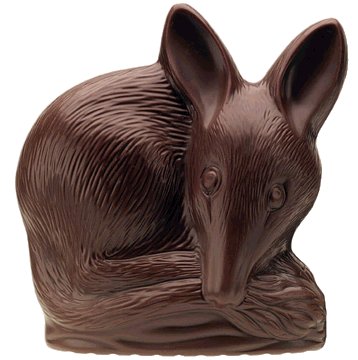
Easter Sunday. Movable holiday.  [NWS] Because Easter follows a period of fasting (during Lent) for many people, Easter is a time of celebration that includes a lot of food. Australians also do the decorated Easter egg tradition as well. Some cities will even have workshops to teach decorating ideas, such as in the Ukrainian style of egg decorating. There is a movement aimed at offering a chocolate bilby instead of chocolate bunnies since rabbits are often considered pests in Australia

Easter Monday. Movable holiday. [ALL] Easter Monday is spent with family. There are also a lot of music fests and sporting events that take place on Easter Monday, since businesses and schools are closed.

Easter Tuesday. Movable holiday. [TAS] Only in Tasmania to they also get the Tuesday after Easter off as well. I’m going to venture to say that it’s spent pretty much in the same way that the long weekend has been spent.


ANZAC Day. April 25. [ALL] Considered one of Australia’s most important national holidays. ANZAC stands for Australia New Zealand Army Corps and commemorates the first military action by Australia-New Zealand forces during World War I. There is always a memorial service that is held at 10:15am and is followed by people placing red poppies besides the names of relatives who are listed on the Memorial’s Roll of Honor. I imagine red poppies are used because of the famous poem “In Flanders Field” by Col. John McCrae, where he mentions red poppies growing on the graves of fallen soldiers.

Labor Day. 1st Monday in May. [QLD] Australians take advantage of the 3-day weekend by spending time outdoors, barbecuing, and perhaps taking a short trip somewhere. In certain cities, labor unions will have parades and key speeches will be led by the city’s leaders.

May Day. 1st Monday in May. [NT] Australians take advantage of the 3-day weekend by spending time outdoors, barbecuing, and perhaps taking a short trip somewhere. In certain cities, labor unions will have parades and key speeches will be led by the city’s leaders.

Western Australia Day. 1st Monday in June. [WA] This is used to commemorate the Swan River Colony back in 1829. It was later changed to Western Australia.


Queen’s Birthday. 2nd Monday in June. [ACT, NSW, NT, QLD, SA, TAS, VIC] Most businesses and schools are closed for this day. There are many sporting events during the day and a large fireworks display at night. This is the only time of year it is legal for people to buy and set off fireworks displays on their own.  It’s illegal at all other times, and only a licensed pyrotechnician can set them off.

Picnic Day. 1st Monday in August.  [NT] Initially created for the railway workers in Darwin so that they could enjoy a day on the Adelaide River for a picnic. It probably doesn’t take a genius to figure out what people will usually do on Picnic Day.


Holiday in lieu of Queen’s birthday. Sept/Oct. [WA] This is the day Western Australia uses to celebrate the Queen’s birthday, since the rest of the country celebrates it around the time that they are celebrating Western Australia Day.

Family and Community Day. 1st Monday of 3rd term school holiday (Sept/Oct). [ACT] This was created as a way for busy workers to take a break and spend time with their families and friends. It’s also claimed that Australians work “the longest hours in the western world.” I don’t know where that figure was attributed from, but I may have to look into that. But still, it’s a far cry from the United States where The Job doesn’t want to believe that people might see that their families slightly more important than work.

Labor Day. 1st Monday in October. [ACT, NSW, SA] Australians take advantage of the 3-day weekend by spending time outdoors, barbecuing, and perhaps taking a short trip somewhere. In certain cities, labor unions will have parades and key speeches will be led by the city’s leaders.

Recreation Day. 1st Monday in November.  [non-Hobart areas of Tasmania only] Although it’s called Recreation Day, a lot of people apparently take this day to catch up on things they don’t necessarily want to do, like study and household chores. Although there are people who spend the day with family or doing outdoor activities. I suppose depending on the family or outdoor activity, household chores may be the better option.

Melbourne Cup. 1st Tuesday of November. [VIC-Melbourne area] Another one of Australia’s most popular horse races and social events. Although there are several local races held throughout the area on this day, the main race is held at Flemington Racecourse. Wine and gourmet fingerfoods are served those distinguished guests that are lucky enough to attend.

Christmas. December 25. [ALL] Many traditions were brought over from England, and this also holds true for Christmas ones as well. Christmas cards, caroling, and Christmas trees all stem from these customs. Because Australia is hot during December, people will also do a lot of outdoor activities and barbecues around this time as well. Christians will often attend Christmas Eve or Christmas Day services. Santa Claus is also popular and you can see him dressed in full costume at area malls and shopping centers. Gift giving is a popular tradition as well, although it depends on the family whether they open them Christmas Eve night or Christmas morning. Nativity scenes are common, but you may also find native Australian animals in with the traditional animals as well.

Boxing Day. December 26. [ACT, NSW, NT, QLD, TAS, VIC, WA] This has become a day of sporting events. There is a really important cricket match that takes place on Boxing Day. In total, these matches may take up to five days. Another popular event is the Sydney to Hobart yacht race. It used to take much longer, but now the fastest yacht can make it in about two days. And if sports aren’t your thing? Don't worry, Boxing Day marks the beginning of end of the year sales, so shop away.


Proclamation Day. December 26. [SA] South Australia doesn’t officially celebrate Boxing Day, but rather Proclamation Day. It’s the day used to commemorate the founding of South Australia as a British province.

New Year’s Eve. December 31. [SA] Many people will have parties with lots of food, or will barbecue at their homes. Many of these parties will have different themes to them. There are usually fireworks at midnight. People of drinking age will often toast to the new year with champagne or wine. 

Up next: Art and Literature

Resources:
Wikipedia: “Public holidays in Australia” “Royal Hobart Regatta” “Family Day” “Proclamation Day”

Saturday, June 2, 2012

AUSTRALIA: THE LAND AND THE PEOPLE


So, we’ve come to the land down under. It’s the land of kangaroos, koalas, wombats, Tasmanian devils, dingos, emus, and the outback.  It's the land of Steve Irwin, the didgeridoo, "G'day, mate!" and shrimp on the barbie. It’s one of the world’s largest islands, located in the South Pacific (also called Oceanea). Australian culture is a fusion of many different cultures, as diverse and unique as it’s flora and fauna.


The island itself is just slightly smaller than the contiguous United States. The vast majority of the people live on the southern and eastern coast.  Much of the western and northern parts consist of the Outback: a desert-like, sparse, arid area, an area of much tourism and mining.  There are still some Aboriginal (the original people to live on the island) communities in the Outback as well as other towns and cities, where because of the sparseness and distance between these communities, school is taught over the radio. This area is home to the famed Ayres Rock, also called “Uluru” by the local indigenous people. Australia in recent years has dealt with many severe droughts and damages from wildfires.


Outside of the Outback, the other major ecotourism hotspot is the Great Barrier Reef, located off of the northeastern coast.  It’s one of the world’s largest coral reefs (which is actually a living being, not a rock like it looks like). It’s also home to many fish and sea life that depend on it. Climate change, pollution, and fishing are threats to the area, as well as certain other animals and sea life that loom over this delicate environment.


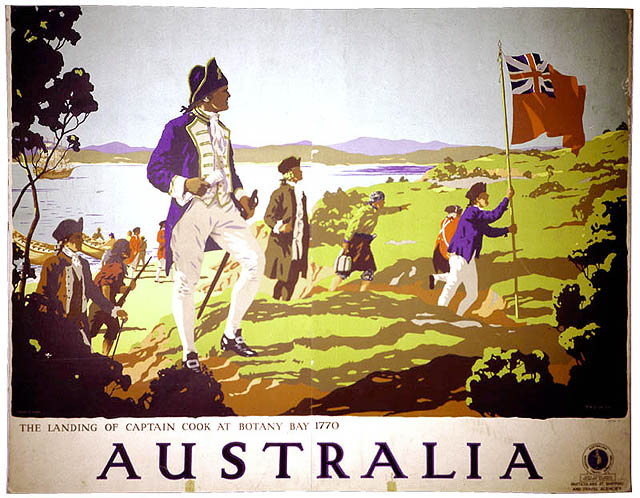
Australia was officially claimed as a British colony by Captain Cook, even though the Dutch were actually the first Europeans there. The British turned the island into a penal colony, where they sent prisoners to do manual labor under extremely harsh conditions as punishment. Many died of hunger or disease, some were shot trying to escape, and some just died from having a life sentence.

While most of the people there are of English and Irish descent and speak English, there is no official language in Australia.  The word Australia itself comes from the Latin word for “southern.”


To the chagrin of many Americans, the capital isn’t Sydney or Melbourne.  It’s Canberra, a city with a population of around 358,000 – roughly a little smaller than Arlington, Texas.  Ironically, the area chosen for the capital city was strategically located between Sydney and Melbourne, the two largest cities, and is unusual in the fact that it’s a planned city (like Brazil’s capital city, Brasilia).  The name Canberra is often contributed to being from one of the local indigenous languages, Kambera, meaning “meeting place.” An appropriate name for the center of government, I think. An alternate version is that it was derived from the Anglicized form of the local word “nganbira” (or “nganbra”) which roughly means a woman’s cleavage (worded better as the “hollow between a woman’s breasts”). It was actually referring to the fact that the city was placed in the flood plane between two nearby mountains. I don’t think I’ll ever think of the city the same now.

But the country on a whole is fairly developed, with access to clean water and sanitation, even in the rural areas. Literacy rates are at around 99%. Australians will also be happy to know that they also have the 9th longest average life expectancy, averaging at almost 82 years. (Side note: they’ve updated these stats for 2012 figures, and earlier, I think I had noted that Andorra was at 4th, but now it’s at 6th.)

Because of Australia’s history and ties to the U.K. and its proximity to Asia, its culture is a blend of all of these cultures. You’ll find this British-Asian traditions seeping into all aspects of its culture, from the arts to its cuisine. It’s as diverse as countries like the United States, the U.K., or Brazil. And I think I’m gonna have fun with it this week.

Up next: Holidays and Celebrations

Resources:
Wikipedia: “Australia” “Canberra” “List of US cities by population” “Great Barrier Reef” “Outback”
CIA World Factbook: Australia
Y-Axis Australia Blog

Sunday, May 27, 2012

ARMENIA: THE FOOD

Well, today is the Indianapolis 500, and I’m doing Armenian food today. Being from Indianapolis, the whole city is one giant festival.  When I was a young kid, I thought the Indy 500 was a holiday in and of itself. But I did find out that back in the 1950s, there were two Armenian drivers in the Indy 500. You can read about it here, from the site where I got all of my recipes (awesome site, please check it out!).

These past two weeks, I’ve been reading all about baking. I thought that maybe I should probably figure out why sometimes my bread doesn’t turn out the way I think it’s supposed to. Well, it turns out that baking more or less needs to be exact, from the types of ingredients (unsalted vs. salted, different kinds of flour, etc.) to the exact amounts used, and the order and temperature they are used. One example said that unlike soup where you could add a pinch of salt at the end if needed, you can’t sprinkle salt on the bread once its done and think it’ll make a difference. (I suppose you can if you’re really hard-headed, but the bread's not budging.) So that being said, I gained a lot more confidence with this bread than I had before. And it turned out that my dough actually acted like dough!

My parents were right: THIS is why we have kids -- for putting them to work, like kneading dough.  
The bread – chorag – is a braided yeast roll that’s popularly eaten around Eastertime. (See, I told you in the blog post “Holidays & Celebrations” that this was coming!) I actually found the mahlab, but I couldn’t find it ground. And I never got the mortar and pestle for Mother’s Day, so I had to just crush it.  I omitted the fennel seeds and anise seeds and used caraway seeds instead (my husband feels the same way about fennel seeds as he does watching romantic comedies, and I just forgot to get anise seeds).   After the dough rested for two hours, you took small balls of dough and formed a long rope. Their method of braiding was a little different (and probably a little easier) than what I saw in some baking books. They have you break off 1/3 of the rope and make the longer part into an upside-down U. You put the shorter piece coming down from the middle: sort of like the Euro sign on its side (€). Then you braid the three parts. It still has to rest another hour, and after a quick egg wash, it’s ready to go into the oven.

It's braided, like a friendship bracelet, but tastier (after it's baked of course). I wouldn't recommend tying the
chorag around your wrists though. It won't stay. Not so friendly. 
Once it came out, it was so beautiful. The color, the smell – it put a tear to my eye that this is first time (after blogging eight countries so far) it turned out “right.” Even though when it was completely finished, I did brush it with melted butter in hopes that it would keep it from becoming too dry.  (Let’s hope.)

So beautiful. I may put this picture in a frame and keep it at work. Or in my car. Maybe next to my kid's pictures.  
I had gone into this with every intention of using ground lamb for the lahmajoun, but I couldn’t get anyone to ground the lamb for me. Apparently the good looks and charms that got me by in my 20s are wearing off in my 30s. So, I ended up using ground beef.   And unbeknownst to me, I evidently picked up hilal beef that was 100% zabiha. Thanks to Wikipedia, I found out it’s more or less being “kosher” for Muslims and was slaughtered in the approved manner.  See, you learn something every day.  And I did the short-cut recipe: I used flour tortillas instead of baking my own bread for it. After I mixed the ground beef with peppers, onion, garlic, parsley, and mint (which I should’ve been paying attention – I used 1 ½ TABLESPOONS instead of 1 ½ TEASPOONS. Hope they like mint!), you spoon it in a thin layer onto the tortillas and put it in the oven. My husband and I thought they were really great, and he put this recipe in the “must do again” pile.  The kids, however, were of a different sentiment. Can’t win ‘em all, but I know it was awesome. 

Lahmajoun. Let's just put it this way: I ate two and the kid's leftovers. I think my husband ate three and a half. 
This turned out to be a meal different from the others, because usually I serve everything at the same time, but this time it was spread out. There was another change in how I usually do my cooking days: I baked twice! When I saw the recipe for apricot-pistachio scones, I couldn’t resist. I really tried to, but avoiding this recipe was like trying to put down a mystery book at the point they discover who the killer is. While the scone itself is more native to the England and Scotland, the apricots and pistachios are more of an Armenian/Middle Eastern contribution to this savory treat. After it was finished, I buttered it slightly and drizzled a little honey on top, and it was absolutely heaven.

There's a reason I timed the scones coming out of the oven after the kid's bedtime. 
Overall, everything turned out well.  Dario Franchitti won the Indy 500, and I’ve got chorag and scones to take to the Memorial Day get-together tomorrow. I’ve also got baba ghanoush (I think called mutabal in Armenia) and pitas, but I went store-bought instead. It was 92 today, and I was trying to limit the length of time the oven was on (and laziness won out over cleaning the grill). I enjoyed this food immensely; it's definitely been one of my favorites so far. 

Up next: Australia

Recipes:

Saturday, May 26, 2012

ARMENIA: MUSIC AND DANCE


The earliest forms of Armenian music were Christian chants.  After polyphony was introduced to the area by Komitas Vardapet during the latter part of the 19th century, many Armenian folk songs (as in over 3000!) were harmonized by him.  And I thought this blog would take a while to get to the end.  Traditional folk music isn’t based on the same scales that you find in most European music; it’s based on a continuous set of tetrachords. A tetrachord is a set of four consecutive diatonic notes, and in this case, the next tetrachord is built on the last note of the previous tetrachord. 

There are a few instruments that are important to Armenian folk music. Among those that you will find, probably the most important one is the duduk.  You’ll find this instrument and similar ones across southern Europe and the Middle East, sometimes called by different names. The duduk is part of the reed family, and actually it’s a double reed (in the same family as the oboe, the bassoon, and the English horn).  One of the most famous Armenian duduk players is Djivan Gasparyan.  Other instruments you’ll find in folk music is the kanun (similar to a dulcimer or zither), the dhol (a double-headed drum played with sticks, sometimes called a davul), oud (a type of small necked lute that lacks frets), shvi (a fipple flute, meaning one that’s played in the same direction like a clarinet, not out to the side), zurna (another reed wind instrument, thought possibly to be an ancestor of the shawm, similar to the duduk but with a larger bell to make it more apt for outdoor performances). This video is of the kanun, the next instrument I've got my eye on (since I just bought a Zimbabwean mbira). 


There are several Armenians who were fairly prominent in the classical music world. The most famous one is Aram Khachaturian. Music majors should know his name, but others would recognize his most widely-known piece is “Sabre Dance” from the ballet Gayane.  This is a great piece for percussionists, especially the xylophone – one of my favorite instruments I used to play.


When it comes to popular music, one of the most famous bands is System of a Down. They are actually from California, but the members are Armenian and attended the Armenian school there (even though they all met later).  I’ve liked them for years, even though I think their slower, more melodic songs sound better than their harder songs. Having a bachelor’s degree in music, I’m not so much of a fan of the “screaming as singing” style; however, a little bit here and there is bearable. But don’t push it. But if you listen closely, the melodic lines (especially in the guitars) are reminiscent of folk melodic lines. I also noticed that they were standing on Armenian carpets in the video as well.


Another famous Armenian-American is Cher, born Cherilyn Sarkisian. (Her father was of Armenian decent.) I haven’t always been a huge fan of Cher’s, but I have to respect her for having won so many awards and having had such a successful career that’s spanned almost five decades.

Armenian dancing has been inscribed in rock drawings in the mountain areas around Mt. Ararat. Kochari is considered to be the “national” dance of Armenia.  In Armenian, kochari is literally translated as “knee-go” and involves high jumps with the intention of being daunting. Dancers, both men and women, will gather in a r line, and put their hands on the shoulders of those beside them or hold hands. The music is danced in 2/4 time and ranges from moderate to fast tempos. There are other variations of this that are danced in neighboring countries as well. You don't have to listen very hard for the zurna; it sort of overpowers the rest of the instruments. 


Another folk dance that is popular is the Tamzara. The dance is usually accompanied by the lyra (a type of stringed instrument, similar to a lyre or a rebab). Like the kochari, there are regional variations, but one of the identifying factors of a tamzara is its unique 9/8 time signature. The dancers gather in a line or in a circle and interlock pinky fingers. It's a little harder to pick out the 9/8 beat and this dance can be a little slower than the kochari. 


Next up: the food!

Resources:
Wikipedia: “Tamzara” “Kochari” “Cher” “System of a Down” “Aram Khachaturian” “Duduk” “Kanun” “Dhol” “Oud” “Shvi” “Zurna” “Armenian music” “Armenian dance”

Wednesday, May 23, 2012

ARMENIA: ART AND LITERATURE


Armenian art is something that originates in antiquity. Most of their art, no matter the medium, is full of symbolism – especially Christian symbolism.


Armenia is famous for its carpets. These carpets were woven to not only cover the floors but also to decorate walls and to use as covers for furniture. To learn how to weave is something every Armenian woman would learn to do. Armenian rugs and carpets were not only known for its variety of colors, but it’s resistance to fading. Even the oldest surviving knotted carpet (dated from between 5th to 3rd century BC) showed very little signs of fade, but there was noticeable deterioration of the weave itself. From what I’ve gathered in looking at pictures of Armenian carpets, most carpets will have a border design with a symmetrical geometric-shaped design (or sets of designs) in the middle, usually in a contrasting color to the background. The border design may or may not be a completely different set of colors and designs. They’re absolutely beautiful; I’d love to have one of my own.

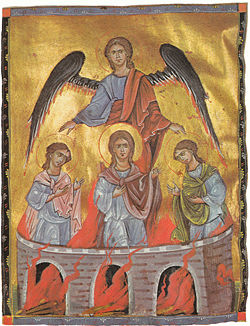
Another art form that started in the same era was the illuminated manuscripts, especially those of Toros Roslin. His illustrations to Armenian manuscripts have become the baseline that others are compared to, and some of the most famous that have survived to this day.  Fresco painting inside churches and cathedrals were also quite popular and quite extensive works of art.


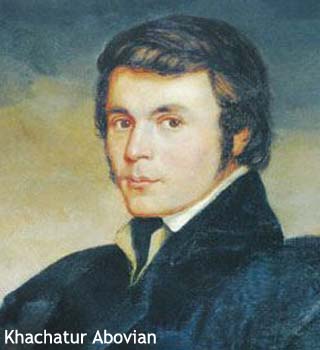
Most pre-19th century literature was religious and/or history based material. The father of modern Armenian literature is contributed to Khachatur Abovian (1804-1848) whose work The Wounds of Armenia is considered his finest. He was among the first to veer away from the classical form of literature. It’s amazing that he accomplished such a title, and he was only 44 years old.


Even after communist Russia took control, traditional-style literature still maintained its popularity despite its highly-controlled and censored publishing practices. During the 1960s, a new class of writers emerged again, becoming more forthright about topics such as communist rule and the Armenian Genocide. Among these writers is Hovhannes Shiraz. His mother was actually killed during the Genocide, and he was given the surname Shiraz (named after the Iranian city known for its roses and poetry, and my favorite: shiraz wine) by novelist Atrpet.


One untitled poem I found on Wikipedia has stuck with me all day. His writing is based in emotion, and his use of various literary devices (such as metaphors, personification, anecdotes) enhances the descriptions. I really enjoyed it; it was something to think about:

In my dreams my door was knocked at,
"Who is it?" I asked from inside.

Some elderly lady from the outside

Answered and said, "I'd sacrifice myself for you."


"I've come to ask for a piece of bread as charity

I'm a poor orphan woman with no one to support me."

At this point I opened my door immediately,

Only to find a miracle; it was my deceased mother indeed!


I was shocked but fell into her arms;

And my mother said, "It's me, it's me,

I've come to try you and to check on you.

I hope life hasn't changed your spirit and also you?!"


I came in the form of a beggar

So that the whole world can be a witness

To see if your conscience, my dear son,

If your conscience also died along with me?!"

I found that the Armenian Research Center at the University of Michigan at Dearborn has a nice collection of Armenian poetry and excerpts of texts translated into English. Please check it out for yourself: http://www.umd.umich.edu/dept/armenian/literatu/

Up next: Music and Dance

Resources:
Wikipedia: “Armenian art” “Toros Roslin” “Hovhannes Shiraz”