Showing posts with label djali. Show all posts

Saturday, May 21, 2016

MALI: MUSIC AND DANCE


Mali is an incredibly diverse country. There are many, many ethnic groups here, and they all have made their own contributions to the whole of what is Malian music. Of course, some of these groups have had larger influences on music here. Among the most traditional music customs, djalis go back centuries. And yes, although they are known for being historians and being able to recite long historical passages, they are also known for being praise singers. Most of these praises are geared toward kings and national heroes, but some of these songs also include more poetic works like proverbs. 
Man playing the kora.
Many instruments utilized in their traditional music (and even in a lot of popular music as well) are similar to other areas of Western and Northern Africa. If you listen to Malian music, you’re likely to hear the kora (21-24 string lute harp), n’goni (a 4-7 string lute), or the bala (a type of xylophone with calabash resonators). Percussion is also an important part of many African music traditions, including in Mali. Some popular types of drums include tabale (a tall conga-like drum played with flexible sticks), dunumba (a large drum that hangs from the shoulder and played with a mallet while the other hand plays a bell), or the n’taman (a talking drum shaped like an hourglass). After WWII, the guitar started making its way into African music, and it was incorporated into a lot of their music. Jazz and Latin music (especially Cuban music) also gained popularity in Mali. 


Of all of the traditional styles of music, no matter what the tribe, they all include music to dance to. With percussion at its roots, their music was often used in dancing for ceremonies and other festivities. Most dances are performed wearing traditional clothing and are often seen as a form of expression. For Malians, drumming and dancing go hand in hand, and it’s often spiritual for the performers. 


One of the biggest names in Malian music is Salif Keita. Not only is he an established musician, but he’s also a huge advocate for promoting and supporting local music. As a singer, he uses music as a means of expression outside of the traditional djeli role, and he’s been credited for bringing the Afro-pop movement to the global forefront. His work has influenced countless other musicians as well. I really like his music; it has elements of jazz and Latin styles mixed with some traditional styles and instruments. It has a very chill effect. I feel like I should be drinking a beer sitting outside on the patio after dark. I can see why he was popular. 


I listened to many other artists who had similar styles to his, relying heavily on the kora, which I love. It almost has a dulcimer sound to it. Some artists are more instrumental, some of the instruments used may vary, and some have vocals, but each share a similar musical style. There are several artists who have become fairly popular that I would recommend listening to: Toumani and Sidiki Diabaté, Ali Farka Touré, Afel Bocoum, Vieux Farka Touré, Mory Kanté, Les Ambassadeurs, Bassekou Kouyate, and Fanta Damba.  


There is also a Tuareg band called Tinariwen that put Tuareg music on the map. To me, they took elements of jazz and blues and mixed it with traditional Tuareg musical styles. It’s pretty catchy -- I like it a lot.  


I found a couple of other bands/groups that fell into the rock or pop category. They’re not quite definite categories, but they do have qualities that lead them to sound a bit more Western. A few I found include Amadou & Mariam, Rokia Traoré, and Tamikrest. There’s even a hip-hop group of sorts I ran across who call themselves SMOD. I like what I heard from them. 


Up next: the food

Wednesday, May 18, 2016

MALI: ART AND LITERATURE


Mali is rich in visual and textile arts. Many of these arts are tied to day-to-day living, though. Textile arts are one of the most common artistic styles easily seen in Mali. Both men and women wear brightly colored, patterned cloth. They’re known for a type of cloth style known as mud cloth, which has abstract patterns made from mud. Typically, this is a woman’s art.


To go along with the art of textile making, many Malians are adept at making jewelry. Because of Mali’s history, gold is the preferred metal in jewelry for most of the people; however, the Tuaregs prefer silver. Styles depend on personal taste and on tribe. Some tribes have their own particular style, sometimes with patterns that reflect their history or ancient religious views. Shells, clay, amber, wood, and stone are also used in making jewelry. 
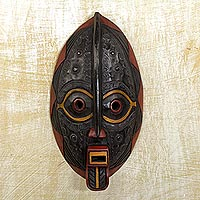
They’re also known for their woodcarving. Like many other cultures in Western Africa, wooden masks and sculptures are a part of many Malian cultures. The masks are actually used to disguise the person wearing the mask when they impersonate ancestors or gods. Some tribes, like the Dogon, believe that when a person dies, their spirit stays in the mask, so therefore masks are an important part of funeral rites. The idea of gender is very important and much of their society is drawn on gender lines. In their sculptures, body features are often exaggerated to make the distinction between genders.


Mali has a particular unique type of architecture, at least different than most other building types in Western and Northern Africa. Many of the buildings (especially mosques) here are built using sun-dried mud on top of tree branch beams. Even the shapes of buildings will vary slightly from other regions as well. 

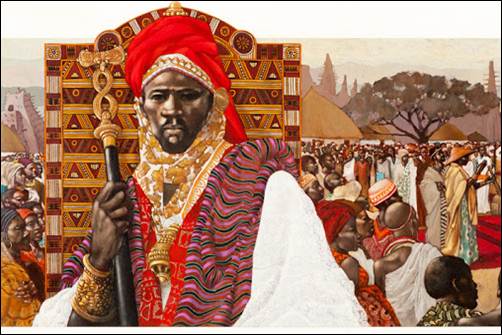
Askia the Great
Even as far back as the early 1500s, historians have noted the importance of literature in Mali. One of the great military leaders and emperors of the Songhai Empire, known as Askia the Great, was credited with promoting universities and Malian education at the time. Not only bringing in some of the world’s greatest scholars, he also built one of the largest book publishing centers in this region of Africa. One early explorer wrote about this area, saying that the demand for books is huge, especially from the North African states, and that Malians earn more profit from producing books than any other industry. 

The djali from Mali (come on, it rhymes)
Like other areas of Africa, Mali’s literature is rooted in the traditions of the djali (or sometimes spelled jali, jeli, djeli, or sometimes referred to as a griot). Djalis were an integral part of the Mali Empire and had a great responsibility: they are often quipped as walking history books, but essentially that’s what they were in a nutshell. But not exactly. Yes, they were great storytellers and musicians who retell historical stories and family traditions, but they also work in satire, gossip, political commentary, praise songs, among other topics. One of the most well-known historians, Amadou Hampâté Bâ, spent a large part of his time studying these traditions. 


Some popular Malian writers include Yambo Ouologuem (known for his book Le Devoir de Violence, it was raked with controversy over plagiarism), Maryse Condé (descended from the Bambara people and writes on their culture, although she lives in the French Antilles), Massa Makan Diabaté (known for his work The Epic of Sundiata and the Kouta Trilogy, he’s a descendent of griots), Fily Dabo Sissoko (author and political leader, writing about the Negritude movement, died in prison), and Moussa Konaté (teacher, writers, playwright).

Up next: music and dance