Showing posts with label saz. Show all posts

Saturday, December 8, 2012

BOSNIA AND HERZEGOVINA: MUSIC AND DANCE

One of the most traditional forms of music from Bosnia and Herzegovina is ganga music. It originated in the rural areas, especially in Herzegovina and the Croatian region of Dalmatia (the namesake of the famous black and white spotted dog breed). It mostly consists of a lead singer singing one line and then the other singers coming in, some describing it as a “wail.” It also utilizes dissonant harmonies, often having different singers singing half-steps from each other. In most Western and European classical music traditions, especially  before WWI, it’s often recommended to not to have half-steps against each other because these are tendency tones and need to be resolved. But here, it’s desired to have that dissonance, probably something that takes a while for Western ears to listen past. However, this dissonance was used for a purpose: ganga was performed in the fields, and used as a means of communicating with people in distant fields.


Common instruments found in ganga and other related forms are the droneless bagpipe, wooden flutes and the šargija (a long-necked, fretted string instrument that is plucked). The gusle is a single-stringed instrument with a long neck which is bowed that is really similar to the Albanian lahuta (mentioned earlier when we did Albania).
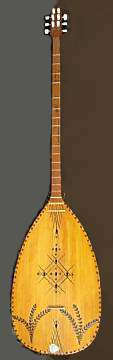

Another style of folk music in Bosnia Herzegovina is called sevdalinka, some thought of as the most traditional (or most “Bosnian”) of musical forms. It has more emotion and melancholy in the melody line, the subjects being mostly about lost loves and death, especially of a loved one. Originally, it was performed with a saz (a type of stringed instrument originating from Turkey), but now accordions are used far more, along with the help of clarinets, violins, upright bass, and snare drums. Not only are the sevdalinkas a merge of Bosnian and Turkish music, but it also incorporates certain musical styles of Muslim music as well.


As far as modern music goes, I found a ton of music available on Spotify for free and iTunes if you want to buy it (most priced around $10). Rock music is really popular, even though many groups sound like the rock from the late 1980s/early 1990s US rock groups a la Journey or Rush, or some of the hair band anthem rock sounds of Def Leppard or Poison. (Don’t get me wrong, I like that style.) And then there are several groups I found who have more of an indie rock feel by bringing in folk music into the music. Some of the groups that I found that I liked are Dino Merlin, Laka, Igor Zerajic, Letu Stuke, Zoster, Monolit, Zabranjeno Pusenje, Indexi, Bijelo Dugme, Divlje Jagode.


Hip-hop music is starting to make its way into Bosnia Herzegovina as well. It’s not quite as popular, but there are a few artists making a name for themselves, and it’s growing in popularity. Two that I like are Edo Maajka and Frenkie.


The kolo is a dance that is danced in many of the Balkan countries, including Bosnia and Herzegovina. The dancers will gather in a circle (sometimes as a single or double line) and hold hands or put their hands around each other’s backs, and practically all of the dance steps are complicated steps with just the legs and feet. Each region and even each city has its own kolo. Both men and women dance the kolo, and typically wear traditional dress while doing so.


Up next: the food!

Friday, July 6, 2012

AZERBAIJAN: MUSIC AND DANCE


One of the most important musical styles of Azerbaijan is that of the mugham. It’s basically a long segment of sung poetry with musical interludes between the segments.  They will also utilize a form of yodeling as well. The poems these are based off of are most about a divine love that is often sourced from Sufism and originated in Iran.

Some of the common instruments you’ll find in Azerbaijani music are the tar (a type of lute with a double bowl), kamancha (a bowed string instrument similar to the rebab), the oud (a short-necked lute), and the saz (a long-necked lute). There are also a number of drums that are used: naghara (cylindrical double-faced drum), goshe nagara (pair of small kettle drums), ghaval (frame drum), daf (another type of frame drum), and the nagara (a barrel drum).

I found this video of the ashik style music. I believe what the performer is using is a saz (please correct me if I’m wrong here). You can definitely hear the “yodeling” style when he sings, although there are times when it's almost sung-spoke. Although I have no idea what he’s singing about, at times I get the feeling he’s the Bob Dylan of Azerbaijan.


It was somewhat harder to find current popular musicians. This year the Eurovision Song Contest was held in Baku, and I did find a singer named Emin Agalarov. (Spotify, I'm wagging my finger at you for not having any of his stuff.) This video is of the finals from the 2012 Eurovision and showcases some of the mugham concepts mentioned above as well as showcasing current pop music. You’ll be able to pick out some of the instruments mentioned as well as the drums.


Azerbaijan has a number of folk dances that have developed over the past centuries as part of its national culture. Asma Kasma is one of the oldest dances, one that’s used when the people escort a bride to the groom’s home. It’s generally somewhat slow and includes a lot of exaggerated jumps.

The Halay (also called Yalli in Azerbaijan) is a dance that’s centered around fire. Fire is and has been an important symbol in Azerbaijani history. It starts out slow, but speeds up to where the steps are almost running.


The Uzundara is a slow, attractive dance danced solely by women. It’s origins lie in the Karabakh region and traditionally is danced and sung while the bride and groom are away. It reminds me a little of ballet at times. 


The Zorkhana is a men-only dance that is used to signify courage and valor. However, this video made me smile. Perhaps the courage and valor comes in the form of actually getting the guts to go out there and dance. To all the nerdy guys at frat parties in college we laughed at because we thought they couldn't dance, well, apparently they one-upped us: they were beyond us all the whole time dancing the zorkhana. 


Up next: the food!

Resources:
Wikipedia: “Music of Azerbaijan” “Dances of Azerbaijan” “Mugham”