A blog inspired to teach my children about other countries and cultures through their food. It also includes music, arts, and literature from those countries as well.
If there’s one thing Trinidad and Tobago is known for, it’s their music. The music from these islands is a mix of African, Caribbean, French, and other European styles. I’d say the most well-known style to come from these islands is calypso. The origins trace back to West African kaiso music that evolved into calypso music as the French planters arrived on the islands during the 18th century. In its early days, it was sung in French Creole but later changed to English. It eventually spread from Trinidad and Tobago across the Caribbean as well as into Venezuela.
Calypso isn’t the only musical genre that’s popular here. Soca is a style that mixes calypso with Indian music and is usually used as dance music. Chutney and Chutney Soca are also related styles that use of Indian music. Pichakaree is a style often used as social commentary and sung in both English and Trinidadian Hindustani.
Social commentary is also used in rapso, a style that started in the 1970s and 1980s out of a mix of calypso, soca, and American hip-hop. Parang is a folk music style that developed in the island’s Hispanic neighborhoods. Steelbands developed after WWII and slowly grew in popularity. These steel pans (or steel drums) are concave toned metal drums that were developed in the African communities. Ok, it’s not actually a drum, but rather an idiophone.
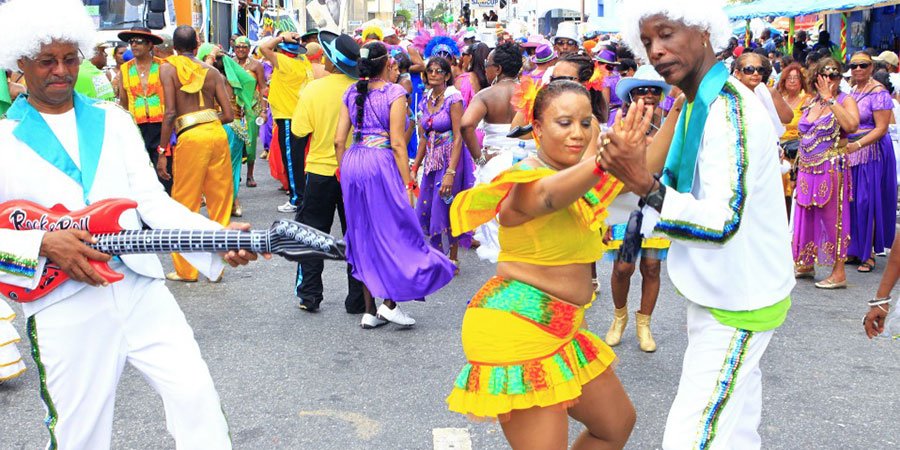
One dance that is commonly performed is the Bélé. This dance was introduced by the French (known as “belle aire”). It’s actually a dance that’s performed with variations across the Caribbean, but in Trinidad and Tobago, the dancers tend to be women. It’s thought that it stems from the times slave women would dance for the masters there. The women still wear dresses that look like dresses from that era during the dance. And then there’s calinda, a type of choreographed stick-fighting. (Reminds me a little of capoeira?) Carnival in Trinidad is a super popular ordeal with tons of music and dancing as well as calinda, which is said to have its origins as a martial art in the Kingdom of Kongo.
So, I found quite a few Trinidadian musicians on Spotify. The first one I listened to is Lord Kitchener, one of the most famous calypso musicians. He rose to international fame in the time he got started singing calypso in the late 1930s to the time he retired in the 1990s. I really enjoyed listening to his music with its harmonics and rhythmic guitars and percussion. And in quite a few songs, it really reminds me of the jazz bands of the 1930s-1960s, especially Latin jazz in some cases. Lord Melody is another calypso musician of a similar style and era.
Lancelot Layne was often considered the father of Rapso music. Popular in the 1970s and 1980s, it was his song “Blown Away” that put this genre on the map. It was a genre that grew out of social issues like the Black Power movement and labor unions. Cheryl Byron is another rapso musician.
David Rudder is another famous calypsonian. I listened to the album Trinidad Stories, and it had a more modern feel to it. He also performs soca style music as well. There’s one thing I can say is that it always seems like it’s happy music.
When it comes to Chutney music, Sundar Popo is credited as the creator of this genre that developed out of Bhojpuri music of India. He got started in the late 1960s. It definitely sounded more like Indian music to me, but I can also hear some of the Caribbean rhythms behind some of the songs.
Machel Montano
Machel Montano is a soca musician who has performed with quite a few reggae and dancehall musicians around the Caribbean. I think his music is pretty catchy. One soca band I listened to was Kes. They also bring in bits of rock, calypso, and reggae in their music as well. And I even found a female soca singer: Destra Garcia, who often just goes by Destra. I liked her style. It was kind of upbeat like dancehall. I also listened to Bunji Garlin, a ragga soca musician. Ragga is related to dancehall and reggae. I thought it was fairly catchy, but I’m also a fan of dancehall and reggae.
Nicki Minaj
And of course, one of the biggest names in hip-hop is Nicki Minaj. She probably needs no introduction, but she was born in Trinidad and raised in Queens, New York. I think she can be a little raunchy at times and certainly brings the drama at times, but she’s entertaining. And she can certainly rap fast, which always impresses me.
Much of the music from Saint Kitts & Nevis has its
origins from Africa mixed together with various types of Caribbean music along
with some British, French, and American styles. Vocal music is an integral part
of their musical traditions, with chanteys and other songs sung for a variety
of occasions. A Tea Meeting is a type of performance found in Saint Kitts &
Nevis (but also in the Virgin Islands and on Barbados). A chairman and
vice-chairman will lead comedic songs and give speeches, often being heckled by
the audience.
During the 1940s, iron bands started making its way into the
islands. These bands consisted of musicians (typically guitars, saxophones, and
trumpets) along with a percussion section using instruments made of things they
found, like car rims and other metal scrap. This gave way to the steel pan
bands of the 1950s and 1960s. Following a Trinidadian tradition, several of
these bands from Trinidad were equally popular in Saint Kitts and Nevis. Some
of the more popular steel pan bands include Roy Martin’s Wilberforce Steel Pan,
Casablanca Steel Orchestra, and The Invaders.
By the 1960s, brass bands became known for its role in
Carnival music. They not only use modern instruments that we know, but even a
few of their own, like the baha (a blown metal pipe) and what they call the
shack-shack (a tin can with beads in it – a most descriptive name). Not only is
Carnival a festival filled with music, but there are several other music
festivals held throughout the year like the St Kitts Music Festival and
Culturama held on Nevis. The traditions around Christmas, especially those of
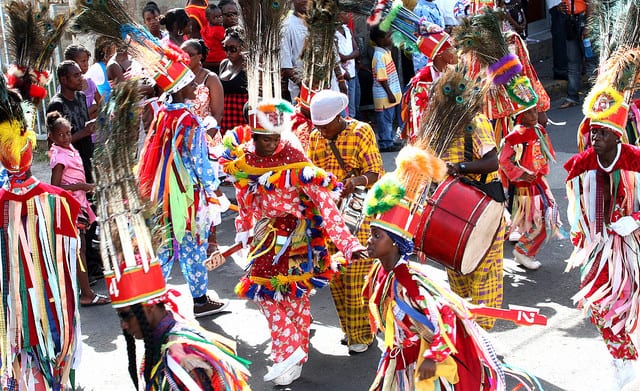
parades, music, masqueraded dancers, and stilt walkers called Moko-Jumbies, are
some of the best times to watch these iconic music and dance festivals.
Another musical style Saint Kitts & Nevis borrowed from
Trinidad and Tobago is calypso music. This musical style was originally used as
a means for the African slaves to communicate with one another about the
oppression they were facing. Needless to say, it made its way across the
Caribbean where many other countries adopted it and made it their own as well.
During the 1950s, there used to be calypso competitions on St Kitts and on
Nevis. Some calypso bands of note include Ellie Matt and King Starshield.
There are several musicians who share a heritage with Saint
Kitts & Nevis, so I thought it would be fair to include them as well. Joan
Armatrading is a folk singer who got her start during the mid-1970s. Her main
style is folk music, with her playing the acoustic guitar and vocals. I like
her style.
Another musician with ties to these islands is Corinne
Bailey Rae. I have one of here albums, but I admit I only listened to it a few
times when I got it years ago. I didn’t tag it for a long time, so I just
realized a number of months ago that I had it in my iTunes. It was like finding
a new album! I had forgotten how much I like her music. She mixes a little bit
of folk, soul, blues, jazz, acoustic, and a little pop into her music. This is
her Tiny Desk Concert she gave at NPR. You can tell she really enjoys what she
does.
Mel B is probably better known for her role in Spice Girls.
I was probably one of the only high school girls in the US who was not gaga
over them when they were popular in the 1990s. I was more into Metallica and
Smashing Pumpkins at the time (and still am). After Spice Girls stopped being
spicy, she went out on her own. I think some of her songs are pretty catchy.
This video, however, is weird with stripping in the middle of the street and
kissing herself. But you be you, boo.
The music of Antigua and Barbuda has a lot of similarities
to and is heavily influenced by the music of nearby Trinidad and Tobago. While
there are several types of music heard and played here, there are three main
types of music found in Antigua and Barbuda: steel pans, calypso, and soca. Others
also include reggae and zouk (another type of music from the Caribbean).
While the correct term is steel pan, many people call it
steel drum. However, it is not a drum at all, as most people know it. A drum by
definition is called a membranophone, meaning an instrument that creates its
sound from a membrane (like the head of a drum, made of various materials). A
steel pan falls under the category of an idiophone, one that creates its sounds
from vibration.It gets its name
because it was originally made out of used oil drums that were made of steel
which are then formed into the instrument. The “notes” are arranged using the
cycle of fifths. There are many different sizes of steel pans, some are quite
large while others are smaller to give an array of range.A famous steel pan band from Antigua is
the Brute Force Steel Band. The Hell’s Gate Steel Band and the Big Shell Steel
Band are two others. The video is of the Antigua Carnival Panorama 2011 champs,
the Hell’s Gate Steel Band. It’s really something to see all those people
performing together. It really makes me want to buy a steel drum next (side
note: I just purchased a Zimbabwe [of the Shona people] mbira today – I’m still
excited, and I haven’t even received it. I have a long time before I even get
to Zimbabwe to blog about it. But by then, I should be good.)
Calypso is an integral part of Antiguan music because it is
closely tied to other forms as well. It also came from Trinidad, created by
slaves at a time when they were not allowed to speak to each other for fear of
planning to overthrow their “owners.”In Antigua and Barbuda, calypso has been used as a means to express
social and political ideologies, often using metaphors and symbolism, much like
Rai music does in Algeria. Calypso bands often will have two guitars and a bass
guitar, but will add other instruments, like drums as needed. Every year, there
are calypso contests, especially during Carnival. I really like the musician
Claudette Peters (from the band Taxik). There isn’t a lot of information on
her, and only a few YouTube videos. One famous calypso band is Burning Flames.
This is a video of the song “Swinging Engine.”Ok, it's not much of a video per se, but the song is cool.
Soca, which is probably the most well-known form, is closely
related to calypso. It’s actually a combination of calypso and cadence (another
genre from the Caribbean) with certain Indian instruments, like the dholak (a
type of drum), the tabla (another type of drum, I mentioned it when I wrote on
music from Afghanistan), and the dhantal (a long metal rod struck with a
smaller U-shaped metal rod). It’s once been thought that the term “Soca” stood
for “soul calypso” (as in SOul CAlipso), but it really was a misinterpretation
of a quote from Soca musician Lord Shorty, which actually was supposed to be
that “soca was the soul of calypso.”Soca is also very popular around Carnival time as well. It’s mostly a
pretty upbeat style of music. One famous soca band is El-A-Kru; this is the
song “Expose.”
There isn’t a lot of information on traditional dance. I did
however manage to find a video for the Xephorae Dance Theatre performing with
the Da Vibez Steel Band. I don't know if it's traditional to Antigua or not, but it's still good. Although I am wondering what the significance of the baskets on the head are. [The first part is announced in French, so I'm not sure where they're performing.] I also found a video on YouTube of
some guys doing what they call a Bakka dance on Market Street. But I can’t find
any more information on traditional dances. There are several dance troupes,
including several videos on YouTube of the Antigua Dance Academy.There are also several dance
contests during Carnival festival.
Music and dance go hand-in-hand in Antigua and Barbuda. When
you hear the music, you can’t help but sway to the music. Even if you’re not a
dancer, like me. I totally wish I were a dancer though (partly because most
dancers have really awesome bodies).Perhaps that’s why I can’t find any information on Antiguan dance – dancing
is so engrained into the music that it’s not known by its own genre.It’s more of an expression, of
something that comes natural, rather than a deliberate move. Whether you give
it a name or not, you can tell it comes from deeper than the heart – music and
dance is built into the fibers of what it is to be from Antigua and Barbuda.
Up next: the food!
Resources:
Wikipedia: “Music of Antigua and Barbuda” “Steel pans”
“Calypso” “Soca”
:max_bytes(150000):strip_icc()/Caribbean_band_Christof46CCSA40-5805348b3df78cbc28d9e648.jpg)